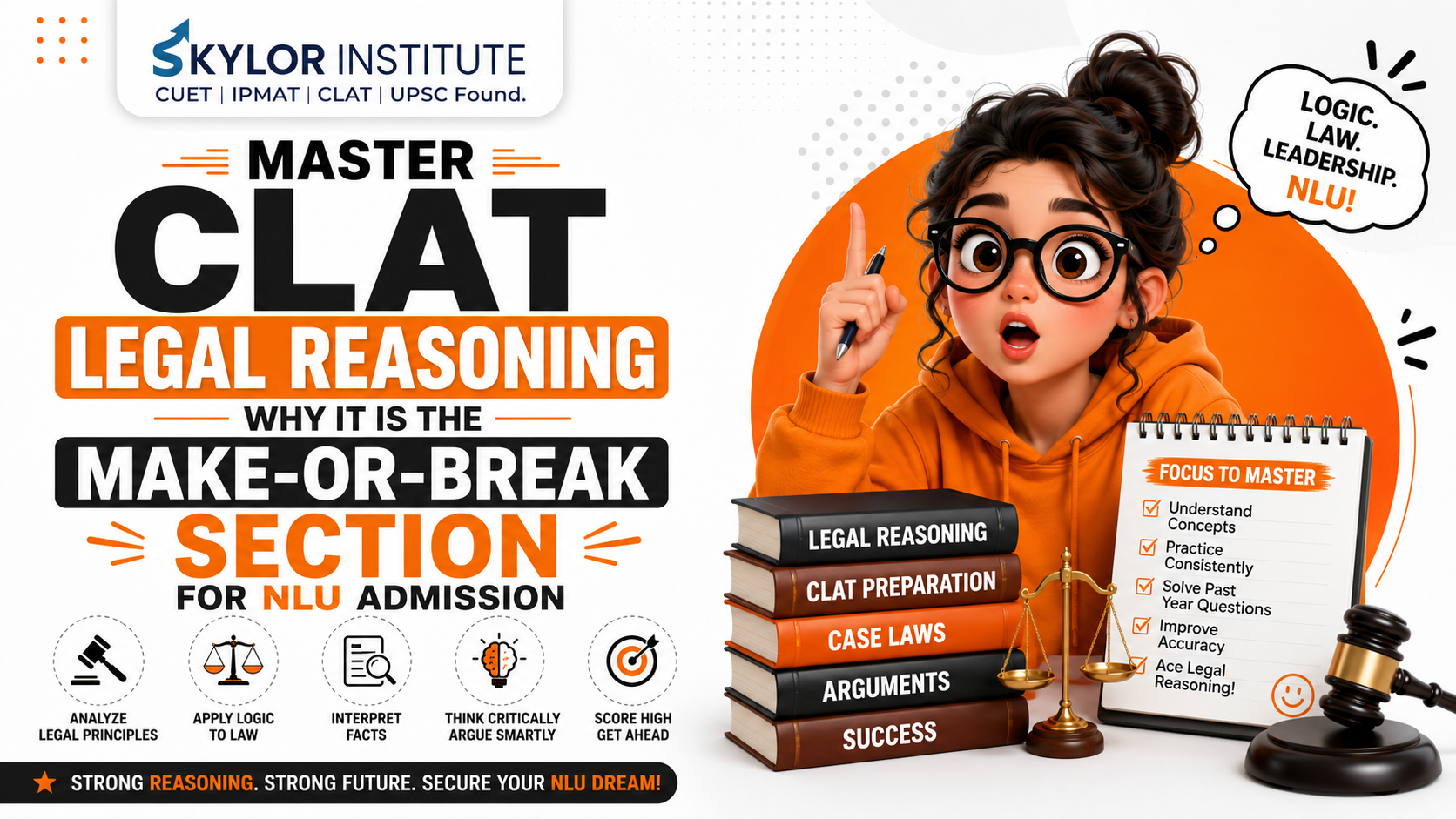
Master CLAT Legal Reasoning: Why It Is the Make-or-Break Section for NLU Admission
Cracking the Common Law Admission Test (CLAT) is the golden ticket to entering the prestigious National Law Universities (NLUs) in India. While thousands of aspirants sweat over Q...
Cracking the Common Law Admission Test (CLAT) is the golden ticket to entering the prestigious National Law Universities (NLUs) in India. While thousands of aspirants sweat over Quantitative Techniques or memorize complex current affairs, top rankers know a fundamental truth about this exam: the CLAT Legal Reasoning section is the ultimate game-changer.
Accounting for a massive 25% of the total question paper (around 28 to 32 questions out of 120), the Legal Reasoning section carries the highest weightage along with Current Affairs. However, unlike Current Affairs - which can be wildly unpredictable - Legal Reasoning is highly structured, logical, and entirely scoreable if you master the right framework.
If you are aiming for top-tier NLUs like NLSIU Bengaluru, NALSAR Hyderabad, or NUJS Kolkata, your performance in this specific section will determine your final rank. This comprehensive guide breaks down exactly why Legal Reasoning is the make-or-break section in CLAT and details the exact preparation strategies you need to dominate it.
The Numbers Don't Lie: Section-Wise Weightage Breakdown
To understand why this section determines your fate, look at how the Consortium of NLUs structures the UG-CLAT question paper format:
| CLAT Section | Approximate Number of Questions | Percentage Weightage |
| Legal Reasoning | 28–32 Questions | 25% |
| Current Affairs, including GK | 28–32 Questions | 25% |
| English Language | 22–26 Questions | 20% |
| Logical Reasoning | 22–26 Questions | 20% |
| Quantitative Techniques | 10–14 Questions | 10% |
| Total | 120 Questions | 100% |
With 25% of the marks resting on your legal application skills, a minor drop in accuracy here can push your rank down by thousands. Conversely, a high score in this section acts as a massive buffer, absorbing any unexpected drops in tougher or more volatile sections like General Knowledge.
Why Legal Reasoning is the Real Tie-Breaker in CLAT Rank Lists
When two or more candidates score the same overall marks in CLAT, the Consortium uses a strict tie-breaking mechanism to assign ranks.
The First Rule of Tie-Breaking: If overall marks are tied, the candidate with higher marks in the Legal Reasoning section is automatically awarded the higher rank.
Imagine working tirelessly for a year, scoring a phenomenal 92 out of 120, only to miss out on your dream NLU because another student with the same score performed slightly better in the legal section. It is the ultimate tie-breaker. This administrative rule alone elevates Legal Reasoning from a standard section to the single most critical section on the entire exam paper.
3. The Shift to Comprehension-Based Formats
Ever since the Consortium overhauled the CLAT exam pattern, the Legal Reasoning section has moved entirely away from rote memorization. You no longer need to look up real-world article numbers or memorize raw legal sections. Instead, the section tests your legal passage interpretation skills.
The Core Structure of a CLAT Legal Question
Every question sets up a distinct ecosystem consisting of three distinct parts:
- The Passage: A dense, 450-word text sourced from legal editorials, recent judgments, or public policy debates.
- The Principle: A specific legal rule or legal proposition embedded directly within that passage.
- The Fact Situation: A hypothetical, real-world scenario where a dispute has occurred.
Your job is not to play judge or use emotional ethics. Your job is to act as a cold machine: extract the principle from the passage, place it over the given facts like a stencil, and choose the option that logically matches.
4. Crucial Topics: The Pillars of CLAT Legal Reasoning
While you don't need formal legal training, you do need conceptual clarity regarding foundational law topics. Passages are consistently built around specific legal domains. Familiarity with their terminology allows you to read and process the 450-word passages significantly faster.
A. Constitutional Law
This forms the bedrock of the section. You must have an excellent grasp of Fundamental Rights (Articles 14, 19, and 21), Directive Principles of State Policy (DPSPs), the structure of the judiciary, and core constitutional doctrines like the Basic Structure Doctrine.
B. Law of Torts
Torts handle civil wrongs and liabilities. Expect frequent questions testing principles like negligence, defamation, vicarious liability, nuisance, strict liability, and absolute liability. These passages rely heavily on tricky exceptions and conditional clauses.
C. Law of Contracts
Contract law tests how valid agreements are formed, executed, and broken. Pay close attention to definitions of offer, acceptance, valid consideration, free consent, fraud, misrepresentation, and breach of contract.
D. Criminal Law
Criminal law passages explore the mechanics of crimes, focusing heavily on the intersection of Mens Rea (guilty mind) and Actus Reus (guilty act). Important subtopics include the basics of murder vs. culpable homicide, theft, criminal trespass, and private defense.
E. Legal Current Affairs
The Consortium loves pulling passages from contemporary legal news. Staying updated on landmark Supreme Court judgments, major constitutional amendments, and new legislative bills (such as the Bharatiya Nyaya Sanhita - BNS or changes to digital data privacy laws) will give you a massive contextual advantage on exam day.
5. Master the "Principle-Fact Method" Step-by-Step
To score 25+ marks out of 32 in this section, you must replace instinctive guessing with a repeatable, systematic workflow.
> Skim for the Big Idea
First 60 Seconds.
Quickly read the 450-word passage to identify the primary legal domain (e.g., Contract law breach or a Criminal law defense). Do not get bogged down in deep technicalities on this first pass.
> Isolate the Core Principle
Critical Extraction.
Locate the exact legal rule or proposition stated in the text. Pay absolute, hyper-focused attention to conditional keywords such as "only," "unless," "provided that," "except," or "shall." These modifiers completely alter how a rule applies.
> Deconstruct the Fact Scenario
Fact Analysis.
Read the hypothetical scenario given in the question. Break it down into simple components: Who did what? Was there a clear intent? Did actual harm occur? Separate material facts from decorative background details.
> Apply Principle-First Logic
Matching Phase.
Treat the extracted legal principle like a checklist. Run the facts through it. If the principle requires three distinct conditions to be met, and the facts only show two, then the rule does not apply. Trust the passage blindly, even if it contradicts real-world laws.
> Eliminate Extreme Options
Final Selection.
Weigh the multiple-choice options. Eliminate choices that make absolute moral judgments, apply external real-life legal knowledge not mentioned in the text, or use hyper-emotional logic. Select the option that mirrors the exact wording and scope of the passage's principle.
6. Common Traps That Cost Aspirants Marks (And How to Avoid Them)
The reason Legal Reasoning breaks so many scores is that it is littered with deliberate psychological traps designed by the paper setters. Recognizing these traps during your practice is half the battle.
- The Trap of Real-World Legal Knowledge: You might know a real-world Supreme Court precedent inside out. However, if the passage deliberately provides an altered or inverted version of that rule, you must use the passage's rule. Introducing outside knowledge is the fastest way to click a trap option.
- The Moral Compass Illusion: CLAT does not test whether you are a good person; it tests whether you are a logical thinker. An option might feel morally right or fair, but if it violates the strict, cold application of the text's principle, it is completely wrong.
- Missing the Negative Triggers: Missing a single word like "unless" or "except" completely flips a rule's application. Slow down your reading speed marginally when passing through the core rules of a text.
7. The Ultimate Legal Reasoning Preparation Strategy
Achieving elite speed and accuracy requires a balanced, long-term practice routine. Use this structured approach to maximize your sectional score:
- Enhance Legal Vocabulary: Regularly learn the explicit context of critical legal maxims, terms, and phrases (e.g., quid pro quo, obiter dicta, ultra vires). Knowing what these mean beforehand saves valuable reading time.
- Analyze Editorial Sections: Make reading national daily newspapers like The Hindu or The Indian Express a daily habit. Focus deeply on the editorial and opinion pages to build strong stamina for complex legal terminology.
- Maintain a Legal Error Notebook: After completing every sectional mock test, do not just check your final score. Log your mistakes. Write down exactly why you chose a wrong option - whether you misread a modifier, applied personal bias, or missed an exception clause. Revisit this tracker before every new mock test.
- Time Management Drills: On the final exam, you have exactly 120 minutes for 120 questions. This means you should ideally spend no more than 6 to 7 minutes per legal passage (including reading and answering its corresponding questions). Use timed drills to force quick decision-making under intense time pressure.
Conclusion
The CLAT Legal Reasoning section isn't just a hurdle - it is your single biggest opportunity. Because it carries an immense 25% weightage and serves as the primary rank-deciding tie-breaker, mastering it is the most efficient way to secure your seat at a top National Law University. By prioritizing passage comprehension, executing the principle-fact method mechanically, and drilling with a strict error notebook, you can transform this intimidating section into your highest-scoring asset.
Ultimately, building the critical reading stamina and legal logic required for this section takes consistent, expert-guided mentorship. Dedicated preparatory hubs like Skylor Institute provide aspirants with the targeted conceptual frameworks, exhaustive passage analysis drills, and structured mock test strategies necessary to demystify complex legal texts. With the right training partner and an analytical mindset, navigating these dense case scenarios shifts from a source of exam anxiety to your ultimate competitive advantage on race day.
Need Personalized Diagnostic Guidance?
Speak directly with Skylor's academic directors in Bathinda. Discuss batch schedules, test analytics, and personalized preparation strategies.