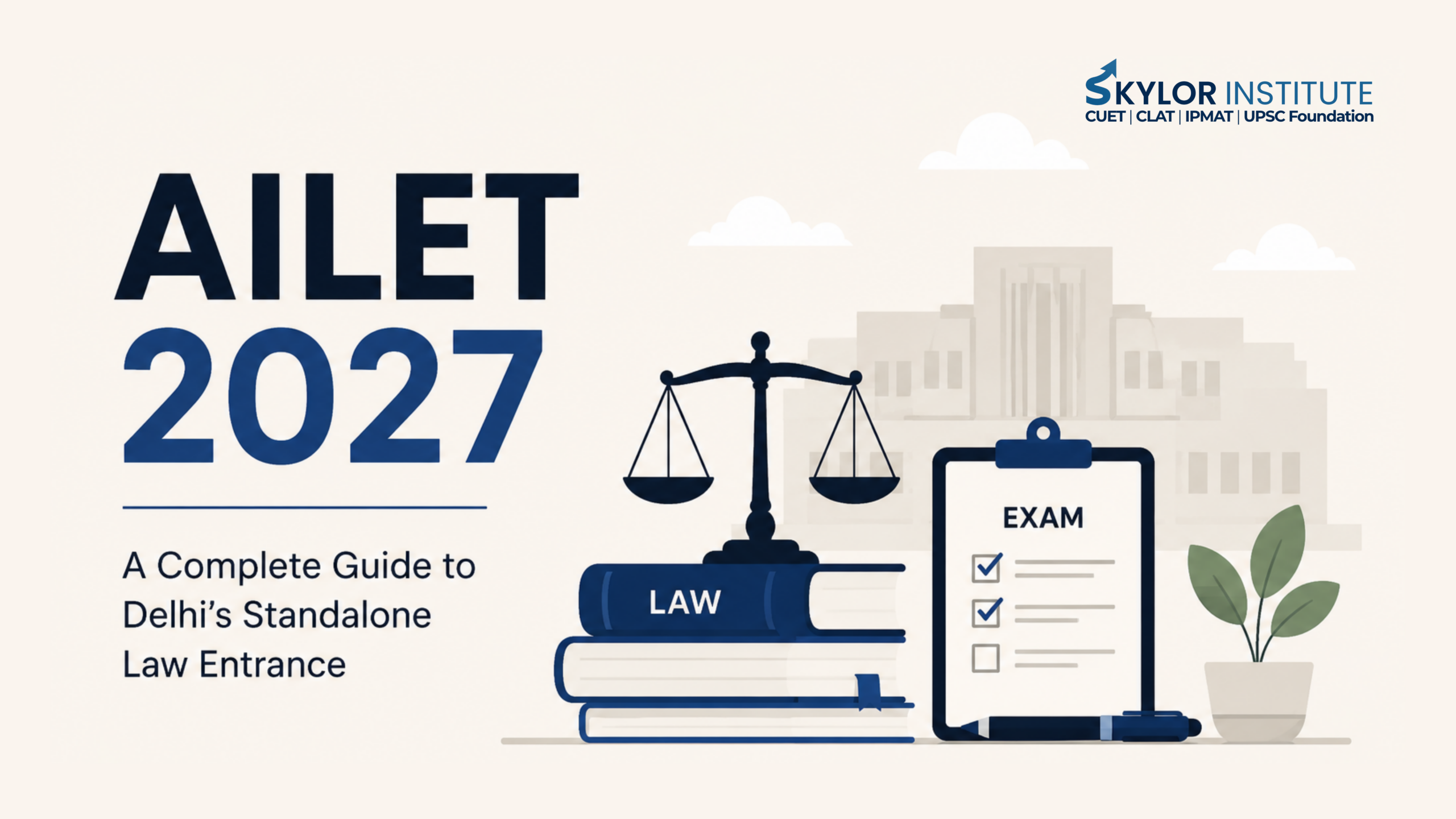
AILET 2027: A Complete Guide to Delhi's Standalone Law Entrance
If you plan to pursue law after Class 12 and have National Law University Delhi on your target list, there is one entrance exam you cannot afford to treat as an afterthought: AILE...
If you plan to pursue law after Class 12 and have National Law University Delhi on your target list, there is one entrance exam you cannot afford to treat as an afterthought: AILET 2027. The All India Law Entrance Test is the dedicated entrance examination for NLU Delhi's five-year integrated B.A. LL.B. (Hons.) programme. Unlike most National Law Universities that participate in CLAT, NLU Delhi uses its own entrance test, making AILET a separate battleground for law aspirants. The university's official AILET 2027 information confirms that the examination will be conducted on December 13, 2026, from 2:00 PM to 4:00 PM, in offline pen-and-paper mode.
The timing makes AILET particularly interesting for students preparing for multiple law entrances. A candidate preparing for CLAT 2027 can use much of the same foundation - reading comprehension, current affairs, logical reasoning, vocabulary, and exam strategy - but AILET has its own structure and therefore demands dedicated preparation. The current official pattern consists of 150 questions for 150 marks in two hours, divided among English Language, Current Affairs & General Knowledge, and Logical Reasoning. That means your preparation cannot simply be a copy-paste of a CLAT strategy.
This guide covers everything an AILET 2027 aspirant needs to know: eligibility, important dates, application, exam pattern, syllabus, seats, fees, reservation, preparation strategy, books, common mistakes, and what life after NLU Delhi can look like. Since admissions information can change, the details below are based primarily on the official AILET 2027 information published by NLU Delhi, rather than older coaching-centre calendars or previous-year assumptions.
What Is AILET 2027 and Why Does It Matter?
AILET stands for All India Law Entrance Test, and it is conducted by National Law University Delhi for admission to its undergraduate B.A. LL.B. (Hons.) and postgraduate LL.M. programme. For undergraduate aspirants, the examination is the gateway to one of India's prominent national law universities. The university itself describes AILET as a national-level entrance examination conducted annually for its UG and PG programmes.
The biggest reason AILET matters is simple: you cannot use CLAT as a substitute for AILET when applying to NLU Delhi. The university's official FAQ explicitly states that candidates cannot secure admission to NLU Delhi through CLAT or LSAT and must appear for AILET. In practical terms, this creates an interesting situation for law aspirants. You may prepare for CLAT and AILET together, but if NLU Delhi is your goal, you need to register for AILET separately and prepare specifically for its examination pattern.
The competition is also shaped by the relatively limited number of seats. For the B.A. LL.B. programme, NLU Delhi lists 120 total seats, consisting of 110 seats for Indian categories and 10 seats for Foreign Nationals/OCI/PIO categories. With a limited seat pool, every mark can become meaningful, particularly because AILET includes negative marking.
AILET vs CLAT: The Key Difference
The simplest way to understand AILET is to think of it as a separate entrance route to NLU Delhi. CLAT is used by participating National Law Universities, whereas NLU Delhi conducts AILET independently. Therefore, students who want to keep both options open should normally approach the two examinations as related but distinct tests.
There are also differences in examination structure. AILET 2027's undergraduate paper has 50 English questions, 30 Current Affairs & General Knowledge questions and 70 Logical Reasoning questions, giving Logical Reasoning the largest share of the paper. That distribution should influence preparation time. A student who spends almost all preparation hours on general knowledge while neglecting reasoning is effectively ignoring the largest section of the AILET paper.
The smarter approach is to build common foundations for both exams and then adjust your preparation according to each test's actual structure. This prevents duplication of effort while still respecting the fact that AILET deserves its own strategy.
AILET 2027 Important Dates and Timeline
The official AILET 2027 schedule is already available, which means aspirants do not have to plan around speculation. NLU Delhi started accepting applications on August 7, 2026, and the last date for submitting the online application is November 10, 2026. The examination itself is scheduled for December 13, 2026, from 2:00 PM to 4:00 PM.
The university has also stated that AILET 2027 admit cards will be available for download from November 30, 2026 through the candidate login. A correction window, if applicable, will be available for three days after the application deadline. These dates matter because missing the registration deadline is not a preparation problem - it is an eligibility problem.
| Event | AILET 2027 Date |
|---|---|
| Online applications begin | August 7, 2026 |
| Last date to apply | November 10, 2026 |
| Application correction window | Three days after the application deadline, if enabled |
| Admit card availability | November 30, 2026 |
| AILET 2027 examination | December 13, 2026 |
| Examination timing | 2:00 PM–4:00 PM |
| Examination mode | Offline, pen-and-paper/OMR |
The dates above should be treated as the working calendar for AILET 2027, but students should continue checking the official portal for announcements or changes.
AILET 2027 Eligibility Criteria
Eligibility is one of those areas where students often make unnecessary assumptions. You do not need to have studied a particular stream such as Humanities, Commerce or Science to sit for the undergraduate AILET. The relevant requirement is the prescribed Class 12 qualification and minimum marks.
B.A. LL.B. Eligibility
For the five-year B.A. LL.B. (Hons.) programme, NLU Delhi states that candidates must have passed the 10+2 or equivalent examination with at least 45% aggregate marks. The minimum is 42% for OBC candidates and 40% for SC/ST/PwD candidates. Candidates who are appearing for or awaiting their qualifying examination results can also apply, subject to obtaining the required eligibility by the prescribed cut-off date.
The university also states that there is no minimum or maximum age limit for appearing in AILET 2027. This is useful for students who may be taking a gap year or completing their qualifying examination through an alternative recognized route.
One important distinction concerns Foreign Nationals and OCI/PIO applicants. The university has separate provisions for these categories, and foreign nationals are exempted from taking the entrance examination subject to the applicable conditions. OCI/PIO candidates applying as Indian candidates, however, must appear for AILET.
AILET 2027 Exam Pattern
AILET 2027 is a 150-question, 150-mark examination with a two-hour duration. The paper is divided into three sections: English Language, Current Affairs & General Knowledge, and Logical Reasoning.
| Section | Questions | Marks |
|---|---|---|
| English Language | 50 | 50 |
| Current Affairs & General Knowledge | 30 | 30 |
| Logical Reasoning | 70 | 70 |
| Total | 150 | 150 |
The paper is conducted in offline pen-and-paper/OMR mode. Candidates therefore need to prepare not only academically but also for physical paper-solving: bubbling answers accurately, moving efficiently between questions and managing a two-hour examination without the conveniences of a computer interface.
AILET also has negative marking. According to the official examination scheme, 0.25 marks are deducted for every incorrect answer, meaning four wrong answers result in a one-mark deduction. This makes accuracy important. Random guessing can quickly become expensive when multiplied across a 150-question paper.
AILET 2027 Syllabus
The AILET syllabus looks manageable on paper because it has only three broad sections. The challenge lies in the depth of skills required within those sections. You need strong reading ability for English, consistent awareness of national and international events for General Knowledge, and speed plus analytical accuracy for Logical Reasoning.
English Language
The English section contains 50 questions, making it one-third of the undergraduate paper. Preparation should therefore go beyond memorising vocabulary lists. AILET preparation should develop the ability to understand passages, identify arguments, interpret context, and distinguish between closely related options.
A good English preparation routine combines newspaper reading, editorial analysis, vocabulary development, and regular question practice. Instead of learning 50 random words every day, focus on understanding words in context. When you encounter an unfamiliar term in an editorial, try to infer its meaning before checking the dictionary. That small habit gradually develops the contextual reading ability required in competitive examinations.
Grammar should also not be ignored. A student with excellent vocabulary but weak sentence structure can still lose marks. The objective is not to become a literary scholar; it is to become a fast, accurate reader who can process dense information without repeatedly going back to the beginning of a passage.
Current Affairs and General Knowledge
AILET assigns 30 questions to Current Affairs & General Knowledge. This section is particularly difficult to prepare for through last-minute cramming because current affairs accumulate over months.
A better approach is to divide current affairs into recurring categories: national events, international developments, government policies, economy, science and technology, environment, awards, sports, important appointments, and major legal or constitutional developments. Since you are preparing for a law entrance, legal and constitutional developments deserve special attention, even though the undergraduate AILET does not require prior technical legal knowledge.
The key is consistency. Fifteen minutes of serious current-affairs reading every day is more sustainable than attempting to digest six months of news during the final two weeks. Maintain concise revision notes and revisit them repeatedly.
Logical Reasoning
Logical Reasoning is the largest component of AILET 2027, with 70 questions out of 150. This is where aspirants can gain a significant advantage because reasoning performance is closely connected to practice.
The section may include questions involving arguments, assumptions, conclusions, relationships, patterns, analytical reasoning and other logical structures. The official syllabus also states that legal principles may be used in the Logical Reasoning section, but the examination does not require legal knowledge or technical understanding.
That distinction is important. You do not need to start memorising the Indian Penal Code, constitutional articles or case-law before AILET. Your job is to understand the reasoning presented in a question and apply the information logically.
AILET 2027 Application Process
AILET 2027 applications are submitted online through the official NLU Delhi admission portal. The university advises applicants to read the application guidelines carefully and makes the candidate responsible for ensuring that all information entered is correct.
The application process generally involves registration using an email ID and mobile number, filling in personal and academic details, selecting the relevant category and programme, uploading the required photograph and signature, selecting examination-city preferences, paying the application fee, and submitting the form.
Do not treat the application as a formality. Small errors in names, dates, category information or uploaded documents can create avoidable problems. The university's FAQ states that no hard copy of the completed application needs to be sent to NLU Delhi.
After submitting the form, download and preserve the submitted application and payment receipt. Keep your registration credentials safe because they will be needed for subsequent stages such as checking application status and downloading the admit card.
AILET 2027 Application Fee
For AILET 2027, the application fee is ₹3,000 for General, OBC, EWS, Foreign Nationals, and Kashmiri Migrant applicants. The fee is ₹1,000 for SC/ST and PwD applicants. SC/ST and women candidates who are BPL applicants are exempt from the online application fee.
| Applicant category | AILET 2027 application fee |
|---|---|
| General/OBC/EWS/Foreign Nationals/Kashmiri Migrants | ₹3,000 |
| SC/ST/PwD | ₹1,000 |
| SC/ST & women BPL candidates | Exempt |
Applicants should remember that the application fee is separate from the much larger cost of actually studying at NLU Delhi. Paying the entrance fee simply gets you into the selection process.
AILET 2027 Exam Centres and Admit Card
AILET 2027 is scheduled to be conducted across a broad network of cities, including Delhi, Chandigarh, Bengaluru, Mumbai, Kolkata, Hyderabad, Jaipur, Lucknow, Pune, Patna, Ahmedabad, Chennai, Gurugram and several others. Candidates can provide up to three preferences for test centres.
The university states that it will try to accommodate candidates' preferences but may assign another centre for administrative or technical reasons. It also states that if fewer than 200 candidates are registered in a particular city, that centre may not be created and candidates can be assigned according to their second or third preferences.
The admit card is scheduled to become available from November 30, 2026. Do not wait until examination week to download it. Check the details immediately, including your name, photograph, examination centre and reporting instructions.
AILET 2027 Seat Matrix and Reservation
The B.A. LL.B. programme has 120 total seats for AILET 2027. Of these, 110 are distributed among Indian categories, while 10 seats are allocated to Foreign Nationals and OCI/PIO applicants.
| Category | Total seats |
|---|---|
| General | 50 |
| OBC-NCL | 24 |
| SC | 17 |
| ST | 8 |
| EWS | 11 |
| Indian-category subtotal | 110 |
| Foreign Nationals & OCI/PIO | 10 |
| Total | 120 |
The university also provides 5% horizontal reservation for PwD candidates. A 30% horizontal reservation for eligible women candidates applies across the relevant categories, including candidates selected under reserved and foreign-national categories.
Candidates claiming reservation must be able to produce the required valid certificates during admission and document verification. For example, the university specifies that OBC-NCL and EWS certificates must meet the applicable date and authority requirements.
AILET 2027 Fees and Cost of Studying at NLU Delhi
Getting into NLU Delhi is only one part of the financial calculation. The official AILET 2027 B.A. LL.B. fee structure lists an annual tuition fee of ₹1,63,000, along with annual academic services and facilities charges of ₹43,000, student welfare fund of ₹7,000 and utility services of ₹20,000. There is also a one-time admission fee of ₹10,000 and refundable estate deposit of ₹25,000.
For hostel students, the listed annual Halls of Residence charge is ₹92,000, while mess charges are listed at ₹50,000. The university also states that tuition and hostel charges will increase annually according to the specified fee structure.
This means students and parents should budget beyond the headline tuition number. Accommodation, food, academic expenses, travel, books, technology, and personal expenses can materially change the overall cost of a five-year law degree.
It is also important to understand that hostel accommodation is not automatically guaranteed to every newly admitted student. NLU Delhi states that hostel allocation is subject to availability and its stated allocation policy.
How Is AILET 2027 Merit Determined?
AILET is ultimately a rank-driven examination. Every correct answer contributes to your score, while every incorrect answer carries a 0.25-mark penalty. That makes your attempt strategy important.
The university has also specified a tie-breaking mechanism. For the B.A. LL.B. programme, if candidates obtain the same marks, the candidate with higher marks in Logical Reasoning receives preference. If the tie remains, seniority in age is considered, followed by a computerized draw of lots if necessary.
This gives Logical Reasoning another layer of importance. It is already the largest section of the examination, and it also serves as the first academic tie-breaker.
The practical lesson is straightforward: do not chase attempts blindly. A strong AILET candidate should be able to distinguish between questions that are worth attempting and questions where excessive uncertainty makes guessing dangerous.
AILET 2027 Preparation Strategy
AILET preparation should be treated as a skill-building project rather than a syllabus-completion project. There is a major difference. You can technically "finish" a book in two months without becoming significantly better at solving questions. Conversely, solving fewer but carefully analysed questions can dramatically improve your accuracy.
Start with a diagnostic mock test. Do not worry about your initial score. The purpose is to discover where you stand. Are you slow in reading comprehension? Do you make careless mistakes in reasoning? Are you unable to recall current affairs? Do you spend too much time on one difficult question?
Once you understand the problem, build a weekly routine around it. Give regular attention to all three sections, but allocate additional time to your weakest area and the high-weightage Logical Reasoning section.
A practical routine might look like this:
- English: daily reading + vocabulary + comprehension practice.
- Current Affairs: daily news reading + weekly revision.
- Logical Reasoning: daily timed practice.
- Mocks: regular full-length papers under two-hour conditions.
- Analysis: spend substantial time reviewing mistakes after every mock.
The last point is frequently neglected. A mock test without analysis is little more than a score generator. Your real improvement happens when you understand why you selected a wrong option and why the correct option works.
Best Books and Resources for AILET 2027
There is no single magical book that guarantees an AILET rank. A strong preparation library should instead cover the three areas tested by the examination.
For English, use a reliable vocabulary and grammar resource alongside quality newspapers and editorial content. For reasoning, choose a law-entrance-oriented logical reasoning book with sufficient practice questions and explanations. For current affairs, use a consistent monthly current-affairs source rather than collecting multiple magazines and never revising any of them.
The most important resource, however, is the official previous-year AILET question paper. NLU Delhi itself provides previous-year question papers through its AILET examination information page. These papers reveal something generic books cannot: how the actual examination frames questions.
Do not simply solve previous papers once. Analyse them. Identify recurring question styles, estimate the time required by each section and examine the level of difficulty. Over time, you should become familiar enough with the examination's personality that the actual paper feels like a known environment rather than a surprise.
Common Mistakes AILET Aspirants Should Avoid
The first major mistake is preparing for AILET only through CLAT material. There is overlap, but the exams are not identical. AILET 2027 places 70 of its 150 questions in Logical Reasoning, so your preparation should reflect that distribution.
The second mistake is treating current affairs as a final-month subject. It is not. Thirty questions can make a meaningful difference in a competitive examination, and current-affairs retention improves through repeated revision rather than frantic reading.
The third mistake is ignoring negative marking. Four incorrect answers cost one mark, and careless guessing can quietly damage an otherwise strong paper.
The fourth mistake is taking too many mocks without reviewing them. If you score 90 in a mock and then immediately move to the next test without identifying why you lost 60 marks, you are repeating the same learning opportunity.
Finally, do not leave application and administrative tasks until the final day. AILET 2027 applications close on November 10, 2026, and the university has clearly stated that candidates are responsible for ensuring their application is complete and accurate.
AILET 2027 Preparation Timeline
If you are starting preparation now, you have a defined runway before the December 13 examination. The correct strategy depends on your current level, but the timeline can be divided into phases.
Phase 1: Foundation. Build reading habits, understand the reasoning question types and establish a current-affairs routine. Do not obsess over mock-test scores yet.
Phase 2: Skill development. Increase timed question practice. Begin sectional tests and analyse mistakes. Vocabulary and current-affairs revision should become recurring habits rather than occasional tasks.
Phase 3: Examination mode. Move towards full-length AILET papers under strict two-hour conditions. Practise OMR-style answering because the examination is offline.
Phase 4: Final revision. Stop collecting endless new resources. Revise current affairs, vocabulary, reasoning concepts and mistakes from previous mocks. Your objective at this point is not to become a different student overnight; it is to make your existing preparation reliable under pressure.
What Makes NLU Delhi Different?
NLU Delhi is not simply another law college for which AILET happens to be the entrance examination. The institution has developed a substantial academic and research ecosystem, with specialised research centres covering areas such as constitutional law, cyber law, environmental law and other fields.
The university's career-services ecosystem also connects students with Indian and foreign law firms, corporate and in-house legal teams, PSUs, NGOs and think tanks. This diversity matters because a law degree does not automatically mean becoming a courtroom advocate. Students can move towards litigation, corporate law, policy, public service, academia, research, compliance, arbitration and a range of emerging legal fields.
The institution also continues to engage with contemporary legal and policy questions. For example, NLU Delhi contributed research and recommendations to the Joint Committee examining the Corporate Laws (Amendment) Bill, 2026. That reflects the broader role a modern law university can play beyond classroom teaching.
AILET 2027 Career Prospects After NLU Delhi
A five-year B.A. LL.B. degree provides a foundation for several legal and non-legal career paths. Graduates can pursue litigation, law-firm careers, corporate legal departments, public policy, judicial services examinations, civil services, legal research, academia, and specialised legal domains.
The advantage of studying at a nationally recognised law university is not merely the degree printed on the certificate. It is the ecosystem surrounding the degree: faculty, peers, internships, mooting, research opportunities, competitions, alumni networks and exposure to legal professionals.
NLU Delhi's career services specifically describes its role as connecting the student talent pool with the legal industry and lists law firms, corporate organisations, PSUs, NGOs and think tanks among recruiter categories.
Still, aspirants should keep expectations realistic. Admission to a top law university creates opportunities; it does not automatically guarantee a particular career outcome. Students who actively use internships, competitions, research projects, networking and academic opportunities will generally extract more value from the five-year programme than students who simply attend classes and wait for placements.
Final Checklist for AILET 2027 Aspirants
Before the examination, make sure the basics are under control. Confirm that you have completed the application correctly, saved the payment receipt and submitted the necessary information. Download your admit card as soon as it becomes available and check the examination-centre details rather than assuming your first preference was allotted.
Academically, make sure you can comfortably attempt all three sections within the two-hour limit. You should know your ideal section order before examination day. Your mock-test analysis should tell you where you gain marks quickly, where you lose time and which question types you should avoid when they become excessively time-consuming.
Finally, remember that AILET is not an examination where studying harder automatically means scoring higher. Studying intelligently matters more. The goal is to turn knowledge into marks under time pressure while protecting yourself from avoidable negative marking.
Conclusion
AILET 2027 is the dedicated entrance route to NLU Delhi, and it deserves to be treated as an independent examination even if you are simultaneously preparing for CLAT. The official schedule has already established December 13, 2026 as the examination date, with applications running from August 7 to November 10, 2026. The undergraduate paper consists of 150 questions for 150 marks over two hours, with 50 questions in English, 30 in Current Affairs & General Knowledge and 70 in Logical Reasoning.
The numbers tell an important story. Logical Reasoning accounts for nearly half of the paper, negative marking makes accuracy essential, and the B.A. LL.B. programme has only 120 total seats. This is not an exam where a casual approach is likely to work.
If NLU Delhi is your target, start thinking of AILET preparation as a combination of reading ability, reasoning skill, current-affairs awareness, speed and examination temperament. Build those abilities consistently, practise with real AILET papers, analyse every mock and avoid the temptation to measure preparation only by the number of hours studied. When December arrives, the student who can convert preparation into accurate answers will have the advantage.
Frequently Asked Questions About AILET 2027
1. When will AILET 2027 be conducted?
AILET 2027 is scheduled for December 13, 2026, from 2:00 PM to 4:00 PM. The examination will be conducted offline using pen-and-paper/OMR mode.
2. Can I get admission to NLU Delhi through CLAT?
No. NLU Delhi's official FAQ states that candidates seeking admission to the university must appear for AILET; CLAT or LSAT cannot be used as substitutes for admission to NLU Delhi.
3. How many questions are there in AILET 2027?
The undergraduate AILET 2027 paper contains 150 multiple-choice questions for 150 marks, with 50 English questions, 30 Current Affairs & General Knowledge questions, and 70 Logical Reasoning questions.
4. Is there negative marking in AILET 2027?
Yes. AILET 2027 has negative marking in the MCQ sections. 0.25 marks are deducted for each incorrect answer, so four incorrect answers result in a one-mark deduction.
5. What is the minimum percentage required for B.A. LL.B. through AILET?
For the B.A. LL.B. programme, the general minimum is 45% in Class 12 or equivalent, while the requirement is 42% for OBC candidates and 40% for SC/ST/PwD candidates, subject to the university's applicable eligibility provisions.
Need Personalized Diagnostic Guidance?
Speak directly with Skylor's academic directors in Bathinda. Discuss batch schedules, test analytics, and personalized preparation strategies.