CLAT 2027 Last 19 Days Revision Plan
19 days to CLAT 2027. A day-wise revision plan for all five sections, six full mocks, admit-card steps and exam-day checks to peak on 6 December. Start today.
CLAT 2027 Last 19 Days Revision Plan
There are 19 days left until CLAT 2027, and the work now changes. The exam is on Sunday, 6 December 2026, from 2 to 4 pm, and the days of learning new topics are over. What remains is revision: turning everything you have already studied into marks on the day. This plan shows you exactly what to revise each day, how many mock tests to take, when to download your admit card, and how to spend the final 48 hours so that you walk into the centre calm and ready. It is written for students who have covered the syllabus at least once. If you are starting from zero in a section, this plan will still help, but be honest with yourself about which sections can still move and which ones you should simply hold steady.
Every date and number in this article is checked against the Consortium of National Law Universities schedule and the most recent reporting as of 17 November 2026. The admit card is expected on 20 November, and this article says clearly where a date is an expectation rather than an official announcement. The only official source for your admit card and exam centre is your candidate login on consortiumofnlus.ac.in.
5 Key Takeaways
- CLAT 2027 is on 6 December 2026, 2 to 4 pm, with 120 questions in 120 minutes and 0.25 negative marking for every wrong answer. There are 19 days left from 17 November.
- Stop learning new topics now. The next 19 days are for revision, mock tests and error correction. Legal Reasoning and Current Affairs together carry about half the paper, so they get the most revision time.
- Take 6 to 8 full-length mock tests in the next 19 days, always in the 2 to 4 pm slot, and spend at least two hours analysing each one. A mock without analysis is only practice in making the same mistakes faster.
- The CLAT 2027 admit card is expected on 20 November 2026. Download it from consortiumofnlus.ac.in on the day it appears, check your name, photograph, roll number and exam centre, and print two copies.
- The last two days are for light revision only. No new mock on 5 December, no late-night study, and everything you need for exam day packed the evening before.
The CLAT 2027 Paper You Are Revising For
Before planning the days, fix the paper in your mind. CLAT UG 2027 has 120 passage-based multiple-choice questions, each worth one mark, to be finished in 120 minutes. That is one minute per question on average, and it is the single hardest fact about this exam. Every wrong answer costs 0.25 marks, and unattempted questions cost nothing. The Consortium has confirmed that the syllabus and pattern are unchanged for 2027, so the paper you have been preparing for is the paper you will get.
| Section | Questions (approx.) | Share of paper | What it tests |
|---|---|---|---|
| English Language | 22 to 26 | About 20% | Reading comprehension of 450-word passages |
| Current Affairs including General Knowledge | 28 to 32 | About 25% | Contemporary events, mostly of the last 12 months |
| Legal Reasoning | 28 to 32 | About 25% | Applying principles and rules to facts |
| Logical Reasoning | 22 to 26 | About 20% | Arguments, assumptions, inferences and conclusions |
| Quantitative Techniques | 10 to 14 | About 10% | Class 10 level maths from graphs and tables |
| Total | 120 | 100% | 120 marks, 120 minutes |
Two sections, Legal Reasoning and Current Affairs, carry about 60 marks between them. That is half the paper. In a revision plan, half your time should go to those two sections, and that is exactly what the day-wise plan below does. Quantitative Techniques is the smallest section, but it is also the most certain: Class 10 maths, short sets, and full marks if your method is clean. Do not drop it in the last week just because it is small.
The 19-Day Structure: Three Blocks, One Job Each
Nineteen days is too short for a new study plan and too long for a single sprint, so the plan is split into three blocks. Each block has one job, and each job is different from the one before it.
| Block | Dates | Days | The one job |
|---|---|---|---|
| Block 1: Consolidate | 17 to 21 November | 5 days | Close every open topic and build your revision sheets |
| Block 2: Test and Fix | 22 to 28 November | 7 days | Full mocks, error logs and weak-area repair |
| Block 3: Peak and Rest | 29 November to 5 December | 7 days | GK sweep, final mocks, then taper to exam day |
Block 1 is the last block where new learning is allowed, and only to close gaps you already know about. If a topic is completely untouched on 17 November, it does not belong in Block 1. Skip it and protect the marks in the four sections you do know. Block 2 is where your score actually moves, because mock analysis shows you exactly which question types are costing you marks. Block 3 is where you protect what you have built: fewer hours, more sleep, and no new material at all.
Block 1: Consolidate (17 to 21 November, Days 19 to 15)

Start Block 1 with a 30-minute audit, not with a book. Write down, for each of the five sections, the three topics you are least sure about. That list of fifteen topics is your Block 1 syllabus. Everything else is revision of what you already
know, and it goes on your revision sheets.
Your revision sheets are the most important thing you will make in these 19 days. For each section, make one sheet of paper with only the things you forget under pressure: the principle-fact traps in Legal Reasoning, the formulae in Quantitative Techniques, the argument patterns in Logical Reasoning, the vocabulary and error patterns in English, and the month-wise GK headlines. You will carry these sheets through Block 2 and Block 3, and you will read them the morning of the exam. Keep them short. A sheet you cannot read in ten minutes is a notebook, not a revision sheet.
Day 17 (19 days to go): Audit and Legal Reasoning
Do the audit first, then spend the rest of the day on Legal Reasoning, the joint-heaviest section. Revise principle-fact questions from your notes, not from a new book. Work through 30 principle-fact questions from your old material and write down every question you get wrong, with the exact reason: misread principle, misread fact, or applied the wrong principle. The pattern in your errors matters more than the number. Most students find that one of the three reasons causes most of their mistakes, and fixing that one reason is worth more than 50 extra questions.
Day 18 (18 days to go): Current Affairs sweep, part 1
Current Affairs is the other half of the paper, and it rewards a different kind of revision. Do not reread whole months of news. Instead, revise by theme: government schemes, Supreme Court and High Court judgments, international summits and agreements, awards, sports, and science and environment. For each theme, write the five most important facts of the last twelve months. If you cannot recall five facts for a theme, that theme goes on your weak list and you spend an hour on it the same day. The CLAT current affairs section is built on passages, so facts alone are not enough: for every big news item, ask yourself what question a passage could ask about it.
Day 19 (19 November, 17 days to go): Logical Reasoning and Quant
Logical Reasoning revision is about speed of recognition. Revise the ten argument patterns you have seen most often: strengthen, weaken, assumption, inference, conclusion, parallel reasoning, flaw, principle, paradox and argument evaluation. Do 20 questions and time yourself. If a question type takes more than 90 seconds, it goes in your error log with a note on what slowed you down. Then switch to Quantitative Techniques and revise the five topics that appear most often: percentages, ratio and proportion, averages, profit and loss, and data interpretation from tables and graphs. These are Class 10 topics, and in the last 19 days your job is accuracy at speed, not new methods.
Day 20 (20 November, 16 days to go): Admit card day and English
20 November is the day the CLAT 2027 admit card is expected, according to reporting by The Times of India and The Telegraph on 16 November 2026. It is also the day of the second official Consortium mock test. Download your admit card in the morning from consortiumofnlus.ac.in using your registered mobile number and password, before you start studying. Check five things at once: your name, your photograph, your roll number, the exam centre name and address, and the reporting time. Print two copies, one for exam day and one for NLU counselling later, and keep both safe until the admission process ends. If any detail is wrong, contact the CLAT helpdesk at [email protected] or 080-47162020 between 10 am and 5 pm on working days. The application correction window closed on 10 November, so errors now go to the helpdesk, not to an online correction form.
After the admit card is safe, spend the day on English. Revise reading comprehension the way the exam tests it: read a 450-word passage, answer five questions, and check not just whether you got them right but whether you found the answer in the passage or guessed it from general knowledge. Guessed answers feel good in practice and cost marks in the exam. Revise the grammar and vocabulary patterns that repeat: error spotting, word meanings in context, and para-jumbles. English is 20% of the paper, and it is the section where careful reading beats extra study.
Day 21 (21 November, 15 days to go): First full mock and Block 1 review
Take your first full-length mock of this plan today, in the exact exam slot, 2 to 4 pm, with an OMR sheet and a timer. Treat it as a rehearsal, not a test: same chair, same pen, no phone, no breaks. Spend the evening analysing it using the method in the mock section below, and update your revision sheets with everything the mock exposed. Block 1 ends tonight with your sheets complete, your weak list final, and your admit card downloaded and printed. If any of those three is not done, finish it before Block 2 starts.
Block 2: Test and Fix (22 to 28 November, Days 14 to 8)
Block 2 is seven days, four full mocks, and one rule: no mock without analysis. A mock test tells you your score. Analysis tells you why. The students who improve fastest in the last two weeks are not the ones who take the most mocks. They are the ones who fix the most errors from the mocks they do take.
The mock schedule for Block 2
| Date | What to do | Time |
|---|---|---|
| 22 November | Full mock 2, 2 to 4 pm, then analysis | 2 hours test + 2 hours analysis |
| 23 November | Weak-area repair from mock 2 + GK theme revision | 6 to 7 hours |
| 24 November | Sectional tests: Legal Reasoning + Current Affairs | 2 hours test + 1 hour review |
| 25 November | Full mock 3, 2 to 4 pm, then analysis | 2 hours test + 2 hours analysis |
| 26 November | Weak-area repair from mock 3 + Quant and English drills | 6 to 7 hours |
| 27 November | Sectional tests: Logical Reasoning + English | 2 hours test + 1 hour review |
| 28 November | Full mock 4, 2 to 4 pm, then analysis | 2 hours test + 2 hours analysis |
How to analyse a mock in two hours
Start with the score, then forget it. Your score in a single mock is mostly noise. What matters is the pattern underneath it. Split every question into four boxes: correct and sure, correct but guessed, wrong, and unattempted. The second box is the dangerous one. A guessed correct answer is a wrong answer waiting for exam day, and in CLAT it usually means you did not read the passage carefully enough.
For every wrong answer, write the reason in one line: misread the passage, misread the question, applied the wrong rule, ran out of time, or a genuine knowledge gap. After three mocks you will see one or two reasons appearing again and again. Those are your real weaknesses, and they are fixable in a week. A knowledge gap needs study. A misread passage needs a slower first read. Running out of time needs a different attempt order, not more speed. Fix the reason, not the question.
Then look at your attempt order. CLAT gives you 120 minutes for 120 questions, so order is a strategy, not a preference. Most toppers attempt in the order of their strongest sections first, because early confidence carries into the harder sections. If you always attempt Quant last and always leave it half done, that is not a Quant problem. It is an order problem. Try a different order in the next mock and compare. Your final attempt order should be fixed by 28 November and never changed after that.
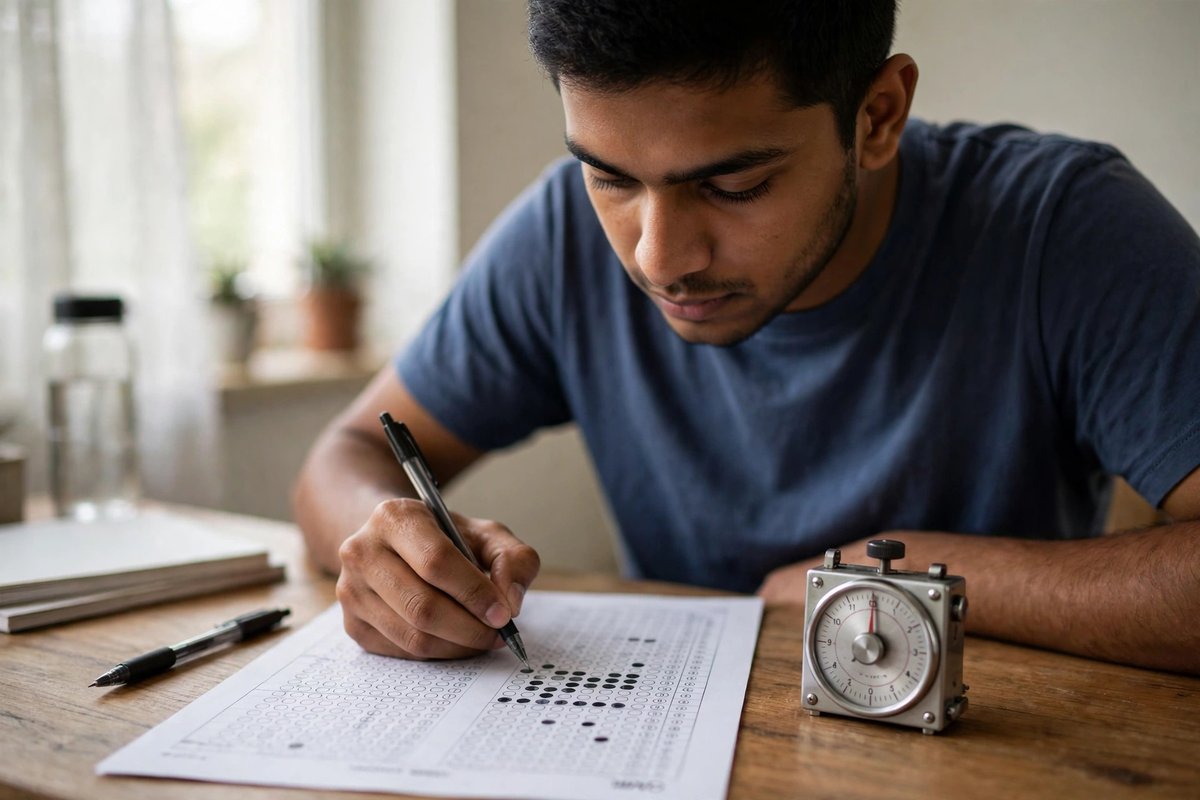
What a good Block 2 score looks like
Do not chase a magic number. A useful target for a strong NLU is around 85 to 95 marks, but the cut-off moves every year with the difficulty of the paper, and your mock score depends on which mock you took. What matters is the trend across your mocks. A student moving from 72 to 78 to 84 across three mocks is in a better place than a student stuck at 86 for three mocks, because the first student is still fixing errors. What you want to see by 28 November is a rising trend, fewer unattempted questions in your strong sections, and fewer than five silly mistakes per mock. Silly mistakes are the cheapest marks in CLAT, and they are the easiest to remove: read the question twice, check what is being asked, and never change an answer unless you can say why the new one is right.
Block 3: Peak and Rest (29 November to 5 December, Days 7 to 1)
Block 3 has two halves. The first half, 29 November to 2 December, is the last serious work: a final GK sweep, two more full mocks, and a full read of your revision sheets. The second half, 3 to 5 December, is a taper: fewer hours, no new material, and sleep becomes part of the plan.
29 November (7 days to go): The November GK sweep
Current Affairs is the section that rewards last-week work most, because November news is still fresh when the paper is set. Spend this day on the news of October and November 2026: major judgments, new schemes, international meetings, and big sports and awards results. Read your month-wise notes rather than fresh newspapers. If you have been following the news regularly, this is a refresh. If you have not, do not try to read six months of news in a day. Take the last three months, theme by theme, and accept that the older months will cost you a few questions. A calm, focused sweep of three months beats a panicked skim of twelve.
30 November (6 days to go): Full mock 5
Take full mock 5 in the 2 to 4 pm slot. This is your last mock at full analysis depth. Analyse it the same evening, and then make a one-page list of the ten things you will do differently on exam day. That list is your exam-day plan: your attempt order, your time checkpoints, your rule for when to skip a question, and your rule for when to guess. A guess in CLAT is worth making only when you can eliminate at least two options. With two options eliminated, a guess has a positive expected value even after the 0.25 penalty. With no elimination, a guess loses marks on average. Decide this rule now, not in the hall.
1 December (5 days to go): Revision sheets, full read
Read every revision sheet from start to finish, slowly, with a pen. Add nothing new. Cross out anything you now know cold. The sheets should be shorter at the end of the day than at the start. Then revise the principle-fact traps and the Quant formulae one more time, because these are the two things that vanish first under exam pressure. Finish the day by 8 pm and sleep on time. The taper has begun.
2 December (4 days to go): Full mock 6, light analysis
Take your last full mock today, again in the 2 to 4 pm slot. Analyse it lightly: only the wrong answers and the time checkpoints. Do not start a new repair cycle. If the mock exposes a gap, note it on your sheet and move on. Four days before the exam, a gap you have not fixed in 19 days will not be fixed by panic. What matters now is that your attempt order, your timing and your guessing rule are settled.
3 December (3 days to go): Taper day one
Study for no more than four hours today. Read your revision sheets, do 20 questions per section as a warm-up, and stop. Use the rest of the day to sort out logistics: confirm your exam centre address from the admit card, plan your route, check the reporting time, and arrange your travel so that you reach the centre at least 45 minutes early. Pack nothing yet, but make the list of what you will pack: printed admit card, original photo ID, two blue or black pens, and an analogue watch. Mobile phones, smartwatches, calculators and study material are not allowed inside the centre.
4 December (2 days to go): Taper day two
Three hours of study at most. Read the revision sheets once, do a short 30-question mixed drill to keep your mind warm, and then stop. Go for a walk, eat well, and go to bed at your normal time. Do not discuss the exam with friends tonight. Other people's panic is contagious, and it has no place in your last 48 hours.
5 December (1 day to go): The day before
No mock test today. No new material. Read your revision sheets once in the morning, then close the books. Pack your bag in the evening: admit card, photo ID, pens, watch, and a water bottle. Check the centre address and the route one last time. Set two alarms. Eat a normal dinner and sleep by 10 pm. The exam starts at 2 pm tomorrow, so there is no need to wake up at dawn, but there is every need to wake up rested. A tired brain reads passages slowly, and slow reading is the most expensive mistake in CLAT.

Exam Day: 6 December 2026, 2 to 4 pm
Reach the centre by 1:15 pm. The admit card carries your reporting time, and the centre will close entry before the exam starts, so do not plan to arrive at the last minute. Carry only what is allowed: the printed admit card, a valid original photo ID, blue or black pens, and an analogue watch. Leave your phone at home or with someone outside, because phones are not allowed inside and there may be nowhere safe to keep one.
When the paper starts, spend the first two minutes reading nothing. Instead, look at the paper: count the passages, note the section order, and confirm your attempt order. Then start with your strongest section. Use time checkpoints: about 30 questions done by 2:30 pm, 60 by 3:00 pm, and 90 by 3:30 pm. That leaves 30 minutes for the last 30 questions and a final check. If a question takes more than 90 seconds, mark it, move on, and come back only if time remains. An unattempted question costs nothing. A wrong answer costs 0.25, and a question that eats three minutes costs you three other questions.
In the last ten minutes, stop solving and start checking. Confirm that every answer you intended is marked on the OMR sheet, and that no question is marked twice. OMR errors are the saddest way to lose marks in CLAT, and they happen to careful students who rush at the end. When the paper ends, leave. Do not discuss answers with anyone outside the centre. The result is expected by 15 December 2026, and nothing you hear in the corridor will change it.
Section-Wise Revision: What to Do in Each of the Five Sections
English Language: read for the question, not for the passage
English passages in CLAT are about 450 words, and the questions test whether you understood the author's point, not whether you remember details. In the last 19 days, practise reading a passage once, then answering without rereading. If you must reread, reread only the lines the question points to. Revise the vocabulary you have met in mocks, not word lists from a book. Words you have seen in a passage stay in your memory. Words from a list do not.
Current Affairs: themes, not dates
Revise current affairs by theme and by month. The most asked themes are government schemes, court judgments, international relations, awards and honours, sports, and science and environment. For each theme, know the last twelve months, with extra weight on the last three. Do not memorise dates. CLAT asks what happened and why it matters, not the exact date it happened on. For the detail in our section-wise guide, read CLAT 2027 Current Affairs Preparation Guide: How to Score 28+ in the GK Section.
Legal Reasoning: the principle is the question
Every legal reasoning question is a test of whether you applied the principle given in the passage, not the law you already know. That is the trap and the opportunity. Revise by doing principle-fact questions slowly and writing the principle in your own words before you look at the facts. If your own-words principle matches the passage principle, the answer follows. If it does not, you have found the mistake before making it. For a full explanation of this question type, read CLAT Legal Reasoning: Principle-Fact Questions Explained.
Logical Reasoning: patterns, not puzzles
Logical reasoning in CLAT is argument-based, not puzzle-based. The same ten patterns repeat: strengthen, weaken, assumption, inference, conclusion, parallel reasoning, flaw, principle, paradox and evaluation. Learn to name the pattern before you read the options. When you know the pattern, the wrong options become visible: they answer a different question, they repeat the passage, or they go beyond what the argument says. Do 20 questions a day in Block 2, and always time them.
Quantitative Techniques: small section, certain marks
Quant is only 10 to 14 questions, but it is the most predictable section in the paper. The topics are fixed, the level is Class 10, and every question has a definite answer. In the last 19 days, revise the formulae on one sheet and practise data interpretation sets under time. A student who gets all 12 Quant questions right gains the same marks as a student who gets 12 extra questions right in a 30-question section, and does it in less time. Do not leave Quant for the last day, and do not skip it because it looks small.
7 Mistakes That Cost Marks in the Last 19 Days
- Starting a new book or a new topic. New material in the last 19 days has a low return and a high cost in confidence. Revise what you know.
- Taking mocks without analysis. A mock you do not analyse teaches you nothing except your score. Two hours of analysis is not optional.
- Studying 12 hours a day. Long hours in the last week produce tired brains, not better scores. Seven focused hours beat twelve distracted ones.
- Ignoring the admit card until the last day. The portal slows down on release day, and a wrong detail needs the helpdesk. Download it on 20 November.
- Changing your attempt order in the last week. Your order should be fixed by 28 November. A new order on exam day is an experiment you cannot afford.
- Guessing without eliminating options. A blind guess loses marks on average because of the 0.25 penalty. Guess only when you can eliminate at least two options.
- Studying late on 5 December. A tired brain on 6 December reads slowly and makes silly mistakes. The last day is for rest, not for revision.
Frequently Asked Questions
Is 19 days enough to improve my CLAT score?
Yes, if your syllabus is mostly covered. Nineteen days of revision, mock analysis and error correction can add 8 to 15 marks for a student who has studied through the year, because most of the gain comes from removing repeated mistakes rather than learning new things. If large parts of the syllabus are untouched, 19 days is enough to secure your strong sections and add the easiest marks in the weak ones, but it is not enough to cover everything.
How many mock tests should I take in the last 19 days?
Six to eight full-length mocks, always in the 2 to 4 pm slot, with at least two hours of analysis after each one. More than eight usually means you are taking mocks instead of fixing errors. Fewer than five means you have not practised enough under real timing. Sectional tests between mocks are useful, but they do not replace full mocks.
When will the CLAT 2027 admit card release?
The admit card is expected on 20 November 2026, according to reporting by The Times of India and The Telegraph on 16 November 2026. It has not been officially announced by the Consortium yet, so treat 20 November as the expected date and check the official portal, consortiumofnlus.ac.in, from that morning. Download it only from your candidate login, using your registered mobile number and password.
Should I study on the day before the exam?
Lightly, in the morning only. Read your revision sheets once, then close the books. The day before the exam is for packing, checking your route, and sleeping well. No mock test, no new material, and no late-night study.
What should I do if my mock scores are falling?
First, check whether the mocks are getting harder or whether you are getting tired. A falling score in the last week is usually tiredness, not lost knowledge. Take a half day off, sleep properly, and take the next mock fresh. If the fall is in one section only, look at the error pattern in that section rather than the score. And remember that one mock is noise. Judge yourself on the trend across three mocks, not on a single day.
What is a good score in CLAT 2027?
There is no fixed cut-off until the paper is written, because it depends on the difficulty of the paper and the number of seats. As a working target, 85 to 95 marks is a strong score for a top NLU, but the real target is your best possible score with the preparation you have. Focus on the marks you can control: fewer silly mistakes, fewer unattempted questions in your strong sections, and a clean attempt order.
Conclusion
Nineteen days is enough. It is enough to revise every section properly, to take six full mocks and learn from each one, to download your admit card without a last-minute rush, and to arrive on 6 December rested and ready. It is not enough to learn the whole syllabus from scratch, and it does not need to be. The students who do well in CLAT are rarely the ones who know the most. They are the ones who make the fewest mistakes with what they know, and the last 19 days are when those mistakes get removed.
Start today with the audit. Make your revision sheets. Take your first mock in the exam slot. And when the admit card appears on 20 November, download it before you do anything else. The exam is on 6 December 2026, from 2 to 4 pm. Nineteen days from now, it will be over. Make them count.
For the full day-wise study framework this plan builds on, read CLAT 2027 Last 28 Days: A Realistic Preparation Plan and CLAT 2027 Exam Day Strategy: What to Carry, How to Attempt. For the official mock schedule and how to use it, read CLAT 2027 Mock Test: How to Attempt the Official Mocks. If you want structured guidance and regular mock practice with personal mentorship in Bathinda, explore the courses at Skylor Institute, Bathinda and the Pariksha mock test series.
Need Personalized Diagnostic Guidance?
Speak directly with Skylor's academic directors in Bathinda. Discuss batch schedules, test analytics, and personalized preparation strategies.