CLAT 2027 Exam Day Strategy: What to Carry, How to Attempt
CLAT 2027 is on Sunday, 6 December, from 2 to 4 pm. This guide covers the admit card, what to carry, entry timings, and a section-wise plan for 120 questions.
CLAT 2027 Exam Day Strategy: What to Carry, How to Attempt
A CLAT 2027 exam day strategy is not something you invent on the morning of 6 December. By the time you reach your exam centre, your preparation is already done. What decides your score in those two hours is how calmly you handle the admit card, the entry timings, the question paper, and the OMR sheet. This guide covers all of it: when the admit card arrives, what to carry, what time to reach, how to attempt 120 questions in 120 minutes, and the mistakes that cost good students marks every year. It is written for every CLAT 2027 aspirant, whether you have been preparing for a year or for the last three months.
As of 13 November 2026, the facts are fixed. CLAT 2027 is on Sunday, 6 December 2026, from 2 pm to 4 pm, in offline pen-and-paper mode at centres across India. The paper has 120 questions for 120 marks, with one mark for a correct answer, a deduction of 0.25 marks for a wrong answer, and no penalty for a question left unattempted. Registration closed on 7 November 2026 and the correction window closed on 10 November 2026, so nothing about your application can change now. The only things left to manage are your admit card, your exam-day routine, and your attempt plan. That is what this guide is for.
5 Key Takeaways
- The admit card is expected in the third week of November 2026: download it from consortiumofnlus.ac.in, print two copies, and check every detail the same day.
- Reach the centre by 1 pm, because entry closes at 2:15 pm and nobody is allowed to leave the hall before 4 pm.
- Carry only the printed admit card, a valid original photo ID, and blue or black ball-point pens: rough sheets are provided at the centre.
- Attempt in two passes: answer the sure questions first in about 70 minutes, then return to the marked ones with the remaining time.
- Budget your time by section weightage: Legal Reasoning and Current Affairs together carry about half the paper, so they deserve half your time.
The Exam Day in Numbers
Before any strategy, get the numbers straight. A surprising number of students lose marks because they walk in with the wrong idea of the paper: they expect 150 questions, or they think there is no negative marking, or they plan for a three-hour exam. CLAT 2027 is a two-hour paper with 120 questions. Knowing the exact structure in advance lets you plan your 120 minutes instead of discovering the paper as you go.
| Detail | CLAT 2027 (as of 13 November 2026) |
|---|---|
| Exam date | Sunday, 6 December 2026 |
| Exam time | 2 pm to 4 pm |
| Mode | Offline, pen and paper, OMR answer sheet |
| Total questions | 120 multiple-choice questions |
| Total marks | 120 |
| Correct answer | Plus 1 mark |
| Wrong answer | Minus 0.25 marks |
| Unattempted question | 0 marks, no penalty |
| Exam centres | Around 131 centres across India |
| Admit card | Expected in the third week of November 2026 |
| Conducting body | Consortium of National Law Universities |
The five sections of the paper carry different weights, and the official pattern gives each section an approximate range rather than a fixed count. Current Affairs including General Knowledge and Legal Reasoning are the two heaviest sections, at about 25 percent each. English Language and Logical Reasoning sit at about 20 percent each. Quantitative Techniques is the smallest section, at about 10 percent. These are approximate ranges from the Consortium's pattern, so do not expect the exact numbers on exam day, but do expect the balance to look like this.
| Section | Approximate questions | Approximate weight |
|---|---|---|
| English Language | 22 to 26 | About 20 percent |
| Current Affairs including General Knowledge | 28 to 32 | About 25 percent |
| Legal Reasoning | 28 to 32 | About 25 percent |
| Logical Reasoning | 22 to 26 | About 20 percent |
| Quantitative Techniques | 10 to 14 | About 10 percent |
| Total | 120 | 100 percent |
Two facts in these tables matter more than the rest. First, the paper is passage-based: most questions sit under a passage of about 450 words, so reading speed matters as much as knowledge. Second, the negative marking of 0.25 means four wrong answers cancel one correct answer. Blind guessing across the paper can cost you 10 to 15 marks, which is often the difference between one NLU and another. The attempt plan later in this guide is built around those two facts.
Before the Day: Your Admit Card and Your Centre
The admit card is the one document without which you cannot enter the exam hall, and it has not been released yet. As of 13 November 2026, the Consortium is expected to release it in the third week of November 2026, around 15 days before the exam. Some reports place the release between 21 and 26 November. The exact date will be confirmed by the Consortium, so check the official portal, consortiumofnlus.ac.in, regularly from the third week of November rather than relying on forwarded messages or coaching advertisements.
Downloading it is simple, but do it the day it releases, not the day before the exam. Log in to consortiumofnlus.ac.in with your registered mobile number and password, open the admit card download link, and save the PDF. The admit card stays available for download until half an hour before the exam starts, but a last-minute download is a risk you do not need: a slow connection, a forgotten password, or a server under load on 6 December can cost you your entry. Download early, and print two copies on clean A4 sheets.
When the admit card arrives, check these five details the same day. Your name and photograph must match your application. Your roll number and application number must be printed clearly. The exam centre name and full address, including the nearest landmark, must be readable. The reporting time must be noted. And the exam-day instructions printed on the card must be read fully, because they are the final authority on what is allowed inside the hall. If anything is wrong, contact the Consortium helpdesk at [email protected] or on 08047162020 between 10 am and 5 pm on working days. Do not wait until the last week to raise a correction.
Your centre is final. The Consortium does not change the allotted centre, and you only learn your centre from the admit card itself. Once you know it, visit it before exam day. Find the exact building, the entry gate, and the route from the nearest bus stop or metro station. Time the journey at the same hour you will travel on 6 December, because Sunday afternoon traffic is different from a weekday morning. Students who visit their centre in advance arrive calm. Students who search for it on exam day arrive stressed, and stress is the first thing that damages a paper.
What to Carry and What to Leave Behind
Pack your exam-day bag the night before, on 5 December, not on the morning of the exam. A bag packed the night before removes a whole set of morning decisions, and on exam day every decision you remove is energy saved for the paper. Keep the bag by the door, with everything in one place.
| Carry this | Why it matters |
|---|---|
| Printed admit card (two copies) | Entry is not allowed without it; the second copy is your backup if one gets damaged |
| Valid original photo ID | Required alongside the admit card; a photocopy is not accepted |
| Two or three blue or black ball-point pens | The exam is OMR-based, so you mark answers with your own pen; carry spares in case one stops working |
| A transparent water bottle | Two hours of reading passages is thirsty work; keep it on the floor, not on the desk |
| A simple watch (if allowed) | To track your own time if the hall clock is not visible; check the admit card instructions first |
Just as important is what to leave behind. Do not bring any paper, including blank sheets, into the exam hall: rough sheets for working are provided at the centre. Do not bring study material, notes, or books. Mobile phones, smartwatches, calculators, and other electronic devices are not permitted inside the hall. Bags are usually kept outside the exam room at your own risk, so carry as little as possible. If you must bring a phone for the journey, switch it off before entering and hand it in exactly as the invigilators direct.
One more thing to settle the night before: your clothes. Wear something comfortable that you have worn before, with pockets you can check quickly. Avoid anything new, tight, or distracting. You will sit for two hours in one place, reading long passages. Comfort is not a luxury on exam day. It is part of the strategy.
The Exam-Day Timeline, Hour by Hour
The Consortium's instructions set hard timings for the day, and they are not flexible. Candidates are allowed to enter the exam centre premises from 1 pm onwards. The exam starts at 2 pm. No candidate is allowed to enter after 2:15 pm, with no exceptions. Once you have entered the exam hall, you are not permitted to leave until 4 pm, when the exam ends. Build your day around those four times.
| Time on 6 December 2026 | What to do |
|---|---|
| 11:30 am | Leave home, allowing extra time for traffic and a wrong turn |
| 12:30 to 12:45 pm | Reach the centre, find your room, and settle in |
| 1:00 pm | Entry to the centre premises opens; complete the verification calmly |
| 1:30 pm | Be seated, check your question booklet and OMR sheet, fill in the QB number and OMR response sheet number on the attendance sheet, and sign where asked |
| 2:00 pm | The exam begins; start with your planned first section, not with a panic read of the whole paper |
| 2:15 pm | Entry closes; if you are not inside by now, you cannot write the exam |
| 3:00 pm | Halfway mark: you should be finishing your first pass of the paper |
| 3:45 pm | Last 15 minutes: fill every remaining OMR bubble, review marked questions, stop solving new ones |
| 4:00 pm | The exam ends; hand in the OMR sheet exactly as the invigilator directs |
The most important row in this table is the first one. Leave home early enough that a traffic jam, a closed road, or a wrong turn still leaves you at the centre by 12:45 pm. Aim to arrive an hour before the paper starts, not ten minutes before. The students who arrive at 1:50 pm spend the first twenty minutes of the paper calming down. The students who arrive at 12:45 pm spend the first twenty minutes of the paper scoring marks.
How to Attempt 120 Questions in 120 Minutes
One hundred and twenty questions in 120 minutes is one minute per question, on average. But no section takes one minute per question in practice. A Legal Reasoning passage with five questions can take six minutes to read and answer. A Quantitative Techniques set can take four minutes. A Current Affairs question you know takes ten seconds. The students who score well do not spend one minute per question. They spend their time where the marks are, and they move on quickly where they are not.
The method that works best for most students is the two-pass method. In the first pass, which should take about 70 minutes, you answer every question you are sure about and mark the ones you are unsure of, skipping the ones you do not know at all. In the second pass, which takes about 30 minutes, you return to the marked questions with fresh eyes and decide each one on its merits. The last 20 minutes are for the OMR sheet: filling every bubble carefully, checking that no question is left unmarked by accident, and reviewing the questions you flagged. This method works because it protects you from the two classic failures: spending ten minutes on one hard question while easy marks sit unanswered, and filling the OMR sheet in a rush at the end.
| Pass | Time | What to do |
|---|---|---|
| First pass | 2:00 to 3:10 pm (70 minutes) | Answer all sure questions, mark the unsure ones, skip the unknown ones entirely |
| Second pass | 3:10 to 3:40 pm (30 minutes) | Return to marked questions, eliminate options, attempt only where you can remove at least two wrong options |
| OMR and review | 3:40 to 4:00 pm (20 minutes) | Fill every bubble, check question numbers match, review flagged answers, leave unknown questions blank |
Three rules govern the whole attempt. First, never leave a question blank by accident: an unattempted question costs nothing, but a question you knew and forgot to mark costs a full mark. Second, never guess blindly. With minus 0.25 per wrong answer, a blind guess has a negative expected value: over a whole paper, random guessing loses marks. Attempt a doubtful question only when you can eliminate at least two of the four options, which raises your odds from one in four to one in two. Third, fill the OMR sheet as you go, in small batches of ten questions, rather than all at once at the end. A single misaligned bubble near the end can shift a whole block of answers, and that is a mistake you cannot fix after 4 pm.
Read the paper in the order that suits you, not the order it is printed in. Most students do best starting with the section they are strongest in, because early correct answers build confidence and rhythm. If Legal Reasoning is your strength, start there. If Current Affairs is, start there. The only section to treat with care is Quantitative Techniques: it carries only about 10 percent of the paper, so do not let it eat 30 minutes of your time. Give it its 10 to 12 minutes, take the marks you can, and move on.
Section-by-Section Attempt Plan
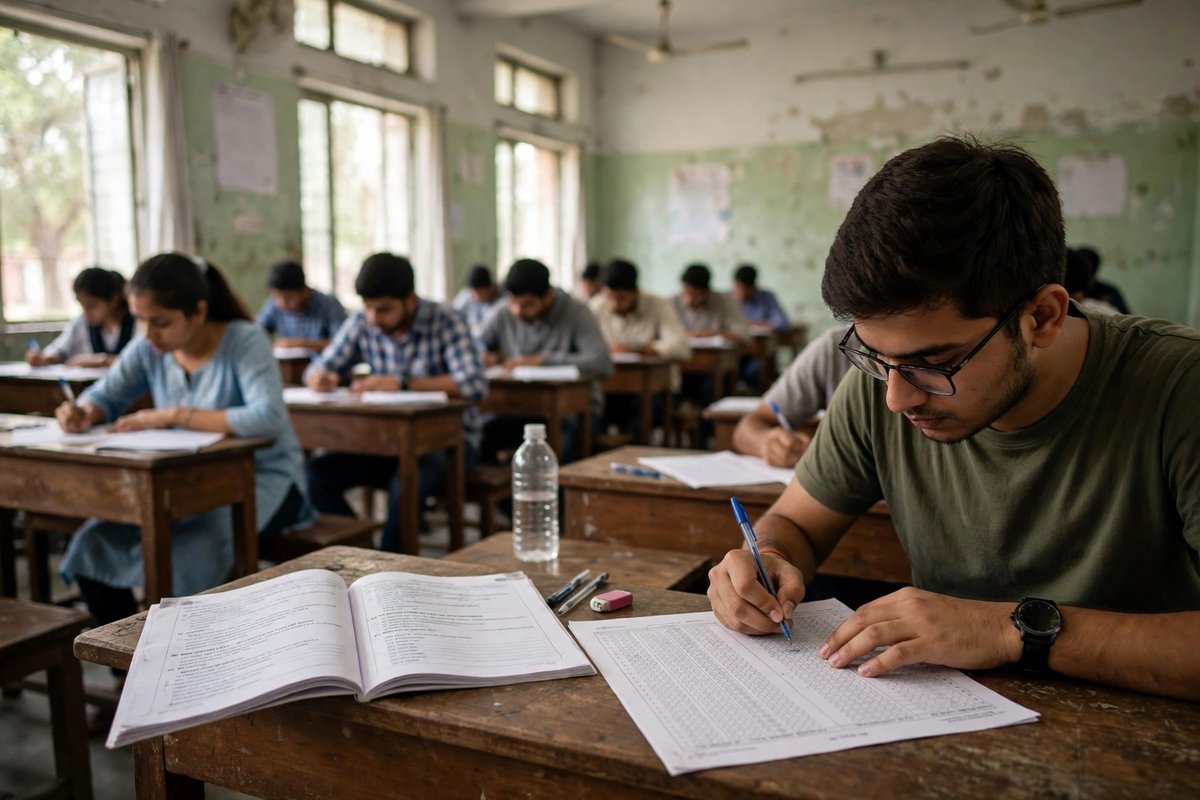
Each section of CLAT rewards a different skill, so each one needs a different approach on exam day. The time budgets below add up to 120 minutes, and they follow the weightage of the paper: the two 25 percent sections get the most time, and the 10 percent section gets the least.
English Language: about 22 to 26 questions, 20 to 22 minutes
The English section is passage-based, with questions on the main idea, the author's tone, vocabulary in context, and inference. Read the passage once, properly, and then answer all its questions before moving on: re-reading a passage five times for five questions wastes minutes. Do not read the questions first and then hunt for answers, because that turns reading into searching. For vocabulary questions, use the sentence around the word, not your memory of the word alone. English is a scoring section for students who read regularly, so if it is your strength, do it early and bank the marks.
Current Affairs including General Knowledge: about 28 to 32 questions, 15 to 18 minutes
This is the fastest section for a prepared student and the slowest for an unprepared one, because you either know the answer or you do not. Read each question once. If you know it, mark it and move on in seconds. If you do not, do not sit and think: a current affairs fact does not come back by staring at the question. Mark it, move on, and return only if time remains. The passages here are usually news-based, so the questions often test the same event from two angles: the fact and its background. If you followed the news through the year, this section can give you 25 marks in under 20 minutes. For a revision plan that targets exactly this section, read our CLAT 2027 current affairs preparation guide.
Legal Reasoning: about 28 to 32 questions, 30 to 32 minutes
Legal Reasoning is the heart of the CLAT paper and the section where good students separate themselves. Each passage states a legal principle and a set of facts, and the questions ask you to apply the principle to the facts. The rule for this section is simple: apply only the principle given in the passage, not your own opinion about what the law should be. Read the principle twice if you must, underline the key condition in it, and then test each option against that condition. The wrong options usually fail on one condition of the principle. This section takes the most time per question, so give it a full 30 minutes and do not rush it: it carries a quarter of the paper.
Logical Reasoning: about 22 to 26 questions, 22 to 25 minutes
Logical Reasoning tests arguments, assumptions, conclusions, and patterns. Read the argument, identify the conclusion first, and then check which option strengthens, weakens, or follows from it. The common trap in this section is the attractive option that is true in real life but does not follow from the argument: the question asks what follows from the passage, not what is true in the world. For assumption questions, use the negation test: if negating an option destroys the argument, that option is the assumption. Keep your pace steady here, about one minute per question, and do not let one hard set consume the time meant for the next section.
Quantitative Techniques: about 10 to 14 questions, 10 to 12 minutes
Quantitative Techniques is the smallest section, and it is built on Class 10 mathematics: ratios, percentages, averages, and data interpretation from graphs and tables. The trap is perfectionism: students who are good at maths spend 25 minutes here chasing every mark, while a quarter of the paper waits unanswered. Give this section a strict 12 minutes. Solve the sets you find easy first, skip the calculation-heavy ones, and remember that one Quant question is worth exactly the same one mark as one Current Affairs question that takes ten seconds.
The Last 10 Days: What to Stop Doing
With the exam on 6 December, the last ten days, from about 26 November, are not for learning. They are for sharpening. Stop all new topics by 21 November at the latest: a topic learned in the last two weeks is rarely strong enough to score under pressure, and it steals revision time from topics you already know. Use the final ten days for three things only: full-length mocks under exam conditions, revision of your error log, and your exam-day routine.
Take the Consortium's official Mock 2 on 20 November 2026 if you have not already taken Mock 1 on 10 November. Official mocks are the closest preview of the real paper's difficulty and pattern, and your score on them is the most honest measure of where you stand. For a full method on using mock scores, read our guide to attempting the official CLAT mocks and our guide to analysing mock tests. After each mock, spend as long reviewing it as you spent writing it. A mock without review is only practice in making the same mistakes faster.
Revise your error log, not your textbooks. By now you should have a list of the mistakes you repeat: the Legal Reasoning principle you misread, the current affairs months you keep forgetting, the Quant formulas you mix up. Read that list every morning in the last week. Sleep properly in the last three nights: a tired brain on exam day costs more marks than any chapter you could revise at 2 am. And do one full dress rehearsal: wake up at the time you will wake up on 6 December, eat the breakfast you will eat, travel to your centre, and write a mock from 2 to 4 pm. On exam day, nothing should feel new except the questions.
7 Mistakes That Cost Marks on Exam Day
- Arriving late. Entry closes at 2:15 pm with no exceptions. A student who arrives at 2:10 pm writes the paper in panic. Leave home an hour earlier than you think you need to.
- Forgetting the admit card or the ID. A photocopy of your ID is not accepted, and a phone screenshot of your admit card is not a printout. Pack both the night before and check them before you leave.
- Guessing blindly. Four wrong answers cancel one correct answer. With minus 0.25 per wrong answer, random guessing across the paper can cost 10 to 15 marks. Guess only when you can eliminate at least two options. For the full maths behind this, read our guide to beating negative marking in CLAT, IPMAT and CUET.
- Spending too long on one question. A question that takes five minutes is a question that has already cost you five marks elsewhere. Mark it, move on, and return in the second pass if time remains.
- Filling the OMR sheet at the end. Filling 120 bubbles in the last ten minutes invites misalignment and panic. Fill in batches of ten as you go, and keep the last 20 minutes for checking, not for filling.
- Ignoring the instructions on the admit card. The admit card carries the final rules on what is allowed in the hall, including watches and other items. Read it fully when it arrives, not on exam morning.
- Discussing the paper during the break. There is no break in a two-hour paper, but the same rule applies after 4 pm: do not spend the evening comparing answers with friends. The paper is done. What matters now is the next step, which is AILET on 13 December for many students, and the answer key when the Consortium releases it.

What Happens After the Exam
The exam ends at 4 pm on 6 December, but the process does not end there. The Consortium usually releases the provisional answer key within a day or two, followed by a short window to raise objections, and then the final answer key and results. When the provisional key appears, check your answers calmly and raise an objection only where you have a clear, evidence-based reason: frivolous objections waste your time and change nothing.
For many CLAT aspirants, the next exam is only a week away. AILET 2027, conducted by National Law University Delhi, is on 13 December 2026, also from 2 to 4 pm, with 150 questions for 150 marks and the same minus 0.25 negative marking. AILET has three sections, with 70 questions from Logical Reasoning, and it tests a different balance of skills, so do not treat the week after CLAT as a holiday. Rest on 7 December, then use the week for AILET-specific practice, particularly Logical Reasoning at full depth.
After the results, the Consortium opens counselling and seat allotment for the participating NLUs, in rounds, based on your rank and your preferences. Keep your documents ready: your admit card, your ID proof, your Class 12 marksheet, and your category certificate if applicable. The students who struggle at this stage are usually the ones who scored well but were not ready with their paperwork. Your preparation does not end at 4 pm on 6 December. It ends when your seat is confirmed.
Frequently Asked Questions
When will the CLAT 2027 admit card be released?
The admit card is expected in the third week of November 2026, around 15 days before the exam on 6 December. The exact date will be confirmed by the Consortium of National Law Universities. Download it from consortiumofnlus.ac.in using your registered mobile number and password, and print two copies the day it releases.
What time should I reach the CLAT exam centre?
Reach the centre by 12:45 pm at the latest. Entry to the premises opens at 1 pm, the exam starts at 2 pm, and no candidate is allowed to enter after 2:15 pm. Arriving early gives you time to find your room, settle in, and start the paper calmly.
What documents must I carry for CLAT 2027?
Carry a printed copy of your admit card and a valid original photo ID. Both are mandatory for entry. Also carry two or three blue or black ball-point pens, since the exam is OMR-based. Rough sheets are provided at the centre, so do not bring any paper of your own.
How many questions should I attempt in CLAT 2027?
There is no fixed number, because it depends on your accuracy. Attempt every question you are sure about, and attempt doubtful questions only when you can eliminate at least two of the four options. Never guess blindly, because each wrong answer costs 0.25 marks. Most toppers attempt between 105 and 115 questions with high accuracy, not all 120.
Can I leave the exam hall before 4 pm?
No. Once you have entered the exam hall, you are not permitted to leave until the exam ends at 4 pm, even if you finish early. Use the extra time to review your marked questions and check your OMR sheet carefully instead of sitting idle.
What should I do in the last week before CLAT 2027?
Stop new topics by 21 November. Take the official Mock 2 on 20 November, revise your error log daily, and do a full dress rehearsal of exam day, including the 2 to 4 pm timing. Sleep properly in the last three nights. For a day-by-day plan, read our CLAT 2027 last 28 days preparation plan.
Conclusion
A CLAT 2027 exam day strategy is not about the exam hall. It is about everything you do before you reach it: downloading the admit card the day it releases, visiting your centre in advance, packing your bag the night before, arriving by 12:45 pm, and walking in with a two-pass attempt plan for 120 questions in 120 minutes. The students who score well on 6 December will not be the ones who studied the most in the last week. They will be the ones who made the fewest avoidable mistakes on the day itself.
Use the remaining 23 days well. Finish your mocks, revise your error log, and rehearse the day once, in full. Skylor's Pariksha mock series is built on the latest exam pattern, with detailed solutions that show you exactly where your marks are leaking before the real paper. Take your last mocks under real exam conditions, from 2 to 4 pm, with the OMR sheet and the same rules you will follow on 6 December. Then walk into your centre calm, on time, and ready. The paper is two hours long. Your preparation has been months long. Trust it.
Need Personalized Diagnostic Guidance?
Speak directly with Skylor's academic directors in Bathinda. Discuss batch schedules, test analytics, and personalized preparation strategies.