How to Beat Negative Marking in CLAT, IPMAT and CUET 2027
Negative marking can erase 20 to 30 marks in one paper. Learn the exact rules for CLAT, IPMAT and CUET 2027 and a simple attempt plan that protects your score.
How to Beat Negative Marking in CLAT, IPMAT and CUET 2027
Negative marking in CLAT, IPMAT and CUET is the quiet reason many well-prepared students score far below their mock-test average. You can know the answer to 80 questions and still lose the marks of 8 or 10 of them to wrong guesses, careless slips and panic attempts in the last ten minutes. In a paper where one mark can move your rank by hundreds of places, that loss is not a small detail. It is often the difference between a call and a rejection.
This guide gives you the exact scoring rules for all three examinations as of November 2026, the simple maths that tells you when a guess is worth taking, and a practical attempt strategy for each exam. It is written for students preparing for CLAT 2027 on 6 December 2026, for IPMAT 2027, and for CUET UG 2027. No formula here needs a calculator on exam day: the rules are simple enough to practise in mocks until they become habit.
Key Takeaways
- CLAT 2027 awards +1 for a correct answer and deducts 0.25 for a wrong one. IPMAT awards +4 and deducts 1 for every wrong MCQ. CUET awards +5 and deducts 1 for every wrong answer. Unattempted questions cost nothing in all three exams.
- A guess is worth taking only when you can eliminate at least one option with confidence. A blind guess on a question you have not understood is a losing habit, even though the pure maths looks kind.
- IPMAT Indore's Short Answer section has no negative marking at all. Attempt every one of its 15 questions, even if you are only partly sure of the answer.
- Careless errors on questions you actually know cost more than wrong guesses. Five silly mistakes in CLAT swing your score by 6.25 marks: the 5 marks you should have earned, plus 1.25 marks in penalties.
- Train your attempt discipline in mocks. Track attempts, accuracy and negative marks separately, and set a target attempt count for each section before the real examination.
The Exact Marking Rules: One Table for All Three Exams
Before any strategy, learn the rules exactly. The three examinations punish wrong answers differently, and the right attempt strategy for one exam is the wrong strategy for another. The table below uses the latest published patterns as of 6 November 2026. For CUET UG 2027, the National Testing Agency has not yet released the 2027 information bulletin, so the CUET figures below follow the latest released pattern, from CUET UG 2026. If the 2027 bulletin changes the marking scheme, the official bulletin at cuet.nta.nic.in is the final authority.
| Exam | Questions | Total Marks | Correct Answer | Wrong Answer | Unattempted | Time |
|---|---|---|---|---|---|---|
| CLAT 2027 | 120 | 120 | +1 | -0.25 | 0 | 120 minutes |
| IPMAT Indore | 90 | 360 | +4 | -1 (MCQ only) | 0 | 120 minutes (40 per section) |
| IPMAT Rohtak | 120 | 480 | +4 | -1 (all MCQs) | 0 | 120 minutes |
| CUET UG (per paper) | 50 | 250 | +5 | -1 | 0 | 60 minutes |
Three facts in that table deserve attention. First, an unattempted question costs nothing in any of these examinations. Skipping is free; a wrong answer is not. Second, the penalty is small in CLAT (0.25 marks) and large in IPMAT and CUET (1 mark against 4 or 5 marks for a correct answer). Third, IPMAT Indore is the only one of the three with a section that carries no penalty at all: the 15 Short Answer questions in Quantitative Ability. That single fact changes how you should treat that section, and it is covered in detail below.
CLAT 2027 is an offline, pen-and-paper examination on Sunday, 6 December 2026, from 2 pm to 4 pm. Its 120 passage-based questions are spread across five sections: English Language with 22 to 26 questions, Current Affairs including General Knowledge with 28 to 32, Legal Reasoning with 28 to 32, Logical Reasoning with 22 to 26, and Quantitative Techniques with 10 to 14. IPMAT Indore has three sections of 40 minutes each: Quantitative Ability (Short Answer) with 15 questions, Quantitative Ability (MCQ) with 30 questions, and Verbal Ability (MCQ) with 45 questions. IPMAT Rohtak has 120 questions across Quantitative Aptitude, Logical Reasoning and Verbal Ability, all multiple-choice, in 120 minutes. CUET UG gives you 60 minutes per paper of 50 questions, and you may choose up to five subjects.
What a Wrong Answer Really Costs
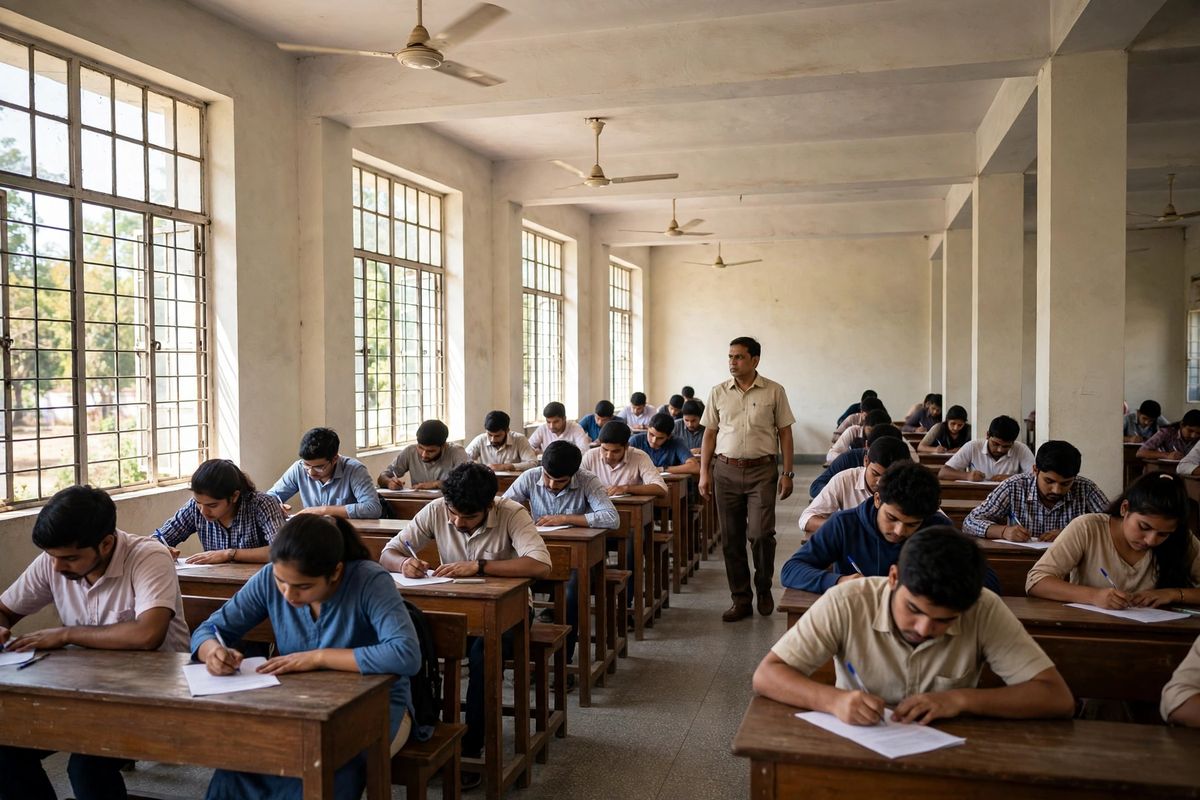
Students usually think of negative marking as a small tax on guessing. It is better to think of it as a second examination running inside the first one: every wrong answer does double damage, because it takes away the marks you would have earned and then subtracts a penalty on top. Worked examples make the scale clear.
Take a CLAT candidate who attempts all 120 questions, gets 82 right and 38 wrong. The score is 82 minus 9.5, which is 72.5. Now suppose the same candidate had skipped the 20 questions she had no idea about, and attempted only 100. Her score would be 82 minus 4.5, which is 77.5. Skipping 20 hopeless questions is worth 5 marks, with no extra knowledge required. In CLAT 2026, a gap of 5 marks separated hundreds of ranks around the cut-offs of the top National Law Universities. Five marks earned by doing nothing is the cheapest improvement in this examination.
Take a CUET candidate in one paper of 50 questions. She attempts 45, gets 35 right and 10 wrong: 175 minus 10 is 165 out of 250. If she had attempted all 50 by adding five blind guesses and got one of them right, her score would be 180 minus 14, which is 166. One mark gained, at the cost of four more wrong answers on her record. And if none of the five guesses lands, the score falls to 175 minus 15, which is 160. The upside of blind guessing is tiny and the downside is real.
Take an IPMAT Indore candidate. In the Verbal Ability section of 45 questions, she attempts 40, gets 30 right and 10 wrong: 120 minus 10 is 110 out of 180. If she had skipped the 6 questions she could not eliminate anything in, her score would be 120 minus 4, which is 116. Six marks in one section, saved by skipping. Across three sections, that habit is worth 10 to 15 marks in the whole paper, which is often the difference between clearing the sectional cut-off and missing it.
The most expensive wrong answers, though, are not guesses. They are careless errors on questions you knew how to solve: a misread passage, a wrong option ticked in a hurry, a calculation slip in Quantitative Techniques. In CLAT, five such errors cost 5 marks you should have earned plus 1.25 marks in penalties, a swing of 6.25 marks. In IPMAT, five careless errors cost 20 marks you should have earned plus 5 in penalties, a swing of 25 marks. That is why the first rule of negative marking is not about guessing at all. It is about slowing down on the questions you know.
The Maths of Guessing: When a Guess Pays and When It Does Not
Every guess is a small bet. The maths of that bet is simple, and it is worth knowing, because it replaces panic with a rule. A guess pays when your chance of being right is higher than the break-even point for that examination. The break-even point depends only on the marks for a correct and a wrong answer.
| Exam | Correct | Wrong | Break-even chance of being right | What it means |
|---|---|---|---|---|
| CLAT 2027 | +1 | -0.25 | 20% | A guess pays if you are right more than 1 time in 5 |
| IPMAT Indore / Rohtak | +4 | -1 | 20% | A guess pays if you are right more than 1 time in 5 |
| CUET UG | +5 | -1 | 16.7% | A guess pays if you are right more than 1 time in 6 |
Since every question in these examinations has four options, a purely random guess is right 25% of the time, which is above the break-even point in all three exams. On paper, then, even a random guess has a small positive expected value: +0.06 marks per question in CLAT, +0.25 in IPMAT and +0.5 in CUET. Eliminate one option and the expected value rises sharply: about +0.17 in CLAT, +0.67 in IPMAT and +1.0 in CUET. Eliminate two options and it rises further: +0.38 in CLAT, +1.5 in IPMAT and +2.0 in CUET.
That maths is true, and it is also a trap. It assumes your guess is genuinely random, with each option equally likely to be your pick. In a real examination, your guesses are not random. The wrong options are written by experts to attract you: the plausible-sounding legal principle, the familiar-looking number, the half-remembered fact. When you guess without understanding, you do not pick at random; you pick the option the examiner wanted you to pick. Your real hit rate on blind guesses is usually below 25%, often well below it. That is why toppers and teachers agree on the practical rule even though the pure maths looks generous: never guess blind. The maths only starts working for you once you have eliminated at least one option by reasoning, not by feeling.
There is a second reason the pure maths misleads. It counts marks, but examinations are decided by ranks and percentiles. In CUET, your NTA score is normalised across shifts, so a cluster of wrong answers can move your percentile more than the raw marks suggest. In CLAT, the paper is the same for everyone, and a 5-mark gap near a cut-off can mean hundreds of ranks. A guess that is worth +0.06 marks on average is not worth the risk of a bad day: variance is real, and ten blind guesses can easily return zero correct answers and cost you 2.5 marks in CLAT or 10 marks in IPMAT and CUET.
The rule that follows from all of this is simple enough to use under pressure. Call it the two-option rule: attempt a question if you can eliminate at least one option with confidence; skip it if you cannot eliminate any. If you can eliminate two options, attempt it without hesitation. If you have read the question carefully and still have no basis for eliminating anything, leave it blank and move on. In IPMAT Indore's Short Answer section, where there is no penalty, the rule is different: attempt everything, because a wrong answer costs nothing.
Attempt Strategy for CLAT 2027
CLAT's penalty is the mildest of the three examinations, which tempts students into attempting all 120 questions. That is usually a mistake, but for a subtler reason than the penalty itself. The real danger in CLAT is time. You have 120 minutes for 120 passage-based questions, which is one minute per question including reading time. Every minute spent on a question you cannot solve is a minute stolen from a question you could have solved.
Work the paper in two passes. In the first pass, answer every question you are sure about and mark the ones where you can eliminate at least one option. Skip anything you cannot eliminate in, and do not spend more than 90 seconds on a single question in this pass. In the second pass, return to the marked questions with fresh eyes, apply the two-option rule, and attempt the ones where elimination now works. Questions you still cannot eliminate anything in should stay blank. Most strong candidates finish CLAT attempting between 105 and 115 questions with high accuracy, not all 120 with low accuracy.
Order matters too. Start with your strongest section, because early confidence protects your accuracy for the rest of the paper. Legal Reasoning and Current Affairs together carry 56 to 64 of the 120 questions, so accuracy there matters more than anywhere else. Quantitative Techniques has only 10 to 14 questions, but they are the easiest marks in the paper for a student who practises data interpretation, and they should never be left to the last five minutes. English Language passages reward careful reading; a rushed passage produces two or three wrong answers at once, which is the most common way CLAT candidates lose 5 marks in a single minute.
One CLAT-specific warning: do not change answers in the last minutes unless you have found a clear error. Second thoughts in CLAT are usually wrong thoughts. If you marked an answer with reason in the first pass, trust the reasoning. Use the last five minutes to check that you have marked the right option number against each question, not to re-solve questions under panic.
Attempt Strategy for IPMAT 2027
IPMAT is two examinations in one, and the strategies are different. In IPMAT Indore, the three sections are separately timed at 40 minutes each, so you cannot borrow time from one section to save another. In IPMAT Rohtak, the whole paper is yours to divide across 120 minutes.
For IPMAT Indore, treat the Short Answer section as free marks. Fifteen questions, 60 marks, no negative marking: attempt all fifteen, even if you are only partly sure. A rough estimate that is right earns 4 marks; a wrong one costs nothing. Many candidates leave Short Answer questions blank out of habit, and that is the single most wasteful habit in IPMAT. In the two MCQ sections, apply the two-option rule strictly. With 4 marks at stake and 1 mark of penalty, a wrong guess costs a fifth of a correct answer's value, and the sectional cut-offs punish low accuracy. Target 24 to 26 attempts in Quantitative Ability (MCQ) and 36 to 40 in Verbal Ability, with accuracy above 80%, rather than attempting everything.
For IPMAT Rohtak, all 120 questions are multiple-choice with the same +4 and -1 rule, and there is no sectional time limit. That freedom is dangerous: students spend too long on Quantitative Aptitude and arrive at Verbal Ability with 20 minutes left. Divide the paper before you start: 45 minutes for Quantitative Aptitude, 35 for Logical Reasoning and 40 for Verbal Ability is a workable split. Attempt the questions you know first in each section, then return for the eliminable ones. Rohtak has sectional cut-offs as well as an overall cut-off, so a very low score in any one section can end your chances even if your total is strong. Never sacrifice a whole section to chase marks in another.
Attempt Strategy for CUET UG 2027
CUET is the examination where negative marking hurts most in absolute terms, because each paper is only 50 questions and each wrong answer costs a full mark against 5 for a correct one. A paper with 35 correct and 15 wrong scores 160 out of 250. The same paper with 35 correct and 5 wrong, with 10 skipped, scores 170. Ten skipped questions bought 10 marks.
The 60-minute limit per paper gives you about 72 seconds per question, which is generous compared with CLAT and IPMAT. Use that time. Read each question twice before answering, because CUET's wrong options often differ from the right one by a single word: a date, a name, a "not" or an "except". In the Language Test and the General Test, where questions are often quick, the saved time should be spent re-checking, not attempting questions you skipped for good reason.
Because CUET lets you choose up to five subjects, your attempt strategy should be set subject by subject before the examination. In your strongest subject, attempt aggressively: eliminate one option and go. In your weakest subject, attempt conservatively: attempt only what you know and what you can eliminate two options in. A weak subject attempted aggressively is how CUET candidates lose 20 marks in a single paper. Remember also that CUET normalises scores across shifts, so accuracy matters even more than raw attempts: a clean paper with 40 attempts and 38 correct will usually normalise better than a messy paper with 50 attempts and 35 correct.
How to Train Attempt Discipline in Mock Tests

Attempt discipline is a skill, and like every skill in these examinations it is trained in mock tests, not discovered on exam day. Most students analyse their mocks by counting their score. That is not enough. After every mock, split your result into four numbers: questions attempted, questions correct, questions wrong, and marks lost to negative marking. Write those four numbers in an error log, mock after mock, and watch the trend. If your negative-marking loss is above 10% of your total score, your attempt strategy is the problem, not your knowledge.
Set a target attempt count for each section before every mock, and judge the mock against it. For CLAT, that might be 110 attempts with at least 85 correct. For IPMAT Indore, 13 of 15 in Short Answer, 25 of 30 in Quantitative Ability (MCQ) and 38 of 45 in Verbal Ability. For CUET, 42 of 50 per paper. If you attempt more than the target and your accuracy falls, you guessed too much. If you attempt fewer and your accuracy is high, you left marks on the table and should attempt more. The target is found by experiment across five or six mocks, not by guessing on the morning of the examination.
Keep a separate list of the questions you got wrong in each mock, with one line for each: what you thought, why it was wrong, and whether it was a knowledge gap, a careless error or a blind guess. After three mocks, patterns appear. Students usually find that one type of error dominates: misreading the question, falling for a trap option, or rushing the last section. Fix the dominant error first. A student who eliminates careless errors gains more marks than a student who learns ten new topics, because the marks were already within reach. For a full method of reading your mocks this way, see the guide to analysing mock tests on the Skylor Educational Journal.
Practise the two-option rule explicitly. In your next three mocks, mark every question where you guessed with a small dot on your rough sheet, and check afterwards how many of those guesses were right. Most students are shocked: their blind guesses land 15 to 20% of the time, below the break-even point, while their elimination-based guesses land 40 to 50% of the time. That single measurement usually cures blind guessing faster than any advice.
Five Mistakes That Bleed Marks
- Attempting everything to "maximise" the score. Attempting all questions maximises your attempted count, not your score. In every one of these examinations, a skipped question costs nothing and a wrong answer costs marks. Accuracy beats attempts.
- Guessing in the last five minutes. Randomly filling unanswered questions at the end is the worst form of guessing: no reading, no elimination, and the trap options do the choosing for you. Use the last five minutes to verify the answers you have already marked.
- Leaving IPMAT Short Answer questions blank. There is no penalty in this section. A blank answer scores zero and a wrong answer scores zero, so there is no reason ever to leave one unanswered. Attempt all fifteen.
- Changing answers without new evidence. First instincts are not always right, but changed answers in these examinations are wrong more often than they are right. Change an answer only if you can point to a specific fact you misread or a step you miscalculated.
- Practising without a timer. Attempt discipline collapses under time pressure if it has never been practised under time pressure. Every mock should be taken in one sitting, at examination timing, with no pauses. A mock taken slowly teaches you knowledge; a mock taken on time teaches you examination behaviour.
A 7-Day Attempt-Discipline Drill

If the examination is close, this one-week drill builds the habit quickly. It needs three mock tests and about two hours a day, and it works for CLAT, IPMAT and CUET alike.
Day 1 — Measure. Take a full mock under examination conditions. Record attempts, correct answers, wrong answers and marks lost to negative marking, section by section. This is your baseline.
Day 2 — Find the leak. Go through every wrong answer and label it: knowledge gap, careless error or blind guess. Count the three types. The largest count is your leak for the week.
Day 3 — Practise the two-option rule. Take a sectional test and apply the rule strictly: attempt only questions where you can eliminate at least one option. Count how many you skipped and how your accuracy changed.
Day 4 — Slow down on known questions. Take another sectional test and spend the first pass only on questions you are sure about, reading each one twice. The aim is zero careless errors in this pass, even if it feels slow.
Day 5 — Second mock. Take a full mock with a written target attempt count for each section. Compare your negative-marking loss with Day 1. It should have fallen by at least a third.
Day 6 — Review and adjust. If your accuracy is above 85% but your attempts are low, raise the target attempt count slightly. If your accuracy is below 75%, lower it. Write your final attempt targets on a card: one line per section.
Day 7 — Rest and revise. No new mock. Revise your error log, re-read the questions you got wrong twice, and read your attempt-target card once. Go into the examination with a plan you have already tested, not with a hope.
Frequently Asked Questions
Should I attempt all questions in CLAT 2027? No. CLAT's penalty is small, but attempting all 120 questions usually means guessing on 10 to 15 of them and rushing the ones you know. Most strong candidates attempt 105 to 115 questions with high accuracy. Skip the questions where you cannot eliminate any option, and use the saved time to protect the answers you know.
Is there negative marking in IPMAT Indore's Short Answer section? No. The 15 Short Answer questions in Quantitative Ability carry +4 marks for a correct answer and no penalty for a wrong one. Attempt all fifteen, even if you are only partly sure of the answer.
How many questions should I attempt in CUET UG? There is no single number, because it depends on your preparation in that subject. As a starting point, aim for 40 to 44 attempts out of 50 in a subject you know well, with accuracy above 80%, and fewer in a weaker subject. Set the exact number from your mock tests, where you can see the trade-off between attempts and accuracy.
Does skipping questions hurt my percentile in CUET? No. An unattempted question scores zero, exactly like a question you never saw. What hurts your percentile is wrong answers, because they subtract marks and lower your normalised score. A clean paper with fewer attempts normalises better than a messy paper with more attempts.
When is it safe to guess? When you can eliminate at least one option by reasoning, your chance of being right rises above the break-even point of 20% in CLAT and IPMAT and 16.7% in CUET. When you can eliminate two options, guess with confidence. When you cannot eliminate any option, skip the question. The only exception is IPMAT Indore's Short Answer section, where you should always attempt.
Conclusion
Negative marking in CLAT, IPMAT and CUET is not a punishment for guessing. It is a test of judgement: can you tell the difference between a question you can solve, a question you can narrow down, and a question you should leave alone? The students who score highest are rarely the ones who know the most. They are the ones who lose the fewest marks to their own errors. Learn the exact rules, use the two-option rule, set your attempt targets in mocks, and protect the marks you have already earned before chasing the ones you have not.
Build the habit now, while there is still time to practise it. Work through the CLAT Quantitative Techniques preparation guide for the section where careful calculation saves the most marks, compare the two IPMAT examinations in the IPMAT Indore vs IPMAT Rohtak guide, and plan your subjects with the CUET 2027 preparation strategy on the Skylor Educational Journal. For the official rules, visit the Consortium of National Law Universities at consortiumofnlus.ac.in and the National Testing Agency at cuet.nta.nic.in. To practise attempt discipline under real examination conditions, explore the Pariksha mock test series and the classroom courses at Skylor Institute, Bathinda, at skylor.co.in.
Need Personalized Diagnostic Guidance?
Speak directly with Skylor's academic directors in Bathinda. Discuss batch schedules, test analytics, and personalized preparation strategies.