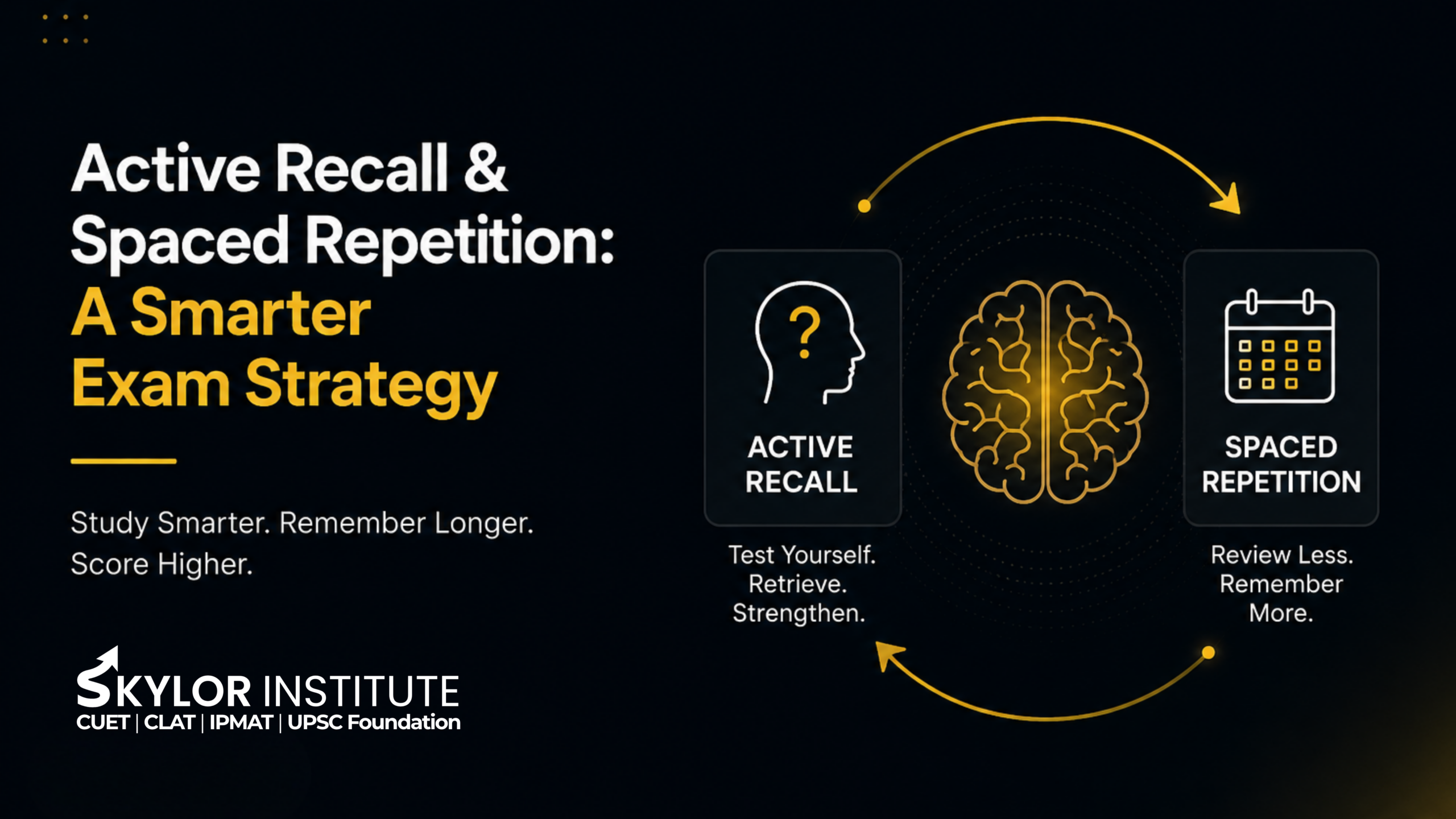
Active Recall & Spaced Repetition: A Smarter Exam Strategy
Why Long-Term Retention Is Harder Than Learning Learning something once and remembering it six months later are two completely different challenges. This distinction matters enorm...
Why Long-Term Retention Is Harder Than Learning
Learning something once and remembering it six months later are two completely different challenges. This distinction matters enormously for competitive-exam aspirants because examinations such as SSC CGL, UPSC, Banking, CUET, CLAT, Railways, and state-level government recruitment exams do not simply ask whether you studied a topic; they ask whether you can retrieve the right information quickly, accurately, and under pressure. You may understand a constitutional article today, memorize twenty new vocabulary words tonight, or learn a dozen mathematical formulae during the weekend, but none of that guarantees that the information will still be available when the examination asks for it months later. Human memory is not a storage cupboard where everything you read gets neatly placed on a permanent shelf. It behaves more like a pathway through a forest: the more intelligently and repeatedly you travel a route, the easier it becomes to find again. This is why effective long-term preparation is less about repeatedly consuming information and more about deliberately strengthening the ability to retrieve it. Research reviews have consistently identified practice testing/retrieval practice and distributed practice among the most useful learning techniques for long-term retention, while modern reviews continue to examine how spacing and retrieval interact across different learning conditions.
The Problem With Cramming
Cramming feels productive because it produces an immediate sense of familiarity. You read a chapter for three hours, recognize almost everything on the page, and walk away thinking, “I know this.” The problem appears several days later when you try to answer questions without looking at the material. Familiarity and recall are not the same thing. Rereading creates repeated exposure, whereas retrieval practice forces the brain to reconstruct information from memory. That small difference changes the nature of the learning experience. A student who reads the same list of vocabulary twenty times may feel more confident than a student who repeatedly tests themselves on the same list, but the second student is deliberately practicing the exact skill required in an examination: producing the answer without seeing it first. Cramming can certainly help with immediate performance, particularly when an examination is extremely close, but it is a poor foundation for retaining a massive syllabus over many months. Distributed learning, by contrast, deliberately separates study episodes over time rather than concentrating them together, and research has repeatedly found advantages for long-term retention when learning opportunities are distributed.

What Happens to Information After You Learn It
Imagine that you study the capitals of twenty countries on Monday. On Tuesday, you can probably recall most of them. A week later, perhaps only fifteen come immediately to mind. A month later, some may feel strangely familiar while others seem completely unfamiliar. This does not mean your brain has “failed.” Forgetting is a normal feature of human memory, and the important question for an aspirant is not how to eliminate forgetting completely but how to make forgetting work in their favor. Every time you successfully retrieve information after a meaningful delay, you create another opportunity to strengthen that memory. The goal is therefore not to keep information permanently active in your conscious mind. That would be exhausting and impossible. The goal is to allow information to become slightly less accessible, then retrieve it again before it disappears completely, gradually extending the interval between successful retrievals. This creates a much more sustainable approach to long-term preparation because you are not trying to review everything every day. Instead, you are selectively returning to information according to how well you can retrieve it.
Understanding the Forgetting Curve
The classic idea behind the forgetting curve is simple: information tends to become harder to retrieve as time passes, especially after initial learning. The exact mathematical shape of forgetting is more complicated than the simplified curve often shown in study guides, and modern research emphasizes that forgetting depends on the material, learning conditions, individual differences and subsequent experiences. Still, the practical lesson remains powerful. If you learn something once and never revisit it, your ability to retrieve it generally weakens. If you retrieve it successfully after increasing intervals, you can make the memory considerably more durable. Spaced repetition takes advantage of precisely this phenomenon. Instead of reviewing “World War II facts” every evening for a week and then abandoning them, you might review newly learned information after a short interval, then again after several days, then after a few weeks, and later at progressively longer intervals. Research on distributed practice has examined hundreds of experiments and found that the optimal spacing depends partly on how long you want the information to remain accessible. In other words, the longer your target retention period, the more intelligently you need to distribute your learning opportunities.

What Is Active Recall?
Active recall is the deliberate act of trying to retrieve information from memory without looking at the answer first. That definition sounds almost too simple, but it represents a major shift in how students study. Instead of opening a textbook and asking, “Does this look familiar?”, you close the book and ask, “Can I explain this without seeing it?” Instead of rereading the definition of inflation five times, you write down what inflation means and give an example. Instead of staring at a list of vocabulary words, you hide the meanings and attempt to produce them. Instead of looking at a formula sheet, you take a blank page and reconstruct the formulas you need. This makes studying feel harder, and that difficulty is exactly why many students dislike it. Yet desirable difficulty can be useful when it requires you to retrieve information rather than simply recognize it. A comprehensive review of retrieval-practice research explains that practicing retrieval after learning can slow forgetting and improve the ability to retrieve information again later, with benefits observed across different types of material and learners.
Why Retrieval Beats Rereading
Suppose you have a list of ten constitutional amendments to remember. If you reread the list, your brain receives the information repeatedly, but you are not necessarily practicing the process of finding that information independently. During active recall, you create a question such as “Which amendment abolished untouchability?” and force yourself to produce the answer before checking. The effort itself matters. If you get the answer wrong, you have identified a weakness that can be repaired. If you get it right after genuine effort, you have practiced successful retrieval. This is why flashcards, self-quizzing, practice questions, blank-page exercises and closed-book explanations can be much more powerful than passive review. The point is not that rereading has absolutely no value; reading is often necessary when learning something initially. The mistake is treating rereading as the main mechanism for long-term retention. A strong study cycle usually looks more like learn → retrieve → check → correct → retrieve again than read → highlight → reread → highlight again.

What Is Spaced Repetition?
Spaced repetition means reviewing information at intervals rather than repeatedly studying it in one concentrated block. The intervals can be adjusted according to how well you remember something. A newly learned and difficult item may need attention sooner, while a well-established item can be reviewed after a much longer interval. This creates an adaptive memory system instead of a rigid timetable in which every topic receives exactly the same amount of revision. The underlying principle is supported by extensive research into distributed practice. A major quantitative review by Cepeda and colleagues analyzed 839 assessments across 317 experiments and found that spacing learning episodes can improve later retention, with the relationship between spacing and the desired retention interval playing an important role. This has an obvious implication for competitive-exam preparation: if you want to remember information for twelve months, you should not design your revision strategy as though the examination were twelve days away. The revision intervals need to expand over time. Spaced repetition is therefore not simply “revising many times.” It is revising strategically across time.

Why Active Recall and Spaced Repetition Work Better Together
Active recall and spaced repetition solve two different problems. Active recall answers the question, “How should I practice remembering?” Spaced repetition answers, “When should I practice remembering?” Put them together and you have a powerful framework for long-term retention. Imagine learning the word “meticulous” today. You could read its meaning repeatedly for five minutes, but a better approach would be to close the notes and ask yourself, “What does meticulous mean?” Once you answer, check your response. Then revisit the word later rather than keeping it in the same session indefinitely. The next time, retrieve it again. If it becomes easy, increase the interval; if you struggle, shorten the interval. The same principle works for facts, dates, formulas, legal principles, geography, economics, science and current affairs. Research reviews published in psychology and education have specifically examined the combination of spacing and retrieval practice and continue to identify them as highly useful strategies for durable learning. The important point is that these techniques are not magic shortcuts. They work because they make the learner repeatedly perform the mental operation that an exam ultimately demands: retrieve relevant knowledge when the answer is not sitting in front of you.
How Top Rankers Retain General Knowledge for 12+ Months
General Knowledge is particularly difficult because the volume is enormous and the information comes in disconnected pieces. One day you study national parks, another day international organizations, another day awards, another day economics, another day history and another day science. If you maintain separate piles of notes without a systematic revision mechanism, the backlog eventually becomes overwhelming. High-performing aspirants solve this problem by converting information into retrievable units. Instead of keeping an enormous notebook that they repeatedly reread, they turn important facts into questions, associations, comparisons and testable prompts. “Who founded the organization?” becomes a question. “Which state has the highest number of national parks?” becomes a question. “What is the difference between repo rate and reverse repo rate?” becomes a question. This transforms passive notes into an active memory system. The student no longer needs to reread every page every month; they need to retrieve the knowledge that matters and identify what has become weak.
Turning Current Affairs Into Long-Term Memory
Current affairs require an additional layer because information becomes more useful when it is connected to context. Suppose you read about a new government scheme. Memorizing the scheme's name may help with one question, but connecting its purpose, ministry, target beneficiaries, launch year and related policy can create a stronger network of knowledge. When revising, ask yourself several different questions about the same event rather than repeatedly reading the same paragraph. “What was launched?” “Which ministry is responsible?” “Who benefits?” “What problem does it address?” “Which previous scheme is related to it?” This approach also makes current affairs easier to connect with static General Knowledge. A good current-affairs system should therefore have multiple layers: initial learning, short-term retrieval, weekly consolidation, monthly mixed revision and longer-term cumulative testing. The objective is not to remember every headline indefinitely. It is to identify examination-relevant information and gradually move it from fragile recent knowledge into durable long-term knowledge. That distinction prevents current-affairs preparation from becoming a never-ending pile of PDFs.

Using Spaced Repetition for Vocabulary
Vocabulary is one of the easiest areas to transform with spaced repetition because individual words can be converted into compact retrieval cards. But there is a trap: students often memorize a word and its dictionary meaning without learning how the word behaves in a sentence. That produces shallow recognition rather than functional knowledge. A better vocabulary card might ask for the meaning, synonym, antonym, contextual usage and occasionally the correct grammatical form. For example, instead of simply memorizing “abate = decrease,” create a prompt that asks, “What does abate mean in the sentence ‘The storm finally began to abate’?” You can also reverse the direction: given “to become less intense,” retrieve the word. This bidirectional retrieval creates stronger access routes. For competitive exams, vocabulary revision can also be linked to error logs from mock tests. If you repeatedly confuse two words, they should receive more frequent retrieval than words you already know effortlessly. Over time, your vocabulary deck becomes personalized. You are no longer revising English vocabulary in the abstract; you are revising your vocabulary weaknesses.
Using Active Recall for Formulae and Concepts
Formulae present a slightly different challenge because recognition can be misleading. Looking at a formula such as a standard algebraic identity may make it appear obvious, but an exam requires you to recognize when the formula applies and then reproduce or use it correctly. A strong revision method therefore has three levels. First, retrieve the formula without looking. Second, explain what each variable represents and identify the conditions under which the formula works. Third, solve a problem requiring the formula without being explicitly told which formula to use. This final stage is crucial because competitive examinations rarely announce, “Use Formula X here.” They present a situation and expect you to identify the appropriate tool. Spaced repetition should therefore not consist solely of formula flashcards. Combine formula recall with short application questions. If a student memorizes ten formulas but cannot recognize when to use them, the memory system has produced a collection of facts rather than usable knowledge. The best approach makes the formula increasingly automatic while simultaneously strengthening conceptual understanding.
The Ideal Revision Cycle for Competitive Exams
A practical revision cycle should begin soon after the initial learning session and then gradually expand. There is no scientifically universal schedule that guarantees perfect retention for every student, so rigid claims such as “everyone must revise exactly on Days 1, 3, 7, 15 and 30” should be treated as convenient rules of thumb rather than biological laws. Research on spacing shows that the optimal interval depends on the desired retention period, the material and the learner. A sensible exam-preparation framework might begin with a first retrieval within a relatively short period, followed by another retrieval after a few days, then approximately a week, several weeks and eventually one or more months. What matters most is not blindly following the calendar but responding to performance. If you cannot retrieve an item, bring it back sooner. If you retrieve it effortlessly several times, allow the interval to expand. This makes the system adaptive rather than mechanical. Your revision schedule should behave like a thermostat, responding to your performance rather than simply following a clock.

How to Build a 12-Month Memory System
A twelve-month preparation period becomes manageable when you stop thinking of revision as “finishing the syllabus again.” You need a system that continuously moves information between stages of memory strength. New information enters the system, weak information receives more frequent retrieval, stable information receives less frequent retrieval, and exam-specific information is repeatedly tested under mixed conditions. This creates a rolling memory pipeline. At any given time, you may be learning new current affairs, revising vocabulary from three months ago, retrieving formulae from last semester and testing historical facts from eight months earlier. That sounds complicated, but the system can be surprisingly simple if every item has a clear next-review date or review category. The biggest mistake is allowing old material to disappear from your schedule because the current syllabus feels more urgent. Competitive exams reward cumulative knowledge. A student who learns brilliantly for six months but forgets the first four months has effectively created a leaking bucket. The goal is to keep adding knowledge while continuously reinforcing what is already inside.
The Three-Level Revision Framework
A useful framework is to divide your material into New, Weak and Stable categories. New material is reviewed relatively soon because the memory is fragile. Weak material receives priority because unsuccessful retrieval indicates that the information needs reinforcement. Stable material is not ignored; it is simply reviewed less frequently. This prevents the impossible task of giving equal revision time to everything you have ever studied. For example, if you have 1,000 vocabulary cards, perhaps 150 are currently difficult, 300 are moderately stable and 550 are highly familiar. Spending equal time on all 1,000 is inefficient. The difficult 150 deserve more retrieval opportunities. The stable cards can be pushed further apart. You can apply the same logic to General Knowledge and formulae. This is one of the biggest advantages of a data-driven or flashcard-based system: the revision workload can respond to performance rather than treating every fact as equally important.
How to Use Flashcards Without Wasting Time
Flashcards are useful, but only when designed correctly. A terrible flashcard can turn active recall into passive recognition. If the front of a card contains an entire paragraph and the back contains another entire paragraph, you may spend more time decoding the card than retrieving the answer. Good cards are focused, specific and answerable. One card should generally test one meaningful unit of knowledge. Instead of “Explain the entire Indian Constitution,” ask something like “Which article deals with equality before law?” or “What is the basic purpose of judicial review?” For vocabulary, use context when appropriate. For formulae, ask both the formula and an application question. For General Knowledge, create questions that resemble the way information might actually be tested. The card should make your brain work, but it should not create unnecessary cognitive clutter. Another important rule is to answer before flipping the card. If you immediately reveal the answer because it feels familiar, you have converted a retrieval exercise into recognition. That habit can quietly destroy the effectiveness of the entire system.

Common Mistakes That Destroy Retention
One of the biggest mistakes is over-reviewing easy material while neglecting weak material. Students often enjoy going through cards they already know because it produces confidence. Unfortunately, confidence is not the same as improvement. Another mistake is creating enormous numbers of cards without maintaining quality. If you generate 5,000 poorly designed cards, the resulting review burden can become so large that you eventually abandon the system. A third mistake is treating every incorrect answer as a failure rather than as diagnostic information. An incorrect retrieval tells you exactly where the memory system is weak. A fourth mistake is using spaced repetition without understanding the material initially. Spaced repetition cannot magically turn a misunderstood concept into a well-understood one. You must first establish meaning, then practice retrieval, then distribute that retrieval over time. Finally, many students make the mistake of trying to review everything every day. That approach is not discipline; it is poor system design. The entire purpose of spacing is to reduce unnecessary repetition while maintaining long-term accessibility.
How Much Should You Revise Every Day?
There is no universal number of flashcards or minutes that every aspirant should complete daily. Your workload depends on the size of your syllabus, the stage of preparation, the examination date, your current knowledge base and how many new items you introduce. A better approach is to control the review burden rather than chasing an arbitrary number. If your daily revision queue takes three hours and prevents you from learning new concepts or solving mock tests, the system is broken. If it takes only five minutes and you are accumulating hundreds of unreviewed items, it is also broken. The sweet spot is sustainable repetition that fits inside your overall preparation schedule. For many students, a short daily retrieval session is more realistic than a massive weekly revision marathon. The session could involve vocabulary in the morning, current-affairs retrieval later in the day and formula recall during a short evening block. The exact schedule matters less than consistency. Long-term memory is built through repeated successful retrieval across time, not heroic revision sessions performed once every few weeks.

How to Avoid Burnout While Using Spaced Repetition
Spaced repetition is supposed to make learning more sustainable, not turn your life into an endless flashcard factory. Burnout usually appears when students confuse more reviews with better preparation. The purpose of spacing is to reduce unnecessary repetition. If a fact has become highly stable, you should not keep reviewing it every day simply because you are afraid of forgetting it. Allow the interval to grow. Another important strategy is to mix memory work with other forms of preparation. An aspirant should not spend six hours doing flashcards. Reading, concept learning, problem solving, mock tests, analysis and revision all serve different purposes. You also need recovery. Sleep, breaks and realistic scheduling are not enemies of productivity; they are part of maintaining a preparation system for months. Think of your preparation like marathon training rather than a sprint. You do not become stronger by running at maximum intensity every day without recovery. Similarly, memory work becomes sustainable when the system automatically reduces attention to information that has become strong.
A Practical Daily Routine for Aspirants
A realistic daily routine can integrate active recall without taking over the entire study day. Begin with a short retrieval session containing older material before introducing new information. This immediately activates knowledge that might otherwise become dormant. During your main study sessions, learn new concepts and convert important information into questions rather than simply copying notes. Later, test yourself on the material you studied that day without looking at the source. At the end of the day, identify the items you could not retrieve confidently and schedule them for earlier review. Once or twice a week, conduct a cumulative mixed session in which questions come from different subjects and different points in your preparation. This is important because examinations rarely separate information into neat textbook chapters. A question may require you to switch from history to geography to vocabulary to quantitative aptitude within minutes. Your memory system should therefore eventually practice that same switching. A simple routine might include 15–30 minutes of spaced retrieval, regular practice questions, weekly cumulative revision and frequent mock-test analysis. The goal is not to spend more time revising; it is to make each revision episode more productive.
Spaced Repetition for General Knowledge, Vocabulary and Formulae
The same core system can work across all three areas, but the cards should look different. General Knowledge benefits from factual questions, comparisons, timelines and cause-and-effect prompts. Vocabulary benefits from definitions, contextual usage, synonyms, antonyms and sentence-based retrieval. Formulae benefit from formula reconstruction, variable identification and application problems. This distinction matters because memory is strengthened when practice resembles the eventual performance requirement. For example, memorizing that a particular mathematical formula exists is not enough; you should eventually solve problems where you must decide whether that formula applies. Similarly, knowing that a vocabulary word means “careful” is less useful than recognizing how the word behaves in a real sentence. General Knowledge can also benefit from linking facts into clusters rather than memorizing isolated trivia. When information becomes interconnected, one remembered fact can act as a cue for another. The result is a memory network rather than a pile of disconnected flashcards.
How Mock Tests Strengthen Long-Term Recall
Mock tests are often treated only as score-measuring tools, but they can also become powerful retrieval-practice environments. Every question forces you to search memory under constraints, and every mistake gives you information about what needs attention. The most productive mock-test analysis therefore goes beyond calculating a score. Separate mistakes into categories: did not know, knew but forgot, misunderstood, careless error, misread question and time-management issue. Each category requires a different response. If you did not know the fact, learn it. If you knew it but could not retrieve it, add retrieval practice. If you misunderstood it, revisit the concept. If you made a careless error, examine the process that produced it. This turns the mock test into a diagnostic instrument. Over several months, your error log can become one of the most valuable revision resources you own because it contains evidence about your actual weaknesses rather than your perceived weaknesses. A student who repeatedly analyzes mistakes is effectively building a personalized syllabus based on performance.
Digital Tools vs. Traditional Revision
Digital flashcard systems can make spaced repetition easier because software can automatically schedule reviews, track performance and prioritize difficult items. That automation is useful when the number of facts becomes large. However, technology is not the underlying method. You can practice active recall with paper cards, a notebook, question sheets or a simple spreadsheet. A digital tool cannot compensate for badly written questions, poor initial understanding or excessive workload. Likewise, a beautifully designed notebook does not automatically create long-term retention. The strongest system is the one you can maintain consistently. Digital tools become particularly valuable when you are studying for an examination over many months because they can manage hundreds or thousands of individual review items more efficiently than manual scheduling. But the principle remains unchanged: attempt retrieval first, check the answer second, and schedule the next retrieval based on performance.
Building a Personalized Long-Term Revision Strategy
The best memory system is not necessarily the most complicated one. It is the one that fits your syllabus, your schedule and your weaknesses well enough to survive for twelve months. Start by identifying the information categories you need to retain: current affairs, static General Knowledge, vocabulary, formulae, definitions, dates, concepts or legal principles. Convert high-value information into retrieval prompts. Establish an initial review soon after learning, then gradually increase the intervals as performance improves. Keep difficult information in a shorter review cycle and allow stable information to move into longer intervals. Every week, add a mixed retrieval session that combines old and new material. Every few weeks, use mock-test performance to decide what should return to the high-priority queue. Most importantly, do not measure the quality of your preparation by how many pages you have read or how many hours you have sat at your desk. Measure it by what you can retrieve accurately without assistance. That is the currency of examination performance.
Conclusion
The secret to retaining twelve months of General Knowledge, vocabulary, and formulae is not extraordinary memory. It is a better system. Active recall trains you to retrieve information instead of merely recognizing it. At the same time, spaced repetition distributes that retrieval across time so that you do not need to relearn the same material from scratch every few weeks. Together, they turn revision from a cycle of rereading into a process of progressively strengthening memory. The science does not suggest that every learner should follow one magical revision schedule, nor does it promise that forgetting can be eliminated. What it does show is that how and when you practice retrieval matters enormously for durable learning. The top ranker advantage is therefore often less mysterious than it appears. While one student keeps consuming new notes and repeatedly starts over, another keeps a living memory system that continuously identifies weak knowledge, retrieves it, strengthens it, and gradually pushes it further into the future. If your goal is to prepare for a competitive examination over six, nine, or twelve months, stop asking, “How many times have I read this?” Start asking, “Can I retrieve this when the answer is not in front of me?” That question can fundamentally change the way you prepare.
Frequently Asked Questions
1. How many times should I revise a topic using spaced repetition?
There is no universal number that works for every topic or student. A better approach is to begin with relatively close retrieval opportunities and progressively increase the interval when recall becomes reliable. Difficult material should return sooner, while information that you can retrieve easily can be reviewed less frequently. The important principle is adaptive spacing, not blindly following a fixed sequence. If you want to retain something for twelve months, your later reviews need to extend into weeks and months rather than remaining concentrated in the first few days. Your performance should determine the next interval.
2. Is active recall better than reading notes repeatedly?
For long-term retention, active recall is generally a stronger strategy than relying primarily on rereading. Reading is still important when you are learning unfamiliar material, building context, or correcting misunderstandings. The problem arises when rereading becomes the main revision method. After learning a topic, close the notes and attempt to reproduce the key information, answer questions, or explain the concept from memory. Then check what you missed. That process gives you much better information about what you genuinely know.
3. Can spaced repetition be used for current affairs?
Yes, and it is particularly useful when current affairs must remain accessible for months. Convert important events into concise questions involving the event, organization, people, location, date, purpose, and related static knowledge. Review recent information relatively frequently at first, then move stable information into longer intervals. You should also periodically mix current affairs with static General Knowledge because examination questions often require knowledge from both areas. Avoid trying to memorize every news headline; prioritize information relevant to your examination.
4. How can I use active recall for mathematical formulae?
Start by attempting to write the formula without looking at your notes. Then identify each variable and explain what the formula represents. After that, solve a problem without being told which formula to use. This final step is important because an examination typically tests formula selection and application, not just formula recognition. Keep difficult formulas in more frequent rotation and combine formula retrieval with short practice problems. This will make your knowledge more useful than simply memorizing a formula sheet.
5. Can spaced repetition prevent exam-preparation burnout?
It can help significantly when it is used correctly because it prevents you from repeatedly reviewing everything at the same intensity. The key is to let strong material move into longer review intervals while giving additional attention to weak material. Avoid creating enormous flashcard collections that become impossible to maintain. Keep cards focused, prioritize high-value information, and integrate retrieval with mock tests, problem-solving, and normal study. A sustainable memory system should reduce unnecessary workload, not create another full-time job.
Need Personalized Diagnostic Guidance?
Speak directly with Skylor's academic directors in Bathinda. Discuss batch schedules, test analytics, and personalized preparation strategies.