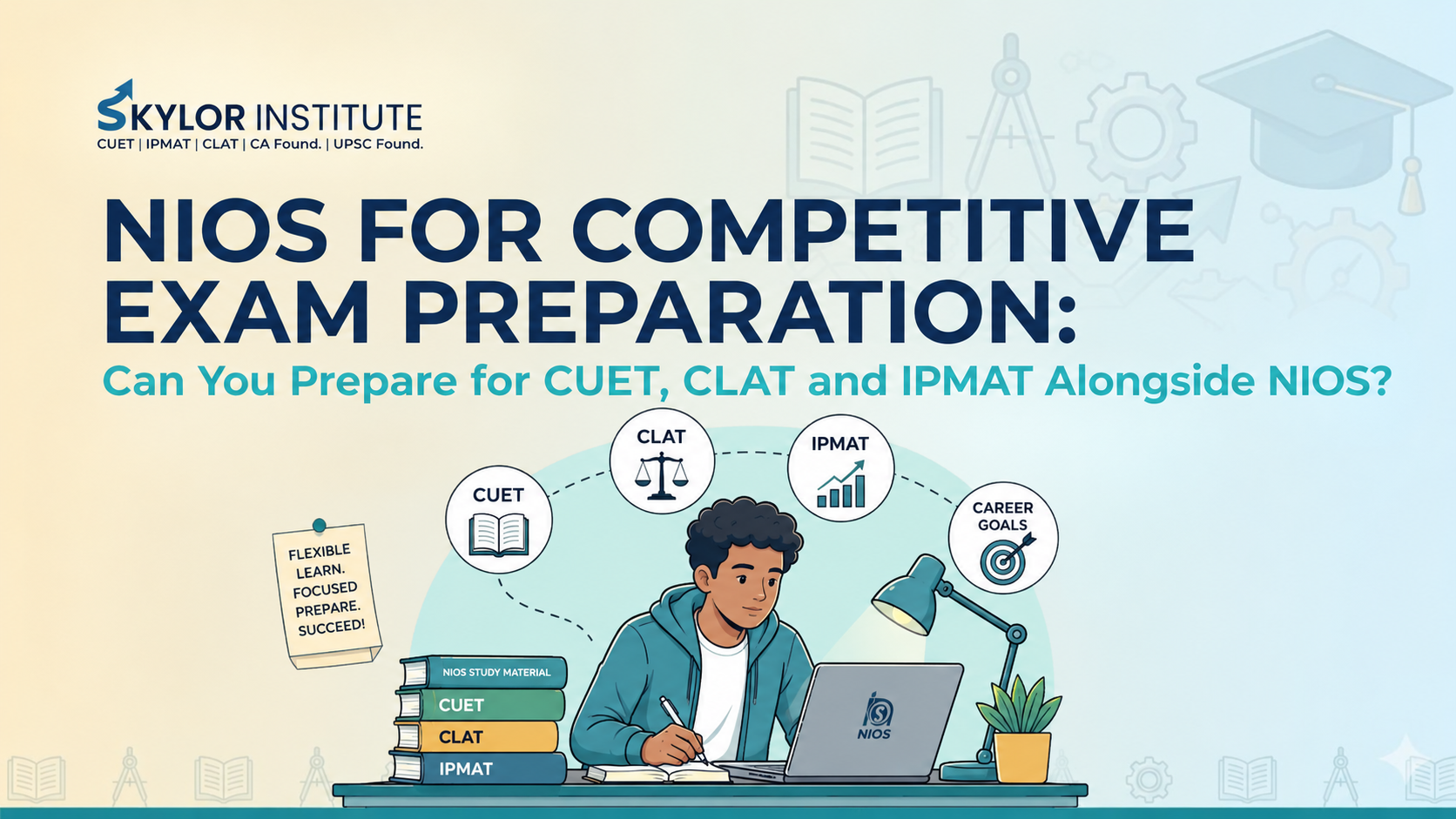
NIOS for Competitive Exam Preparation: Can You Prepare for CUET, CLAT and IPMAT Alongside NIOS?
Why More Students Are Considering NIOS for Competitive Exams For a student preparing for a highly competitive entrance examination, the school timetable can sometimes feel like a ...
Why More Students Are Considering NIOS for Competitive Exams
For a student preparing for a highly competitive entrance examination, the school timetable can sometimes feel like a second full-time job. Regular classes, attendance requirements, internal assessments, homework, practicals, projects, examinations and commuting can consume a large portion of the day before the student even opens a preparation book. That is one reason NIOS for competitive exam preparation has become an option worth considering for students who want greater control over their time. The National Institute of Open Schooling provides Secondary and Senior Secondary education through an open-schooling structure, and NIOS itself states that its certificates are recognised and at par with certificates issued by other national and state boards. Its official guidance also makes an important point: NIOS learners can appear for competitive examinations, provided they satisfy the particular examination's eligibility requirements. The real question, therefore, is not simply whether NIOS is recognised. The better question is whether a student can use its flexibility intelligently without allowing that flexibility to turn into procrastination. For an ambitious Class 11 or Class 12 student targeting CUET, CLAT or IPMAT, the answer can be yes—but only with careful planning, appropriate subject selection and considerably more self-discipline than many students expect.
Flexibility Is the Biggest Advantage of NIOS
The biggest attraction of NIOS is control. A traditional school generally dictates when the student attends classes, completes assignments and participates in academic activities, whereas open schooling gives the learner greater freedom to structure study around individual priorities. NIOS Senior Secondary students can select subjects from the available scheme and can take a maximum of seven subjects, with at least five required for the pass certificate under the standard structure. NIOS also conducts public examinations and provides an On-Demand Examination system in eligible circumstances, adding another layer of flexibility to the learning model. For a competitive-exam aspirant, this flexibility can be valuable because entrance preparation is not evenly distributed across the year. There may be periods when board preparation needs more attention, while other months should be dominated by mock tests, quantitative practice, reading, logical reasoning or current affairs. A student who understands this rhythm can use NIOS almost like a custom-built academic schedule: board education remains important, but the rest of the available time can be deliberately invested in the entrance examination that matters most.
Is NIOS Valid for Competitive Exams?
This is usually the first concern parents raise, and rightly so. Nobody wants a student to spend two years preparing for an entrance examination only to discover during the admission process that the qualifying board certificate or subject combination does not satisfy the institution's rules. NIOS's own FAQ is quite clear that learners with NIOS certification can compete in various competitive examinations, but they must satisfy the eligibility conditions prescribed by those examinations, including requirements relating to age, subjects and minimum marks. NIOS also states that its Senior Secondary certificate is recognised for higher studies, while its official documentation warns that possession of an NIOS certificate by itself does not automatically guarantee eligibility for every university or programme. The institution, university or examination authority ultimately decides its own admission conditions. That distinction is critical. NIOS recognition and competitive-exam eligibility are related, but they are not identical concepts. A student should first identify the exact target programme, check the current official admission notification, identify required subjects and minimum marks, and only then finalise the NIOS subject combination.
What NIOS Says About Competitive Examinations
The official NIOS position removes one common misconception: studying through open schooling does not automatically prevent a student from appearing in competitive examinations. NIOS specifically confirms that its certified learners do appear in competitive examinations, subject to the applicable rules. This means the conversation should move away from the outdated idea that “regular school is always safer” and toward a more useful question: which educational structure gives this particular student the strongest chance of succeeding? For one student, regular school may provide structure, peer competition and teacher supervision. For another, the same structure may leave too little time for serious entrance preparation. NIOS can work particularly well for students who are academically independent, already know which examination they want to target and are capable of following a rigorous self-study schedule. It is much less suitable for a student who needs constant supervision to study. In other words, NIOS does not magically make competitive-exam preparation easier; it can simply remove some of the scheduling constraints that make preparation difficult.

NIOS and CUET UG: Can You Prepare Together?
CUET UG and NIOS can be a workable combination, but students must be careful because CUET admissions ultimately depend on the eligibility rules of the participating university and programme. CUET is not one single admission rule applicable identically to every degree. A student may be eligible for the entrance examination but still need to satisfy the programme-specific requirements of the university they want to join. That is why NIOS students should not select their Senior Secondary subjects casually. NIOS currently offers a broad range of Senior Secondary subjects, including Mathematics, Physics, Chemistry, Biology, History, Geography, Political Science, Economics, Business Studies, Accountancy, Psychology, Computer Science and others. This breadth is useful for students preparing for different CUET pathways, because the appropriate combination depends heavily on the desired undergraduate programme. A student targeting B.Com, for example, may approach subject selection differently from someone targeting Economics, Psychology, Political Science or a science programme. The safest strategy is to start with the target university and degree, work backward to the eligibility requirements, and then choose NIOS subjects that preserve that pathway.
Subject Selection Matters for CUET
This is where a seemingly small decision can have major consequences. Suppose a student decides in Class 11 that they want to pursue Economics through CUET but chooses subjects without checking whether their preferred universities require Mathematics or another specific subject. Two years later, the student may discover that the problem was not NIOS itself—the problem was an unsuitable subject combination. NIOS's own regulations specifically advise learners to consider the requirements of the institution or university they plan to join and choose subjects accordingly. That advice should be treated as a planning principle, not a footnote. A CUET aspirant should maintain a simple target-university sheet containing the university name, programme, qualifying subjects, CUET subjects, minimum marks and any additional conditions. Requirements can change between admission cycles, so students should verify them against the latest official university and CUET documentation before submitting applications. NIOS gives you flexibility; your responsibility is to use that flexibility without accidentally closing doors.
NIOS and CLAT: Is the Combination Practical?
For CLAT preparation, NIOS can actually be a particularly interesting option because CLAT UG does not require students to come from a particular Class 12 stream. Current CLAT eligibility information for the 2027 cycle indicates that candidates need a recognised Class 12 or equivalent qualification, with the stated minimum aggregate requirement of 45% for the general/OBC/PwD-type categories and 40% for SC/ST candidates, subject to the official rules applicable to the candidate. Students appearing for Class 12 can also apply, subject to producing the required qualifying documents at admission. This creates an important advantage for a student who wants to devote substantial time to legal reasoning, logical reasoning, English, quantitative techniques and current affairs rather than spending the majority of the week on a conventional school schedule. Since CLAT does not demand a specific stream, an NIOS student has more freedom to choose a practical academic combination. However, that freedom should not be mistaken for a free pass. CLAT is highly competitive, and students still need consistent reading, timed practice, mock analysis and a serious understanding of current affairs. NIOS can create the time; the student still has to create the performance.
NIOS and IPMAT: What Aspirants Need to Know
IPMAT is where NIOS students need to be especially careful. The reason is that “IPMAT” is not a single uniform admission system across every participating institution. Different IIMs can have different eligibility conditions, age rules, board-mark requirements, subject requirements and selection methodologies. For example, current information for IPMAT 2026 shows substantial differences among institutions: IIM Indore's eligibility structure differs from institutions that impose minimum Class 12 percentage requirements, while some programmes also place greater emphasis on Mathematics or related subjects. Therefore, a student should never make the mistake of asking, “Is NIOS accepted for IPMAT?” as though there is one universal answer covering every IPM programme. The smarter question is: Is my NIOS qualification, subject combination, age and percentage acceptable for the specific IPM programmes I want? Once that question is answered, preparation becomes much easier to structure.
Why IPMAT Requires Extra Attention to Mathematics
For an IPMAT aspirant, mathematics and quantitative aptitude can become a major differentiator. A student who spends most of their time on board-level preparation but rarely solves timed aptitude questions may discover too late that classroom mathematics and entrance-exam mathematics require different habits. Quantitative aptitude demands speed, estimation, pattern recognition, arithmetic fluency and repeated exposure to unfamiliar questions. IPMAT preparation can also involve verbal ability, logical thinking and, depending on the institution, interview or other selection components. NIOS can provide additional preparation time, but the student has to allocate that time deliberately. If the target institutions require or prefer Mathematics/Applied Mathematics in Class 12, the subject should be chosen only after checking the latest admission policies of those institutions. A strategic NIOS student therefore treats subject selection, board marks and entrance preparation as one integrated decision, rather than three unrelated tasks.

NIOS vs Traditional School for Competitive Exam Preparation
The comparison should not be reduced to “NIOS is better” or “regular school is better.” Both models solve different problems. Traditional schooling provides structure, teachers, classmates, scheduled assessments and an environment where students are constantly reminded about academic responsibilities. NIOS provides greater flexibility and allows students to organise their learning around their personal circumstances and goals. The choice therefore depends heavily on the learner's personality and target. A highly disciplined student preparing seriously for CLAT may benefit from the freedom NIOS offers, while a student who routinely postpones homework might struggle badly without the external structure of school. The same is true for CUET and IPMAT. Flexibility is an advantage only when the student knows how to convert freedom into productive hours. Otherwise, the extra hours simply disappear into social media, gaming, random online classes and inconsistent study.
| Factor | NIOS | Traditional School |
|---|---|---|
| Daily schedule | More flexible | More fixed |
| Self-study time | Potentially higher | Usually more restricted |
| External structure | Lower | Higher |
| Competitive-exam integration | Easier to customise | Requires balancing school and coaching |
| Teacher supervision | Depends on support system | Generally stronger |
| Self-discipline requirement | Very high | Moderate to high |
| Subject planning | Flexible within NIOS rules | More predetermined |
| Best suited for | Independent learners | Students who thrive on structure |

The Biggest Advantage: More Control Over Your Schedule
Imagine two students preparing for the same entrance examination. Both have the same intelligence, the same study material and roughly the same academic ability. One student spends several hours every day travelling, attending school and completing school-specific work before starting entrance preparation late in the evening. The other structures the day around focused study blocks, using the flexibility of open schooling to dedicate more time to aptitude practice, reading and mock tests. Over a year, that difference can become enormous. This is where the NIOS competitive exam preparation advantage can become tangible. NIOS itself provides multiple modes of academic support and examination, while its open-schooling structure is designed around flexible learning. The catch is that the student must manage the freedom professionally. The goal should never be to “study less because NIOS is easier.” The goal should be to study more strategically because the timetable is more adaptable.
The Biggest Challenge: Self-Discipline
The biggest threat to an NIOS student's competitive-exam dream is not the board. It is inconsistency. When nobody is forcing a student to wake up at 6:30 a.m., attend a 7:30 class or submit an assignment by Friday, the student has to become their own timetable, teacher and accountability system. That sounds empowering until the first difficult week arrives. Competitive preparation contains long periods where progress feels invisible: hundreds of vocabulary words, dozens of arithmetic sets, repeated logical reasoning questions and mock tests where scores fluctuate. A traditional school environment can provide external pressure during those periods, while an NIOS student must create internal pressure. That is why parents should evaluate maturity before choosing NIOS. If a student is disciplined, NIOS can be an accelerator; if a student is undisciplined, it can become an escape route.
How to Balance NIOS Board Studies and Entrance Preparation
The most effective approach is not to treat board studies and entrance preparation as competing priorities. Instead, students should identify the overlap and build their schedule around it. English, mathematics, economics, political science, history and other academic subjects can strengthen portions of different entrance examinations, although the depth and question style may differ. The student should therefore maintain two connected but distinct preparation tracks: one for NIOS Senior Secondary performance and one for the target entrance examination. NIOS's official material makes clear that learners should consider higher-education requirements when selecting subjects, so the planning process should begin before the academic year gets busy. A sensible annual plan might devote the earlier part of the year to building concepts and completing NIOS coursework, progressively increase entrance-specific practice, and reserve the final months for intensive mocks and revision. The important thing is that neither board preparation nor entrance preparation should be left until the last minute.
Build a Two-Layer Study Plan
Think of your preparation as a two-storey building. The first floor is NIOS academics: textbooks, assignments, practical requirements where applicable, revision and examinations. The second floor is competitive preparation: aptitude, reasoning, reading, current affairs, mocks and exam-specific practice. The foundation has to support both floors, so students should schedule the subjects and tasks that have fixed deadlines first. After that, flexible entrance preparation can be distributed around them. A student targeting CLAT might allocate significant time to reading comprehension, legal reasoning, current affairs and logical reasoning, while an IPMAT aspirant may place greater emphasis on quantitative aptitude and verbal ability. A CUET aspirant should work backward from the chosen university programmes and their subject requirements. The point is not to follow one universal timetable; it is to build a timetable that reflects the actual examination architecture.
Choosing NIOS Subjects for CUET, CLAT and IPMAT
Subject selection should happen before admission rather than after the student becomes emotionally attached to a particular combination. NIOS offers a substantial range of Senior Secondary subjects, including languages, Mathematics, Physics, Chemistry, Biology, Economics, Business Studies, Accountancy, Political Science, History, Geography, Psychology, Computer Science and others. For CLAT, students have relatively broad freedom because the examination does not depend on a particular school stream. For CUET, the situation is more programme-specific, so students should inspect the qualifying requirements of their preferred universities. For IPMAT, students should similarly examine the policies of each target IIM because requirements can differ. The best strategy is therefore simple: choose the career destination first, shortlist institutions second, check eligibility third, and select NIOS subjects fourth. Reversing that order is one of the easiest ways to create unnecessary problems later.

A Practical Weekly Timetable for NIOS Aspirants
A competitive-exam aspirant needs a timetable that protects deep work rather than filling every hour with classes. A practical week could begin with a daily two-to-three-hour block for the NIOS curriculum, followed by two to three hours dedicated to entrance-specific preparation. One additional block can be reserved for reading, current affairs or revision, depending on the examination. Weekends should not simply become “rest days”; they are ideal for mock tests, analysis and backlog clearance. A student preparing for CLAT could use one weekend block for a full mock and another for detailed analysis of incorrect answers. An IPMAT aspirant could use the same structure for a quantitative and verbal mock. A CUET student could combine subject-specific revision with timed question practice. The exact hours will vary by student, but the principle remains constant: daily consistency beats occasional marathon study sessions.
| Time | Monday–Friday Focus | Weekend Focus |
| Morning | NIOS subject/concept study | Revision |
| Late morning | Entrance aptitude/topic practice | Full/sectional mock |
| Afternoon | NIOS assignments and reading | Mock analysis |
| Evening | Entrance preparation | Weak-area practice |
| Night | Current affairs/light revision | Weekly planning |
How Much Time Should You Give to NIOS vs Entrance Exams?
There is no universal 50:50 formula. The correct balance changes throughout the academic year. Early in Class 11, a student might reasonably devote more time to strengthening school-level concepts while gradually introducing entrance preparation. During Class 12, the balance can shift toward entrance-specific practice, particularly when the examination date approaches. However, students should not make the common mistake of treating NIOS board examinations as something they can ignore until the final few weeks. NIOS still requires successful completion of the Senior Secondary course, and the certificate matters for higher education. NIOS currently requires a minimum of five subjects for the Senior Secondary pass certificate under its standard scheme, with options for additional subjects subject to the applicable rules. The smartest approach is therefore dynamic: increase entrance intensity as the exam approaches while keeping NIOS academics consistently under control.
Common Mistakes NIOS Students Make While Preparing for Entrance Exams
The first mistake is assuming that flexibility means fewer responsibilities. It does not. The second is joining multiple coaching programmes because the student suddenly has more time, creating an overloaded schedule that defeats the original purpose of open schooling. The third is ignoring official eligibility notifications until the application deadline. This is particularly dangerous because universities and entrance examinations can have programme-specific subject, percentage and documentation requirements. The fourth mistake is preparing for several competitive exams without identifying a primary target. CUET, CLAT and IPMAT overlap in some areas, but they are not interchangeable. Finally, many students measure preparation by hours rather than outcomes. Sitting at a desk for eight hours does not automatically mean eight hours of productive learning; mock scores, accuracy, reading speed, conceptual mastery and error reduction are far better indicators.

Can NIOS Students Prepare for Multiple Entrance Exams Together?
Yes, but only if the examinations have meaningful overlap and the student has a clear priority. CUET + CLAT can be combined reasonably well for students whose chosen CUET subjects align with their academic interests, while English, reading and general awareness can support both. CUET + IPMAT can also work for commerce or management-oriented students, particularly when mathematics and English are already part of the academic plan. CLAT + IPMAT, however, requires careful scheduling because their preparation styles differ more noticeably: CLAT involves extensive reading, legal reasoning and current affairs, while IPMAT places heavier demands on quantitative aptitude and verbal ability. Attempting all three at maximum intensity from day one can become counterproductive. A better strategy is to identify a primary examination, a secondary option and the specific areas where preparation overlaps.
When NIOS May Be a Better Choice
NIOS can be particularly attractive for students who are already committed to competitive preparation and need significant control over their daily schedule. It may also suit students involved in sports, performing arts, entrepreneurship or other demanding activities where a conventional school schedule creates conflicts. Students who have previously struggled with rigid attendance structures may also appreciate the flexibility of open schooling. The model can be especially powerful when combined with a disciplined coaching programme, a structured home study environment and regular testing. NIOS currently offers online admission and a variety of learning and examination support mechanisms, reinforcing its role as an alternative schooling pathway rather than simply a workaround. The important condition is that the learner must actively manage the opportunity. If the student has a clear goal and a strong work ethic, the flexibility can be turned into additional preparation time.
When Traditional School May Still Be Better
There are students for whom regular schooling is simply the better choice. If a learner needs daily supervision, struggles to follow routines or finds independent study difficult, NIOS may provide too much freedom too early. Traditional schools also offer social interaction, extracurricular opportunities, teacher feedback and a predictable academic environment. For some students, these factors are not distractions; they are part of what keeps them motivated. Parents should also consider whether the student's home environment is suitable for long periods of focused study. A student cannot benefit from having six extra study hours if those six hours are constantly interrupted by household responsibilities, social media or an unsuitable study environment. The best education system is not the one with the most flexibility; it is the one that produces the strongest learning outcomes for that particular student.
How Parents Should Evaluate the NIOS Option
Parents should approach the decision almost like an investment decision. Start with the target: which course, which institutions and which entrance examination? Then check the eligibility conditions directly from the relevant official sources. After that, evaluate the student's self-discipline, academic independence, preferred learning style and ability to work without constant supervision. NIOS itself advises learners to consider the requirements of the institutions they wish to join, because the certificate alone does not override university-specific eligibility rules. Parents should also create a monitoring system: weekly study targets, monthly mock scores, NIOS academic progress and regular review meetings. The objective is not to micromanage the student but to make sure that flexibility does not become academic drift. If the student is consistently meeting targets, NIOS can be a strong option. If deadlines repeatedly slip, the family should reconsider the structure.
Final Decision: Is NIOS Right for Your Competitive Exam Goal?
So, can you prepare for CUET, CLAT and IPMAT alongside NIOS? Yes. There is no inherent contradiction between NIOS Senior Secondary education and competitive-exam preparation. NIOS officially confirms that its learners can appear for competitive examinations as long as they satisfy the relevant eligibility requirements, and its certificates are recognised for higher studies subject to the rules of the destination institution. The bigger issue is strategy. NIOS can give a serious aspirant something extremely valuable: control over time. But control without discipline is useless. If you use the flexibility to build a structured preparation schedule, choose subjects intelligently, monitor your performance and verify eligibility requirements early, NIOS can coexist very effectively with CUET, CLAT or IPMAT preparation. If you are choosing NIOS simply because you want to “avoid school,” however, it is probably the wrong reason to make the switch.
Conclusion
NIOS can be a powerful pathway for competitive-exam aspirants, but it is not a shortcut. Its biggest advantage is flexibility, and that flexibility can be converted into additional hours for entrance preparation, revision, mock tests, reading and skill development. Its biggest weakness is equally clear: students have to supply the discipline that a traditional school timetable normally provides. Official NIOS guidance confirms that learners can pursue competitive examinations, but eligibility remains examination- and institution-specific, which means students must verify current rules before choosing subjects or applying. For CUET, careful programme-specific subject planning is essential; for CLAT, the open-schooling model can pair naturally with the examination's broad stream eligibility; and for IPMAT, students need to examine each participating institution's requirements rather than assuming that every IPM follows identical rules. Ultimately, the decision should be based on the student's goal, discipline, academic needs and target institutions—not on the assumption that one board is universally superior. Used deliberately, NIOS can provide the flexibility needed to prepare seriously for India's competitive undergraduate entrance ecosystem while still earning a recognised Senior Secondary qualification.
FAQs
1. Can NIOS students appear for CUET UG?
Yes, NIOS learners can pursue higher education and competitive examinations, but CUET admission depends on the eligibility conditions of the specific university and programme. Students should check the latest programme requirements and ensure that their NIOS subjects match those requirements. NIOS itself advises learners to consider the eligibility rules of the institution they plan to join.
2. Is NIOS accepted for CLAT?
NIOS is a recognised Senior Secondary board, and NIOS states that its learners can appear for competitive examinations subject to the examination's eligibility requirements. Current CLAT UG eligibility requires a recognised Class 12 or equivalent qualification and specifies minimum aggregate marks, so candidates should verify the latest Consortium notification before applying.
3. Can I prepare for IPMAT while studying through NIOS?
Yes. In fact, the flexibility of NIOS can be useful for students who want more time for quantitative aptitude, verbal ability, mock tests and interview preparation. However, IPMAT-related eligibility varies across institutions, so students should check the admission policy of every IIM/IPM programme they intend to target before selecting NIOS subjects.
4. Which NIOS subjects are best for competitive-exam preparation?
There is no single best combination. The right subjects depend on your target course and entrance examination. A CUET aspirant should begin with the requirements of their preferred university and programme, while CLAT aspirants have greater flexibility because the examination does not require a particular Class 12 stream. IPMAT aspirants should pay particular attention to mathematics requirements wherever applicable.
5. Is NIOS better than regular school for competitive-exam preparation?
Not automatically. NIOS is potentially better for a disciplined student who needs flexibility and substantial self-study time. Traditional school may be better for a student who needs structure, teacher supervision and a fixed routine. The deciding factor should be the student's learning behaviour and target—not the assumption that NIOS is inherently easier or better.
Need Personalized Diagnostic Guidance?
Speak directly with Skylor's academic directors in Bathinda. Discuss batch schedules, test analytics, and personalized preparation strategies.