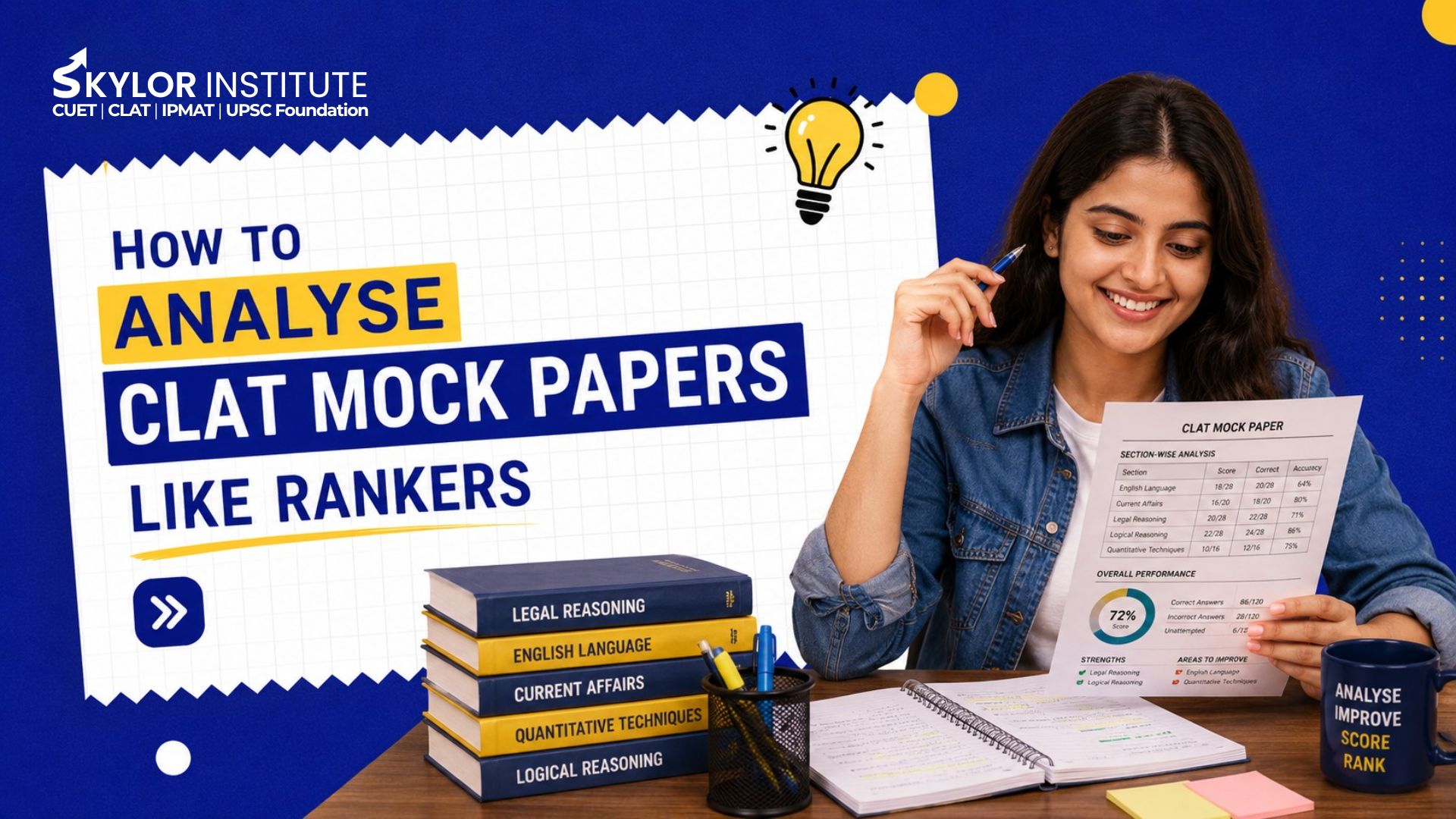
How to Analyse CLAT Mock Papers Like Rankers: A Complete Guide for CLAT Aspirants
Preparing for the Common Law Admission Test (CLAT) is not simply a race to solve the maximum number of mock papers. You can attempt 50 mocks, 100 mocks, or even more, but if you f...
Preparing for the Common Law Admission Test (CLAT) is not simply a race to solve the maximum number of mock papers. You can attempt 50 mocks, 100 mocks, or even more, but if you finish each paper, check the score, look at the rank, and immediately move on to the next one, you may be repeating the same mistakes again and again. That is exactly where many aspirants lose valuable preparation time. A mock test is not merely an examination simulation; it is a diagnostic tool that reveals how you think under pressure, where your concepts break down, which questions consume too much time, and whether your strategy is actually working. The real advantage comes after the mock ends, when you sit down and dissect your performance with the same seriousness that you used while attempting the paper. Toppers do not treat mock tests as score-generating exercises. They treat them as feedback loops. Every mock should answer three questions: What did I do well? What went wrong? What will I change before my next mock? Once you start approaching CLAT mocks this way, a low score stops being a disaster and becomes useful data.
Why Mock Test Analysis Matters More Than Mock Test Scores
Imagine that you are training for a marathon. You run ten kilometres every day, but you never check your pace, breathing, running form or recovery. Are you really training intelligently? The same principle applies to CLAT preparation. Simply taking mock after mock does not automatically make you better. Improvement happens when you understand why you made mistakes and then deliberately work on those weaknesses. The official CLAT framework has historically tested candidates through comprehension-heavy passages and multiple-choice questions across areas such as English Language, Current Affairs including General Knowledge, Legal Reasoning, Logical Reasoning and Quantitative Techniques, making the ability to read, interpret, eliminate and decide under time pressure central to preparation. Your mock analysis should therefore go beyond a final score and examine the complete chain of performance: question selection → reading → reasoning → option elimination → answer selection → time spent.
A strong mock analysis can uncover problems that your raw score hides. Suppose you score 85 in one test and 90 in another. At first glance, it looks like progress. But what if you guessed correctly on six questions in the second mock? What if your accuracy actually declined? What if you spent ten extra minutes on one difficult Legal Reasoning passage and had to rush through Quantitative Techniques at the end? The score alone cannot tell you these things. A topper looks beneath the number. They examine accuracy, question selection, time allocation, section-wise performance, and error patterns. This is why a well-analysed mock can sometimes be more valuable than an additional unanalysed mock. The objective is not simply to become familiar with more questions; it is to become better at making decisions when the clock is running.
The Difference Between Attempting and Analysing a Mock
Attempting a CLAT mock is an activity. Analysing it is a skill. During the mock, your job is to perform like an exam candidate; after the mock, your job is to behave like a researcher studying your own performance. You need to become emotionally detached from the result and look at the paper objectively. Do not ask, "Why am I so bad at Logical Reasoning?" Instead, ask, "What exactly caused my Logical Reasoning errors?" Was the passage too slow to read? Did you misunderstand the author's argument? Did you eliminate the wrong option? Did you choose an answer because it sounded familiar? Or did you run out of time? Each cause requires a different solution. If you treat every incorrect answer as simply a "silly mistake," you will never identify the real problem.
A useful approach is to analyse the paper in two stages. First, conduct a quantitative analysis by recording your score, attempts, correct answers, incorrect answers, accuracy and time spent per section. Then conduct a qualitative analysis by reviewing individual questions and understanding the reasoning behind each outcome. This distinction is important because numbers tell you where the problem exists, while question-level analysis often tells you why it exists. Over several mocks, these two layers of analysis begin to reveal patterns. That is when your preparation becomes strategic rather than repetitive.
What Toppers Actually Do After Every CLAT Mock
Toppers generally do not rush from one mock to another. They create a deliberate gap between tests so they have enough time to analyse their performance and repair weaknesses. The exact frequency will depend on your preparation stage, but the principle is simple: the learning extracted from a mock should be greater than the time spent merely taking it. If you spend two hours attempting a paper and another two hours analysing it, that is not wasted time. You have effectively doubled the learning opportunity from one test. The analysis may reveal a vocabulary gap, a recurring logical fallacy, poor passage selection or inefficient calculations that can be corrected before your next attempt.
The most effective analysis begins by categorising every question according to what actually happened. This prevents the common mistake of looking only at wrong answers. A question answered incorrectly is obviously important, but so is a question answered correctly through blind guessing. Similarly, an unattempted question may indicate either excellent time management or an opportunity that you failed to recognise. Toppers analyse all four categories because each provides a different kind of information about performance.
The Four-Bucket Method for Mock Analysis
Divide every question you attempted or considered into four categories:
| Category | What It Means | What You Should Do |
|---|---|---|
| Correct & Confident | You knew the answer and reached it through sound reasoning | Maintain the approach |
| Correct but Guessed | You got it right without sufficient confidence | Revisit the concept and decision process |
| Incorrect | Your final answer was wrong | Identify the exact cause of error |
| Unattempted | You left the question or could not reach it | Determine whether it was a time, strategy or knowledge issue |
This four-bucket approach immediately makes mock analysis more intelligent. Consider a student who scores 90. They may feel satisfied and stop analysing. But if eight of those correct answers came from guesses, their actual reliable performance may be closer to what their accuracy suggests. On the other hand, a student who scores 75 but has extremely high accuracy and leaves several questions because of poor time management may have a much stronger foundation than the score indicates. The first student needs to improve decision quality and conceptual reliability; the second needs to improve speed and question selection. Both students have different problems, even though their scores may appear to tell the opposite story.
Correct, Incorrect, Unattempted and Guess-Based Questions
Start your analysis with the incorrect questions, but do not stop there. For each incorrect answer, identify whether the problem was conceptual, comprehension-based, analytical, careless or strategic. Then examine correct answers where you were uncertain. These questions are particularly important because a lucky guess can create false confidence. If you guessed the correct answer between two options, you should not celebrate the accuracy and move on; you should understand why you were uncertain and whether you could confidently solve a similar question next time.
Finally, study your unattempted questions. Some should remain unattempted. If a question is exceptionally time-consuming and you correctly recognised that attempting it would damage your overall performance, leaving it may have been a smart decision. But if you skipped a straightforward question because you panicked, misread the passage or spent too long earlier, that is a strategic problem. The purpose of this four-bucket system is to replace emotional reactions with evidence. Instead of saying, "I had a bad mock," you can say, "My accuracy was strong, but I lost marks because I spent too much time on two passages and then rushed the final section." That is a problem you can actually solve.
Step 1 - Analyse Your Overall Mock Performance
Before diving into individual questions, take a broad look at your performance. Record your total score, number of attempts, correct answers, incorrect answers, unattempted questions and accuracy. If your mock follows a negative-marking scheme, also examine how much of your score was lost through incorrect attempts. A student with 90 attempts and 70 correct answers may need a very different strategy from someone with 80 attempts and 72 correct answers. The first student may be attempting too aggressively, while the second may be leaving too many potentially solvable questions.
Do not compare your score with other students too quickly. Different mock providers can vary considerably in difficulty, passage quality and question style, so a score should primarily be interpreted against your own performance history and the difficulty of the specific paper. Track your results over time and look for trends. Is your score rising because your accuracy is improving? Are you attempting more questions without increasing errors? Are you becoming faster in reading-heavy sections? A meaningful improvement is not always a dramatic jump in marks. Sometimes it is a reduction in negative marks, a faster final section or better consistency across multiple papers. Toppers focus on performance trends, not one isolated number.
Step 2 - Analyse Every Wrong Answer
Every wrong answer is a mini case study. Your task is to investigate it. Start by looking at the question without immediately checking the explanation. Try to identify where your reasoning went off track. Did you misunderstand the passage? Did you miss a key word such as "except," "most likely" or "best explains"? Did you choose an option that was factually true but did not answer the question? Did you eliminate the correct option because you relied on an assumption that was not supported by the passage?
Create a simple error classification system. You might use categories such as conceptual gap, comprehension error, reasoning error, calculation error, careless mistake, vocabulary issue, misreading, time pressure and incorrect option elimination. Over five to ten mocks, you will begin to see which categories appear repeatedly. If five of your last seven Logical Reasoning mistakes occurred because you misunderstood the author's conclusion, then solving more random questions may not be the answer. You may need to practise identifying conclusions and premises. If most of your Quantitative Techniques errors are calculation mistakes, you may need timed arithmetic drills rather than more theory.
The most important question after every mistake is: "What will I do differently next time?" If your answer is simply "I will be more careful," your analysis is incomplete. "Be careful" is not an actionable strategy. A better conclusion might be, "I will underline the exact quantity being asked before calculating," or "I will read all answer options before committing when two choices appear plausible." Convert mistakes into behavioural rules. That is how analysis changes future performance.
Step 3 - Analyse Questions You Got Right by Guessing
This is one of the most overlooked parts of CLAT mock analysis. Students usually celebrate every correct answer and move on, but a correct answer achieved through guessing can hide a weakness. Suppose you answered a Current Affairs question correctly because two options looked obviously wrong and you randomly chose between the remaining two. You received the mark, but did you actually know the answer? If the same topic appears in a different form during the actual examination, you may not be equally fortunate.
Mark these questions separately. Revisit the underlying concept or information and ask yourself whether you can now explain why the correct option is correct and why the other options are wrong. This is especially useful in Current Affairs and General Knowledge, where factual uncertainty can easily create false confidence. It also matters in Legal Reasoning and Logical Reasoning, where you may accidentally arrive at the right option through flawed reasoning. The goal is to build reliable knowledge and reliable decision-making, not merely a high mock score.
Step 4 - Analyse Questions You Left Unattempted
An unattempted question is not automatically a mistake. In a competitive examination, question selection is part of the strategy. The real question is whether you made a good decision not to attempt it. During analysis, revisit each unattempted question and classify it. Was it too difficult? Did you lack the required knowledge? Did you understand the question but run out of time? Did you overlook it? Did you avoid it because you were afraid of negative marking?
This analysis can reveal hidden opportunities. Suppose you left ten questions unanswered because you reached the final section with only five minutes remaining. Those questions were not necessarily beyond your ability. Your actual problem may have occurred 30 minutes earlier when you spent too long on a difficult passage. Similarly, if you skipped several questions because you could not understand the passage, the issue may be reading comprehension rather than time management.
Try to identify the recoverable questions - questions that you could reasonably have answered with better strategy. These are your immediate improvement opportunities. You do not need to turn every difficult question into a correct answer. You need to identify the questions you are capable of solving but currently fail to reach, recognise or attempt.
Step 5 - Identify Your Section-Wise Weaknesses
CLAT preparation requires a balanced approach because a candidate can lose valuable marks by allowing one section to become a persistent weakness. After every mock, calculate your performance across individual sections. Look at not only the score but also accuracy, attempts and time spent. A low score in one section does not always mean weak knowledge. It could indicate that you are spending too much time there or using an inefficient solving approach.
For example, if English Language accuracy is high but attempts are low, your reading speed may be the issue. If Logical Reasoning attempts are high but accuracy is poor, you may be rushing through argument-based questions. If Quantitative Techniques takes too long, your problem may involve calculation speed or question selection. If Current Affairs scores fluctuate wildly, your revision system may need improvement. If Legal Reasoning is inconsistent, you may need to examine how well you are applying the principles and facts presented in passages rather than relying on outside legal knowledge.
| Problem Pattern | Possible Cause | Potential Response |
|---|---|---|
| High attempts, low accuracy | Guessing or rushing | Improve elimination and question selection |
| Low attempts, high accuracy | Excessive caution | Build confidence and speed |
| Low attempts, low accuracy | Knowledge or comprehension gap | Strengthen fundamentals |
| Strong early performance, weak final section | Poor time allocation | Redesign section timing |
| Fluctuating Current Affairs scores | Inconsistent revision | Use structured monthly revision |
| Slow Quantitative Techniques | Calculation or method issues | Practise timed arithmetic and shortcuts |
The key is to diagnose rather than label. Saying "I am weak in Legal Reasoning" is vague. Saying "I lose marks because I spend too long reading the passage and then rush the questions" is useful. The second statement gives you a clear direction for improvement.
Step 6 - Find Your Recurring Mistake Patterns
One bad decision is an incident. The same mistake appearing repeatedly is a pattern. Toppers pay close attention to patterns because patterns are easier to fix than isolated mistakes. After every mock, maintain a record of your top three recurring errors. At the end of the month, review them and ask whether the same problems are still appearing.
You might discover that you repeatedly select answers based on extreme language. You might notice that you change correct answers unnecessarily. You may find that you always spend too long on the first difficult passage because you want to "finish what you started." Perhaps you repeatedly make calculation errors when working under pressure. These patterns are valuable because they reveal your personal exam psychology. CLAT is not just a test of what you know. It is also a test of how you behave when you are uncertain.
Once you identify a pattern, create a specific intervention. If you frequently change correct answers without a strong reason, adopt a rule: change an answer only when you identify concrete evidence that your first choice was wrong. If you spend too long on difficult passages, practise setting decision points. If you make calculation errors, build a habit of estimating the answer before calculating. Your goal is to develop a personal operating system for the examination.
Step 7 - Analyse Your Time Management
Time management should never be analysed only by looking at the final five minutes. You need to reconstruct the entire paper. Record when you started and finished each section, or use your mock platform's timing data if available. Then ask yourself where your time actually disappeared. Was it reading passages? Solving calculations? Revisiting questions? Changing answers? Getting stuck on one difficult problem?
A useful technique is to divide questions into three groups: quick wins, moderate questions and time traps. Quick wins should be identified and solved efficiently. Moderate questions deserve reasonable effort. Time traps are questions where the expected benefit of spending additional time becomes too low. Toppers are not necessarily better because they can solve every question. They are often better because they recognise when to stop solving one question and move to another.
Your mock analysis should eventually produce a realistic time strategy. Do not blindly copy the strategy of a topper or coaching faculty member. Your optimal section order depends on your strengths and weaknesses. Test different approaches across multiple mocks. Compare the results. The best strategy is the one that consistently produces your strongest overall performance, not the one that sounds impressive.
Step 8 - Maintain a CLAT Mock Analysis Notebook
A dedicated CLAT mock analysis notebook can become one of the most valuable resources in your preparation. It should not be a collection of explanations copied from answer keys. It should be a record of your personal mistakes and lessons. For every mock, record your score, accuracy, section-wise performance, major errors and the three most important actions you will take before the next test.
You can also maintain an "error log" with columns for the question number, section, your answer, correct answer, error type, reason for mistake and corrective action. Over time, this creates a personalised database of your weaknesses. Before attempting a new mock, spend ten minutes reviewing your previous mistakes. This simple habit can prevent you from repeating the same error pattern.
The notebook should also track improvement experiments. For example, you might decide to change your section order for three mocks. Record the results. You might decide to spend less time on one difficult passage. Record the outcome. This turns your preparation into a controlled experiment. Instead of constantly guessing what strategy might work, you collect evidence from your own performance.
Step 9 - Convert Mock Analysis Into an Improvement Plan
Analysis without action is just documentation. Once you have identified your mistakes, create a short plan for the next seven days. Avoid creating an unrealistic schedule containing ten different weaknesses. Pick the two or three issues that will have the greatest impact on your score.
Suppose your analysis shows that your accuracy is good but your attempts are low. Your plan might focus on timed sectional practice and improving question selection. If your attempts are high but accuracy is weak, you might focus on eliminating blind guesses and strengthening reasoning. If one section consistently consumes too much time, your plan should include targeted timed drills for that section.
The most effective cycle looks like this:
Attempt → Analyse → Identify → Practise → Re-test → Compare.
This is the engine of improvement. A mock is not complete when you see your score. It is complete when you have extracted the lessons, practised the weak areas and tested whether your new approach works. That is how you turn mocks from passive tests into active training tools.
How Many CLAT Mocks Should You Attempt and Analyse?
There is no magic number of mocks that guarantees a top rank. The right number depends on your preparation level, available time and the quality of your analysis. A student preparing months in advance may benefit from a gradual increase in mock frequency, while someone approaching the examination may need more frequent full-length simulations. The important principle is that quality of analysis should not collapse as mock frequency increases.
A useful progression is to begin with enough time between mocks to analyse mistakes thoroughly. As the examination approaches, increase the frequency while maintaining a strict review process. In the final phase, mocks should increasingly simulate real exam conditions, including timing, environment and strategy. After each paper, continue reviewing errors rather than treating the next mock as a fresh start.
If you have to choose between taking five mocks with superficial analysis and taking three mocks with deep analysis, the second approach may produce better learning. The objective is not to collect mock scores. The objective is to build a repeatable performance system.
Common Mock Analysis Mistakes CLAT Aspirants Make
One of the biggest mistakes is checking only the score. A score tells you the outcome, not the cause. Another common mistake is analysing only wrong answers while ignoring guessed correct answers and unattempted questions. Students also frequently read the answer explanation and assume they have learned the concept, without attempting a similar question later to confirm that the learning has actually transferred.
Another problem is excessive emotional attachment to mock rankings. A difficult mock can make a student feel like a failure, while an easy mock can create false confidence. Neither reaction is particularly useful. Your goal is to understand your own performance relative to the demands of the examination. You should also avoid changing your entire strategy after one bad mock. Strategy changes should be based on repeated evidence, not emotional reactions to a single result.
Finally, do not confuse analysis with re-solving every question for hours. Deep analysis is not necessarily endless analysis. Focus on questions that reveal something about your preparation or decision-making. The purpose is to identify actionable lessons, fix weaknesses and improve your next performance.
The Toppers' CLAT Mock Analysis Checklist
Before considering your mock analysis complete, ask yourself:
- Did I calculate my overall accuracy?
- Did I review every incorrect answer?
- Did I investigate correct answers that involved guessing?
- Did I review the questions I left unattempted?
- Did I identify my three biggest mistakes?
- Did I classify the reasons behind my errors?
- Did I check section-wise performance?
- Did I analyse where my time was spent?
- Did I identify recurring patterns across previous mocks?
- Did I decide exactly what I will change before my next test?
If you can answer these questions honestly after every mock, your preparation will become significantly more structured. The most important habit is consistency. You do not need to conduct a perfect analysis every time. You need to develop the discipline to look at your performance objectively and act on what you discover.
Conclusion
The biggest difference between an average mock-test strategy and a topper's strategy is not necessarily the number of papers attempted. It is the quality of learning extracted from every paper. A topper does not simply ask, "What score did I get?" They ask, "Why did I get this score, where did I lose marks, which decisions helped me, which decisions hurt me and what will I change next time?" That mindset transforms a mock from a judgment into a diagnostic tool.
If you want to analyse CLAT mock papers like toppers, start treating every question as evidence. Study your wrong answers, but also study your lucky guesses. Examine your unattempted questions. Track time. Identify recurring mistakes. Maintain an error log. Most importantly, convert every observation into a specific action before your next test. Remember, a mock test does not improve your CLAT preparation by itself; the lessons you extract from it do. Your goal is not to become someone who takes the maximum number of mocks. Your goal is to become someone whose performance improves after every mock.
FAQs
1. Should I analyse a CLAT mock immediately after completing it?
Ideally, you should begin your analysis relatively soon after the mock while your thought process is still fresh. If you remember why you selected an option, why you skipped a question or where you felt confused, that information can be extremely valuable. Start by recording your performance data and then analyse individual questions in a calm state. Avoid analysing while you are emotionally frustrated by a low score because that can lead to inaccurate conclusions.
2. Should I analyse only the questions I got wrong?
No. You should analyse wrong answers, guessed correct answers and strategically important unattempted questions. A wrong answer shows an obvious problem, but a correct answer based on guessing may reveal hidden uncertainty. Similarly, an unattempted question may represent either a smart skip or a missed opportunity. Looking at all three categories gives you a much more accurate picture of your actual preparation.
3. What should I do if my mock scores are not improving?
First, stop taking more mocks blindly and investigate your performance history. Compare your last five to ten tests and look for recurring problems. If your mistakes are similar across multiple papers, you probably need targeted practice rather than more full-length tests. Identify the biggest score-limiting factor - accuracy, time management, comprehension, knowledge gaps, or question selection - and work specifically on that area before testing yourself again.
4. How long should CLAT mock analysis take?
The duration depends on the length and difficulty of the mock, but analysis should be substantial enough to uncover the reasons behind your mistakes. You may spend less time on questions you solved confidently and much more time on questions that exposed weaknesses. The goal is not to spend a fixed number of hours; it is to finish with a clear understanding of what went wrong and what you will do differently next time.
5. Is it better to take more mocks or analyse fewer mocks deeply?
For most aspirants, a balance is best, but deep analysis should never be sacrificed simply to increase the number of tests. A mock that you analyse properly can improve your strategy, accuracy and time management. As the examination approaches, increase the frequency of full-length tests while maintaining the habit of reviewing your performance. Remember: the value of a mock lies not only in taking it but in what you learn from it.
Need Personalized Diagnostic Guidance?
Speak directly with Skylor's academic directors in Bathinda. Discuss batch schedules, test analytics, and personalized preparation strategies.