CLAT 2027 Reforms and Expected Changes: Complete Guide for Law Aspirants
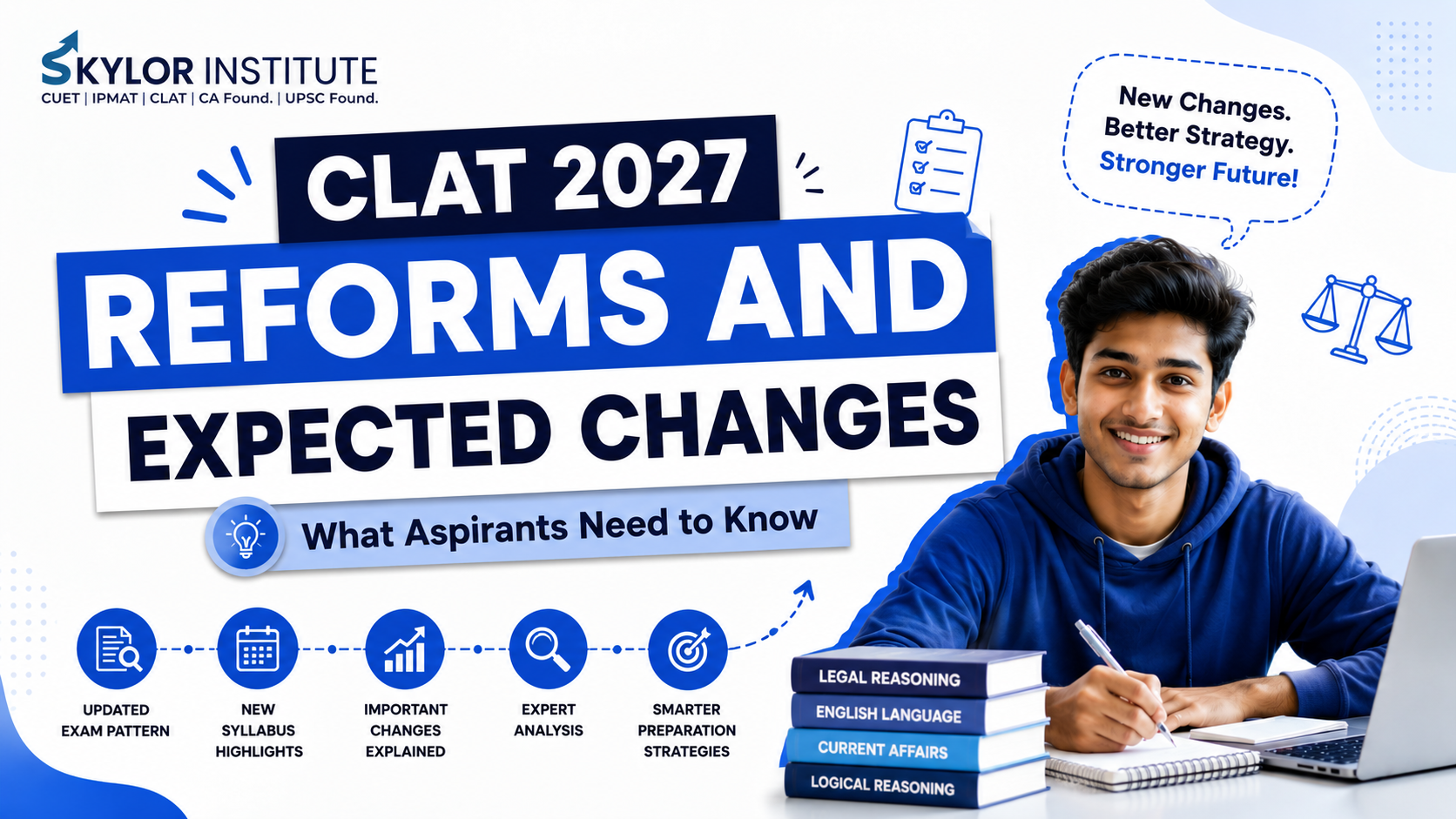
The Common Law Admission Test (CLAT) has undergone significant transformations over the last few years, and CLAT 2027 appears set to continue that trend. Recent reports and announ...
The Common Law Admission Test (CLAT) has undergone significant transformations over the last few years, and CLAT 2027 appears set to continue that trend. Recent reports and announcements indicate that the Consortium of National Law Universities (NLUs) is moving toward a more reasoning-oriented, analytical, and student-friendly examination model. Several sources suggest changes in question distribution, greater emphasis on logical and legal reasoning, and a reduced dependence on rote memorization.
Before diving into the detailed analysis, let's look at the article's structure.
Introduction to CLAT 2027
The landscape of legal education in India is changing rapidly. Law schools are no longer looking for students who can simply memorize facts and reproduce them in examinations. Instead, they want candidates who can think critically, analyze situations, interpret complex texts, and apply reasoning skills effectively. This shift is precisely what appears to be driving the reforms proposed for CLAT 2027.
The Consortium of NLUs has increasingly emphasized comprehension-based testing over fact-based evaluation. Reports regarding CLAT 2027 indicate that the examination may become more focused on analytical thinking and real-world legal aptitude. The intention is clear: identify students who possess the intellectual skills necessary for legal education rather than those who excel only at memorization.
For aspirants preparing for CLAT 2027, understanding these reforms early can provide a substantial competitive advantage. Students who adapt quickly to the new pattern will be better positioned to secure admission to premier National Law Universities.
Why CLAT is Undergoing Reforms
Lessons from Previous CLAT Cycles
Over the years, CLAT has faced criticism regarding question quality, ambiguity, answer key disputes, and overemphasis on speed. Multiple legal challenges and judicial interventions have highlighted the need for a more transparent and academically robust assessment process.
Educational experts have long argued that legal education demands much more than rapid answering ability. Lawyers spend their careers analyzing documents, constructing arguments, interpreting statutes, and identifying logical inconsistencies. An entrance examination should therefore evaluate these skills from the very beginning.
The Consortium appears to have recognized these concerns. The reforms being discussed for CLAT 2027 suggest a deliberate attempt to align the examination with the actual competencies required in law school and legal practice.
Demand for Better Assessment Standards
Students, coaching institutes, law faculty, and industry professionals have increasingly advocated for examinations that reward understanding rather than cramming. The modern legal profession requires adaptability, reasoning, and communication skills.
A reasoning-heavy examination also reduces the advantage enjoyed by students who rely solely on extensive coaching resources. Instead, it creates a more level playing field where genuine analytical ability can shine. This philosophy seems to be at the heart of the CLAT 2027 reforms.
Officially Reported Changes in CLAT 2027
Reduction in Total Questions
One of the most widely reported changes is the reduction of total questions from 120 to 100 while maintaining the two-hour examination duration. This adjustment would provide candidates with significantly more time per question and reduce the pressure associated with rapid answering.
This change signals a strategic shift. Instead of rewarding speed, the examination will likely reward thoughtful analysis and accuracy. Students may encounter longer passages, deeper reasoning problems, and more complex scenarios requiring careful interpretation.
Greater Focus on Critical Thinking
Reports suggest that CLAT 2027 aims to evaluate critical thinking more comprehensively. Questions may increasingly require candidates to analyze arguments, identify assumptions, evaluate evidence, and apply legal principles to unfamiliar situations.
This is a significant departure from older examination styles where factual knowledge often played a larger role. The future CLAT candidate will need to think like a lawyer rather than merely study like a student.
Revised Weightage Across Sections
Several reports indicate that Logical Reasoning and Legal Reasoning may receive increased emphasis, while Current Affairs and General Knowledge could experience a slight reduction in weightage.
If implemented, this shift would further strengthen the examination's analytical character. Students would need to prioritize reasoning skills and legal aptitude throughout their preparation journey.

Expected Changes in Exam Pattern
Legal Reasoning Evolution
Legal Reasoning has always been considered the backbone of CLAT. For 2027, experts expect this section to become even more sophisticated. Instead of testing prior legal knowledge, questions are likely to present hypothetical situations and ask candidates to apply principles logically.
This approach mirrors real-world legal practice. Lawyers rarely deal with textbook examples. They analyze unique situations, interpret rules, and formulate arguments based on available information. CLAT 2027 seems poised to assess these very capabilities.
Students should therefore focus less on memorizing legal facts and more on developing structured analytical thinking.
Logical Reasoning Expansion
Logical Reasoning is expected to become one of the most influential sections in determining ranks. Reports suggest a stronger emphasis on inference-based questions, argument analysis, critical reasoning, and decision-making scenarios.
This transformation reflects global trends in law school admissions testing. Logical reasoning provides a reliable indicator of future academic success because it measures how effectively a candidate processes information and constructs conclusions.
Aspirants who consistently practice editorial analysis, argument evaluation, and logical puzzles will likely benefit from these changes.
Current Affairs Transformation
Current Affairs may undergo a qualitative transformation rather than a quantitative one. Instead of asking candidates to recall isolated facts, questions may increasingly focus on understanding the legal, social, and political implications of major events.
For example, rather than asking for a specific date or organization, a question might require analysis of the constitutional impact of a policy decision. This aligns closely with the analytical objectives of the overall examination.
Section-Wise Impact Analysis
English Language
The English section is expected to remain highly passage-oriented. Reading comprehension, vocabulary in context, inference-making, and critical analysis will continue to dominate the section. Students who develop strong reading habits will enjoy a substantial advantage.
Daily engagement with editorials, legal articles, and opinion pieces can significantly improve performance. Publications such as national newspapers and legal journals provide excellent preparation material because they expose students to sophisticated language and argument structures.
Current Affairs and GK
Current Affairs preparation may become more conceptual than factual. Understanding the broader significance of events will matter more than memorizing dates and statistics. Students should focus on why events matter and how they influence law, governance, economics, and society.
A balanced preparation strategy that combines newspaper reading, monthly current affairs compilations, and issue-based analysis is likely to prove effective.
Legal Reasoning
Legal Reasoning is expected to become increasingly application-based. Candidates should practice identifying principles, interpreting facts, and applying rules systematically. Success will depend on analytical precision rather than legal knowledge.
Regular exposure to case studies and reasoning exercises can help build these skills effectively.
Logical Reasoning
This section may emerge as the ultimate differentiator. Strong logical reasoning abilities often correlate with overall CLAT performance because they support success across multiple sections.
Students should develop skills in assumption identification, conclusion evaluation, logical sequencing, and argument assessment. Consistent practice is essential because logical reasoning improves gradually over time.
Quantitative Techniques
Quantitative Techniques is unlikely to disappear despite speculation within student communities. However, questions may increasingly emphasize the interpretation of data rather than complex calculations.
Candidates should strengthen their ability to analyze graphs, tables, percentages, ratios, and statistical information quickly and accurately.

Comparison Between CLAT 2026 and CLAT 2027
| Feature | CLAT 2026 | Expected CLAT 2027 |
|---|---|---|
| Total Questions | 120 | 100 |
| Duration | 120 Minutes | 120 Minutes |
| Focus | Comprehension-Based | Deep Analytical Reasoning |
| Legal Reasoning | High Weightage | Potentially Higher Weightage |
| Logical Reasoning | Important | Significantly More Important |
| Current Affairs | Fact + Analysis | Primarily Analysis |
| Time Per Question | Moderate | Higher |
| Speed Requirement | High | Moderate |
| Accuracy Requirement | High | Very High |
Sources indicate that the overall examination philosophy is shifting from speed-driven performance toward thoughtful problem-solving and analytical excellence.
How Aspirants Should Adapt Their Preparation
Reading Strategy
Reading will become even more critical for CLAT 2027 aspirants. Students should develop the habit of reading diverse materials every day. Newspapers, legal blogs, policy reports, editorials, and academic articles all contribute to stronger comprehension abilities.
Reading should not be passive. Candidates should actively identify arguments, assumptions, evidence, and conclusions. This approach simultaneously improves English, Logical Reasoning, and Legal Reasoning performance.
Mock Test Strategy
Mock tests remain one of the most powerful preparation tools. However, students should move beyond merely calculating scores. Every mock test should be followed by a detailed analysis of mistakes, reasoning patterns, and time allocation.
The expected reduction in questions means accuracy will likely play a greater role than ever before. Students should therefore prioritize understanding why answers are correct or incorrect rather than simply completing more questions.
Time Management
Although fewer questions may reduce pressure, effective time management will remain essential. Longer analytical passages can consume substantial time if approached inefficiently.
Candidates should practice strategic passage selection, controlled pacing, and intelligent question prioritization. These skills often separate top rankers from average performers.
The Definitive 5-Month Strategy for CLAT 2027: Moving from Foundation to Master
Challenges Students May Face
Every reform creates new opportunities but also introduces challenges. Students accustomed to memorization-based preparation may initially struggle with analytical questions. Critical thinking skills require consistent development and cannot be acquired overnight.
The uncertainty surrounding final exam details may also create anxiety among aspirants. Discussions across student communities reveal concerns about unexpected pattern changes and late announcements.
Adaptability will therefore become a key success factor. Students who remain flexible and focus on fundamental reasoning skills will be better prepared regardless of the final pattern.
Opportunities Created by the Reforms
The reforms create significant opportunities for genuinely capable students. Candidates with strong reading habits, analytical thinking, and problem-solving abilities may find the new pattern more favorable.
The increased emphasis on reasoning reduces dependence on rote learning and expensive coaching material. Students from diverse educational backgrounds can compete effectively if they develop core analytical skills.
These reforms may also improve the quality of legal education by ensuring that incoming students possess the intellectual foundations necessary for success in law school.
Expert Opinions on CLAT 2027
Many legal education experts support the movement toward reasoning-focused assessment. They argue that legal education should begin by identifying students capable of interpreting complex information and constructing persuasive arguments.
Educational analysts have repeatedly emphasized that modern legal careers require adaptability, communication, and analytical precision. The reported CLAT 2027 reforms appear closely aligned with these objectives.
The overall direction suggests that the Consortium aims to create a more academically rigorous and professionally relevant entrance examination.
Future of Law Entrance Exams in India
CLAT 2027 may represent more than a simple pattern adjustment. It could signal the beginning of a broader transformation in Indian legal education admissions. Internationally, leading law schools increasingly emphasize analytical thinking and problem-solving rather than factual recall.
If the reported reforms prove successful, future law entrance examinations may continue moving toward competency-based assessment models. Such a shift would align Indian legal education with global standards while improving the quality of incoming law students.
The future lawyer will need to navigate complex legal environments, emerging technologies, evolving regulations, and interdisciplinary challenges. Entrance examinations must evolve accordingly.
Conclusion
CLAT 2027 appears poised to become one of the most significant turning points in the history of law entrance examinations in India. Reported reforms suggest a clear movement toward critical thinking, logical analysis, legal aptitude, and comprehension-based assessment. The reduction in question count, greater emphasis on reasoning, and potential restructuring of section weightage all point toward a more intellectually demanding examination.
For aspirants, the message is straightforward: focus on reading, reasoning, analytical thinking, and accuracy. Students who adapt early to these evolving expectations will place themselves in the strongest possible position for success. While uncertainty remains until official notifications are finalized, building core reasoning skills today is the safest and most effective preparation strategy for CLAT 2027.
FAQs
1. Has the CLAT 2027 exam pattern officially changed?
Several reports indicate major changes, including a reduction from 120 to 100 questions, but candidates should continue monitoring official Consortium announcements for final confirmation.
2. Will CLAT 2027 be more difficult than previous years?
The exam may not necessarily be harder, but it is expected to be more analytical and reasoning-focused.
3. Which section is likely to gain the most importance?
Logical Reasoning and Legal Reasoning are expected to receive greater emphasis under the proposed reforms.
4. Should students still focus on Current Affairs?
Yes. However, preparation should emphasize understanding the significance and implications of events rather than memorizing facts alone.
5. What is the best preparation strategy for CLAT 2027?
Develop strong reading habits, practice reasoning questions daily, analyze mock tests thoroughly, and focus on comprehension-based learning rather than rote memorization.
Need Personalized Diagnostic Guidance?
Speak directly with Skylor's academic directors in Bathinda. Discuss batch schedules, test analytics, and personalized preparation strategies.