CLAT 2027 Logical Reasoning Preparation Guide
Master CLAT 2027 Logical Reasoning: five question types, worked examples, a five-step passage method and a 4-week plan to score 18+ in the final month.
CLAT 2027 Logical Reasoning Preparation Guide
CLAT 2027 logical reasoning preparation is the part of your study plan that most students leave until last, and it is the part that punishes that delay the most. The Logical Reasoning section carries 22 to 26 questions out of 120 in the CLAT UG paper, about 20 percent of the total marks, and almost every question tests a skill that cannot be memorised: reading an argument carefully, finding the gap in it, and choosing the one answer that must follow. With the CLAT 2027 examination scheduled for 6 December 2026, from 2 pm to 4 pm, there are 29 days left from today, 7 November 2026. That is enough time to lift this section from a weakness to a strength, provided you practise the right question types in the right way.
This guide explains exactly what the section tests, how its marks are distributed, the five critical-reasoning question types that decide most of your score, the analytical-reasoning puzzles that appear without warning, a five-step method for every passage, and a four-week plan that fits the time left before the exam. It is written for students who have already covered the other sections and want a clear, practical plan for this one.
Key Takeaways
- Logical Reasoning carries 22 to 26 questions, about 20 percent of the 120-mark CLAT UG paper, in four to five passages of around 450 words each.
- Most questions are critical reasoning: assumption, strengthen, weaken, inference and main idea. Analytical puzzles such as seating arrangements appear occasionally and can surprise unprepared students.
- Each question carries 1 mark and each wrong answer costs 0.25 marks, so blind guessing hurts; eliminating two options before guessing is the minimum standard.
- The section rewards method, not memory. A fixed five-step approach to every passage is worth more than reading extra theory.
- A realistic target is 18 or more correct answers in about 22 minutes, built through previous-year questions, timed drills and an error log.
What Logical Reasoning Actually Tests
The Consortium of National Law Universities describes the Logical Reasoning section as a test of your ability to recognise an argument, its premises and conclusions, and to analyse the reasoning behind it. You are given short passages of approximately 450 words, each followed by a set of questions. The passages present arguments, situations or sequences of events, and the questions ask you to identify what follows from them, what they assume, and what would make them stronger or weaker.
Unlike Legal Reasoning, this section has nothing to do with law. You do not need any prior knowledge of legal principles. The skill being tested is the same skill a lawyer uses every day: taking a set of statements, spotting what is actually claimed, and refusing to be pushed into a conclusion the evidence does not support. That is why the section is so valuable in the paper. It is also why it cannot be prepared by reading notes alone. You improve only by working through arguments and getting the reasoning wrong, then understanding why.
The CLAT 2027 syllabus and pattern are unchanged from CLAT 2026, as the Consortium confirmed in July 2026. The examination is offline, pen and paper, with 120 multiple-choice questions to be answered in two hours. Here is how the marks are distributed across the five sections, as of November 2026.
| Section | Questions | Approximate Weightage | Passage Format |
|---|---|---|---|
| English Language | 22 to 26 | About 20% | Passages of about 450 words |
| Current Affairs including General Knowledge | 28 to 32 | About 25% | Passages of about 450 words |
| Legal Reasoning | 28 to 32 | About 25% | Passages of about 450 words |
| Logical Reasoning | 22 to 26 | About 20% | Passages of about 450 words |
| Quantitative Techniques | 10 to 14 | About 10% | Short data sets |
| Total | 120 | 100% | 120 marks, 2 hours |
The Consortium gives question-count ranges, not fixed numbers, so the exact split varies slightly from year to year. What does not vary is the marking: 1 mark for each correct answer, a penalty of 0.25 marks for each wrong answer, and no penalty for a question left blank. With 22 to 26 questions at stake, this section alone is worth more than the entire Quantitative Techniques section, and it is decided almost entirely by how carefully you read.
The Two Halves of the Section
Logical Reasoning in CLAT has two distinct halves, and students who prepare for only one of them lose marks in the other. The first half is critical reasoning: passage-based arguments where you evaluate claims. The second half is analytical reasoning: puzzles and arrangements where you apply rules to reach a definite answer. Analysis of previous-year papers from 2021 to 2025 shows that critical reasoning dominates, but analytical questions appear often enough that ignoring them is a mistake. The CLAT 2025 paper, for example, included a seating arrangement puzzle, cause-and-effect reasoning and questions based on statistical interpretation.
| Question Type | What It Asks | How Often It Appears |
|---|---|---|
| Strengthen the argument | Which statement most supports the conclusion? | Most frequent, every year since 2020 |
| Weaken the argument | Which statement most damages the conclusion? | Most frequent, every year since 2020 |
| Inference | What must be true from the passage? | Very frequent, every year since 2020 |
| Assumption | What unstated belief does the argument depend on? | Frequent, especially 2021 and 2022 |
| Main idea and conclusion | What is the author really saying? | Regular, in most passages |
| Analytical puzzles | Seating, series, syllogism, blood relation | Occasional, for example seating in 2025 |
The pattern is clear. If you master strengthen, weaken, inference and assumption questions, you cover most of the section. The rest of this guide takes each type in turn, with a worked example you can practise on, and then covers the analytical half.
Critical Reasoning: The Five Question Types That Decide Your Score

Every critical-reasoning argument in CLAT has the same structure: a premise, which is the evidence stated in the passage, plus an assumption, which is the unstated bridge, leading to a conclusion, which is what the author wants you to believe. Most wrong answers fail because they attack the premise instead of the bridge, or because they support the topic in general without touching the specific conclusion. Learn to draw this structure in your head before you look at the options, and the section becomes far easier.
1. Assumption Questions
An assumption is a belief the argument needs in order to work, but which the author never states. The test is simple: if the assumption were false, the conclusion would collapse. A useful check is to negate the option. If negating it destroys the argument, it is the assumption. If the argument survives, it is not.
Consider this argument: "The city council plans to reduce traffic congestion by building a new flyover on the busiest road in the city. Therefore, the average travel time in the city will fall." The stated premise is the flyover. The conclusion is that travel time will fall. The hidden bridge is that drivers will actually use the flyover, and that the flyover will carry enough traffic to ease the road below. If drivers avoid the flyover, or if the flyover simply moves the jam to the next junction, the conclusion fails even though the flyover is built. That is the assumption.
Three rules will save you marks here. First, an assumption is always unstated. If an option repeats something written in the passage, it cannot be the assumption. Second, the assumption must be necessary, not merely helpful. An option that would be nice to have but is not required is a trap. Third, watch for extreme words. An option that says "all drivers" or "always" is usually too strong to be a necessary assumption, while an option that says "some drivers will use the flyover" is often exactly right.
2. Strengthen Questions
A strengthen question asks which new statement makes the conclusion more believable. The strongest answer closes the gap between the premise and the conclusion, usually by ruling out an alternative explanation or by confirming the missing link.
Take this argument: "A study found that students who study in the morning score higher in examinations than students who study at night. Therefore, studying in the morning causes better scores." The gap is obvious. Perhaps morning studiers were already stronger students, or had quieter homes, or slept better. The conclusion assumes the time of study is the cause, but the study only shows a correlation. An option that strengthens the argument would say that the two groups of students were matched for ability, sleep and home conditions before the study began. That rules out the most obvious alternative explanation, and the conclusion becomes much more believable.
The common trap is an option that repeats the premise in different words, or gives a fact about the topic that does not touch the conclusion. "Morning light improves mood" sounds relevant, but it does not connect studying in the morning to examination scores. Always ask: does this option make this conclusion, in this argument, more likely to be true? If it only makes the topic sound good, reject it.
3. Weaken Questions
A weaken question is the mirror image. You are looking for the statement that most damages the conclusion, usually by offering an alternative explanation for the evidence, or by showing that the premise does not lead where the author claims.
Using the same morning-study argument, the strongest weakening option would be that the morning group consisted mostly of students who were already toppers, while the night group consisted mostly of students who worked part-time jobs after school. That single fact explains the score difference without any help from the time of study, and the conclusion collapses. Notice that the weakening option does not need to prove the conclusion false. It only needs to make it less likely.
Students lose marks here by choosing an option that mildly disagrees with the author instead of one that strikes at the reasoning. "Some students prefer night study" weakens nothing, because the argument never claimed that everyone prefers mornings. "Night study also has benefits" is equally weak. The right answer attacks the link between evidence and conclusion, not the conclusion's popularity.
4. Inference Questions
Inference questions ask what must be true, given only what the passage says. The word "must" is doing all the work. An inference is not something that could be true, or is probably true. It is something that cannot be false if the passage is true. That strict standard is what makes these questions hard, and also what makes them fair, because only one option ever meets it.
Consider this passage: "A city library extended its opening hours last year. Membership rose by 20 percent over the same period, but the number of books borrowed fell slightly." Which of these must be true? That some members joined for reasons other than borrowing books? That the library is now less popular? That longer hours caused the rise in membership? Only the first must be true. Membership rose while borrowing fell, so at least some of the new members are not borrowing books. The other options might be true, but they are not forced by the passage. Longer hours might have caused the rise, or a new reading room might have caused it. You cannot tell from the passage, so you cannot infer it.
The discipline is to stay inside the passage. Do not import your own knowledge, your own opinions, or what usually happens in real life. If an option needs a fact the passage never gives you, it is not a valid inference, however sensible it sounds.
5. Main Idea and Conclusion Questions
Main idea questions ask what the author is really saying, and conclusion questions ask what the argument is driving at. The conclusion is the one statement everything else in the passage exists to support. A reliable way to find it is to ask: if I deleted this sentence, would the rest of the passage lose its point? The sentence that passes that test is the conclusion.
Watch for conclusion markers such as "therefore", "so", "hence" and "as a result", but do not trust them blindly. Authors sometimes place the conclusion in the middle of a passage, with evidence before and after it. Also watch for the trap option that states a premise as if it were the conclusion. A premise is evidence offered in support of something else. The conclusion is the claim the evidence is offered for. In the flyover example above, "the council plans to build a flyover" is a premise. "Average travel time will fall" is the conclusion.
Analytical Reasoning: Puzzles, Seating and Series
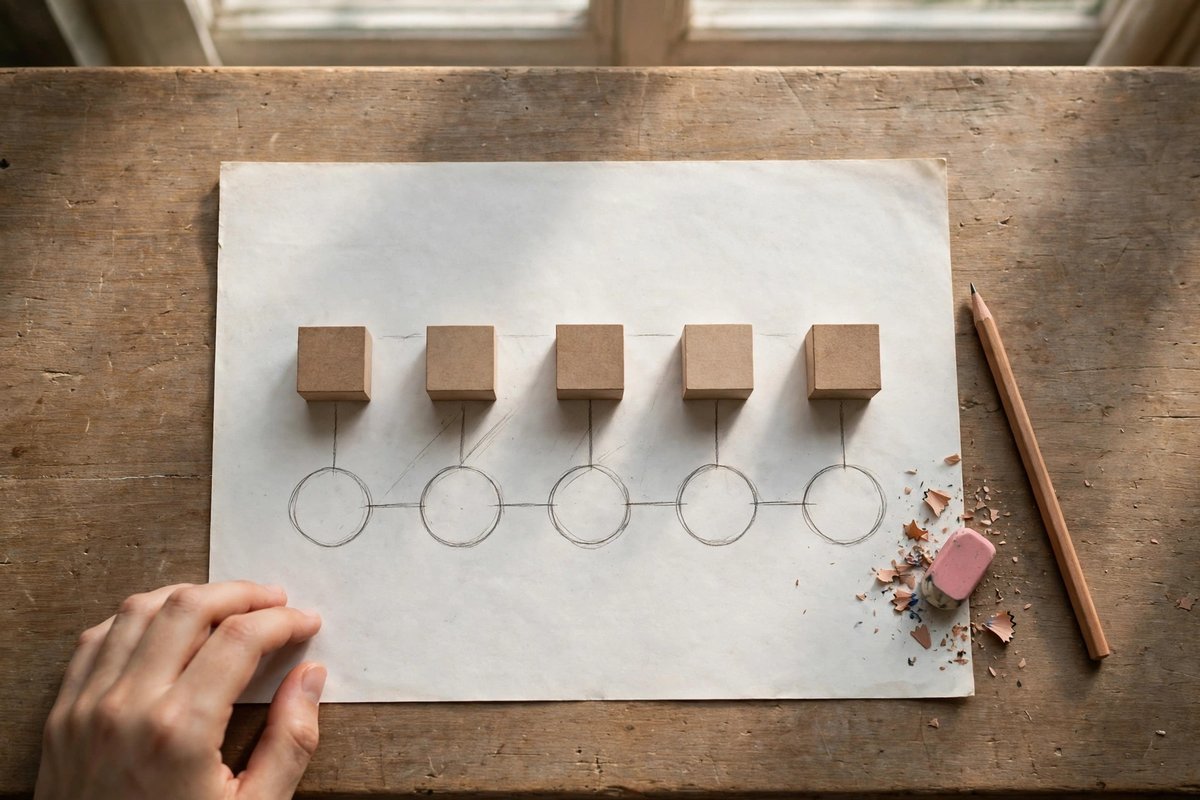
Analytical reasoning questions give you a set of rules and ask you to work out what follows from them. Unlike critical reasoning, there is usually one definite answer, and you can prove it. The CLAT syllabus names analogies, series, logical sequences and matching, seating arrangements, syllogisms and blood relations as the topics in this area. They do not dominate the section, but the CLAT 2025 paper showed they can appear without warning, and a student who has never practised them will lose easy marks.
The method is always the same: write down the rules, draw a diagram, and fill in what is fixed before guessing anything. Never try to hold a seating arrangement in your head. Five seconds with a pencil saves two minutes of confusion.
Work through this example. Five friends, A, B, C, D and E, sit in a row facing north. B sits in the middle. A sits immediately to the left of B. E sits at the right end. D sits immediately to the right of C. Who sits at the left end?
Start with the fixed facts. B is in the middle, so B is in position 3. A sits immediately to the left of B, so A is in position 2. E sits at the right end, so E is in position 5. Two positions remain, 1 and 4, for C and D. D sits immediately to the right of C, so C must be in position 1 and D in position 4. The row is C, A, B, D, E, and the answer is C. Notice that every step used a rule from the question. Nothing was guessed. That is how analytical questions are meant to be solved, and with practice each one takes under ninety seconds.
Syllogisms follow the same discipline. Take the statements: "All lawyers are graduates. Some graduates are writers." Does it follow that some writers are lawyers? No. The graduates who are writers might be an entirely different group from the graduates who are lawyers. The statements never connect writers to lawyers, so no conclusion about writers and lawyers follows. The most common error in syllogisms is assuming that two groups overlap just because both overlap with a third group. Draw the circles, or list the groups, and the error becomes visible.
Blood relation questions are the same idea in family form. Always draw the family tree, use standard symbols, and work from the oldest generation down. The questions are easy once drawn and almost impossible if attempted in your head, which is exactly why they are asked.
The Five-Step Method for Every Passage
Do not read a Logical Reasoning passage the way you read an English passage. Read it the way a judge reads an argument: looking for the claim, the evidence, and the gap. Use these five steps on every passage, in order, until they become automatic.
Step 1: Read the question stem first. Before you read the passage, read the question. Knowing whether you are looking for an assumption, a weakening statement or an inference changes what you notice. It takes five seconds and it focuses the whole reading.
Step 2: Find the conclusion. Ask what the author wants you to believe. Underline it, mentally or with your pencil. If there are two candidate conclusions, pick the one everything else supports.
Step 3: Find the premises. Ask what evidence the author offers. Separate the evidence from background detail, examples and opinions. Most passages contain one or two real premises and several sentences of decoration.
Step 4: Find the gap. Ask what must be true for the premises to lead to the conclusion. This gap is the key to assumption, strengthen and weaken questions, and it is usually a single idea. Name it in your own words before you look at the options.
Step 5: Predict, then match. Before reading the options, predict the kind of answer you are looking for. Then read the options and find the one that matches your prediction. This order matters. Students who read the options first are pulled towards attractive wrong answers. Students who predict first use the options only to confirm.
Common Mistakes That Cost Marks
Most marks lost in this section are lost to the same five errors. Knowing them in advance is worth several questions on exam day.
- Choosing what is true instead of what must be true. In inference questions, an option can be sensible, likely and even true in real life, and still be wrong, because the passage does not force it. Only "must be true" counts.
- Attacking the premise instead of the reasoning. In weaken questions, an option that says the evidence is false is usually wrong. CLAT asks you to accept the premises and attack the link to the conclusion.
- Picking an option that is too strong or too weak. In assumption questions, an option with "all" or "always" is usually too strong. In strengthen questions, an option that only slightly helps is usually too weak. The right answer matches the argument's own strength.
- Bringing in outside knowledge. Your opinions about the topic, and facts you know from elsewhere, are irrelevant. The passage is the only evidence. If an option needs a fact the passage never gives, reject it.
- Spending too long on one question. With 120 questions in 120 minutes, a Logical Reasoning question is worth about one minute. If a question takes more than ninety seconds, mark it, move on, and return only if time remains. One stuck question must never cost you three easy ones.
A Four-Week Plan for the Final Month

There are 29 days between today, 7 November 2026, and the examination on 6 December 2026. Here is a plan that uses them well. It assumes you have already covered the basics of the other sections and can give Logical Reasoning about ninety minutes a day.
| Week | Dates | Focus | Daily Work |
|---|---|---|---|
| Week 1 | 7 to 13 November | Foundations | Learn the five question types. Solve 20 questions a day, untimed, writing down the premise, conclusion and gap for each one. |
| Week 2 | 14 to 20 November | Question-type drills | One question type per day: assumption, strengthen, weaken, inference, then analytical puzzles. Solve 30 questions a day with a timer. |
| Week 3 | 21 to 27 November | Timed sectional tests | One full Logical Reasoning section a day in 25 minutes, plus error-log review. Download your admit card when it is released in the third or fourth week of November. |
| Week 4 | 28 November to 5 December | Full mocks and revision | One full mock every alternate day, with the days between spent only on the error log and the weakest question type. Light revision on 5 December. |
Two notes on this plan. First, the admit card is expected in the third or fourth week of November 2026 on the official portal, consortiumofnlus.ac.in. Check the portal directly rather than trusting forwarded links. Second, the correction window for applications opened on 3 November 2026 and closes at 11:59 pm on 10 November 2026, so if you have already registered, confirm that your details are correct before the window closes./p>
How to Practise: Previous-Year Questions, Mocks and the Error Log
Previous-year questions are the single best preparation material for this section, because they show you exactly how the Consortium frames arguments. Work through the Logical Reasoning sections of the CLAT papers from 2021 to 2025, one paper at a time, and study the pattern. You will notice that strengthen and weaken questions appear every year, that inference questions reward strict reading, and that the passages use everyday topics such as health, education, the environment and technology rather than legal subjects. That is deliberate. The section tests reasoning, not knowledge.
After every timed set, do the analysis before you do anything else. Our guide on how to analyse mock tests explains the full method, but the core of it is the error log: a notebook, or a simple spreadsheet, with four columns, the question type, the reason you got it wrong, the correct reasoning, and the date. Review the log every Sunday. After three weeks you will see your own pattern clearly. Most students discover that one question type, usually assumption or inference, causes half their errors. That discovery is worth more than solving a hundred extra questions at random, because it tells you exactly where to spend the next week.
Time your practice from the second week onwards. Untimed accuracy first, then speed. A good benchmark is 22 to 26 questions in 25 minutes with at least 18 correct. When you can hit that in a sectional test, you are ready for the exam. Do not chase speed before accuracy. A fast wrong answer costs you 0.25 marks and the minute you spent on it.
Exam-Day Strategy for This Section
On 6 December 2026, plan to spend about 22 to 24 minutes on Logical Reasoning, which is roughly one minute per question. Do the section after English and before Legal Reasoning, or in whatever order your mock practice has shown works best for you. The order matters less than the discipline: one pass through the section, marking anything that takes more than ninety seconds, and a second pass over the marked questions only if time remains.
Start each passage by reading the question stem, then the passage, then the options. For analytical puzzles, draw the diagram before reading the questions that follow it, because one diagram usually answers four or five questions. If a puzzle resists you after two minutes, leave the whole set and move on. A puzzle set is five marks, but five scattered critical-reasoning questions are also five marks, and they are usually quicker.
On guessing, be strict with yourself. If you have eliminated two options, an educated guess is reasonable, because your chance of being right is now one in two and the expected value is positive. If you have eliminated nothing, leave the question blank. A blank question costs nothing. A random guess costs 0.25 marks three times out of four. Over 22 to 26 questions, that difference is worth several marks, which is often the difference between two ranks in the final list.
Finally, remember that Logical Reasoning rewards calm reading more than any other section. The passages are about 450 words, the arguments are about everyday subjects, and the correct answer is always the one the passage itself supports. Read the passage once, slowly, instead of twice in a hurry. Students who rush this section usually finish it early and score badly. Students who read carefully usually finish it on time and score well.
Frequently Asked Questions
How many questions are in the CLAT 2027 Logical Reasoning section?
The section carries 22 to 26 questions, about 20 percent of the 120-mark paper. The Consortium of National Law Universities gives ranges rather than fixed numbers, so the exact count varies slightly each year. Each question carries 1 mark, with a penalty of 0.25 marks for a wrong answer.
Is Logical Reasoning the same as Legal Reasoning?
No. Legal Reasoning asks you to apply legal principles to fact situations, and it carries 28 to 32 questions. Logical Reasoning asks you to analyse arguments, identify assumptions, draw inferences and solve puzzles, and it needs no knowledge of law. The two sections test different skills, and they need different preparation. Our guide to CLAT Legal Reasoning principle-fact questions covers the legal side in detail.
Do I need to study formal logic, syllogisms and seating arrangements?
Yes, but in proportion. Critical reasoning, meaning assumption, strengthen, weaken, inference and main idea questions, decides most of your score. Analytical topics such as seating arrangements, series, syllogisms and blood relations appear occasionally, and the CLAT 2025 paper included a seating arrangement puzzle. Give them one day a week, not one week, and always practise them with a diagram.
How much time should I spend on Logical Reasoning in the exam?
About 22 to 24 minutes for 22 to 26 questions, roughly one minute per question. If a question takes more than ninety seconds, mark it and move on. Return to marked questions only after finishing the rest of the section.
Can I improve Logical Reasoning in the one month left before CLAT 2027?
Yes. This is the section where a month of focused practice shows the fastest improvement, because the skill is method rather than memory. Work through the previous-year papers from 2021 to 2025, drill one question type at a time, keep an error log, and take timed sectional tests from the third week. Most students gain five or more marks in this section in four weeks of steady work.
Conclusion
CLAT 2027 logical reasoning preparation comes down to a simple truth: this section does not test what you know, it tests how you think. Twenty-two to 26 questions, about 20 percent of the paper, are decided by whether you can find the conclusion, spot the gap in the argument, and choose the answer the passage actually supports. Learn the five critical-reasoning question types, keep a diagram ready for the analytical puzzles, practise with previous-year questions and an error log, and follow the four-week plan above. With 29 days left before the examination on 6 December 2026, that is enough to turn this section into one of your strongest.
If you want structured practice with detailed solutions, Skylor Institute runs classroom and test-series preparation for CLAT 2027 in Bathinda, including the Pariksha mock series with full-length papers in the latest pattern. You can also read our CLAT 2027 English Language preparation guide to strengthen the other reading-heavy section of the paper. Visit skylor.co.in to know more, or walk into the campus at Gali No. 29, Ajit Road, Model Town, Bathinda, to speak with the academic team. The exam is 29 days away. Start today.
Need Personalized Diagnostic Guidance?
Speak directly with Skylor's academic directors in Bathinda. Discuss batch schedules, test analytics, and personalized preparation strategies.