CLAT 2027 Exam Updates, Syllabus, Exam Pattern & Last 4 Months Preparation Strategy
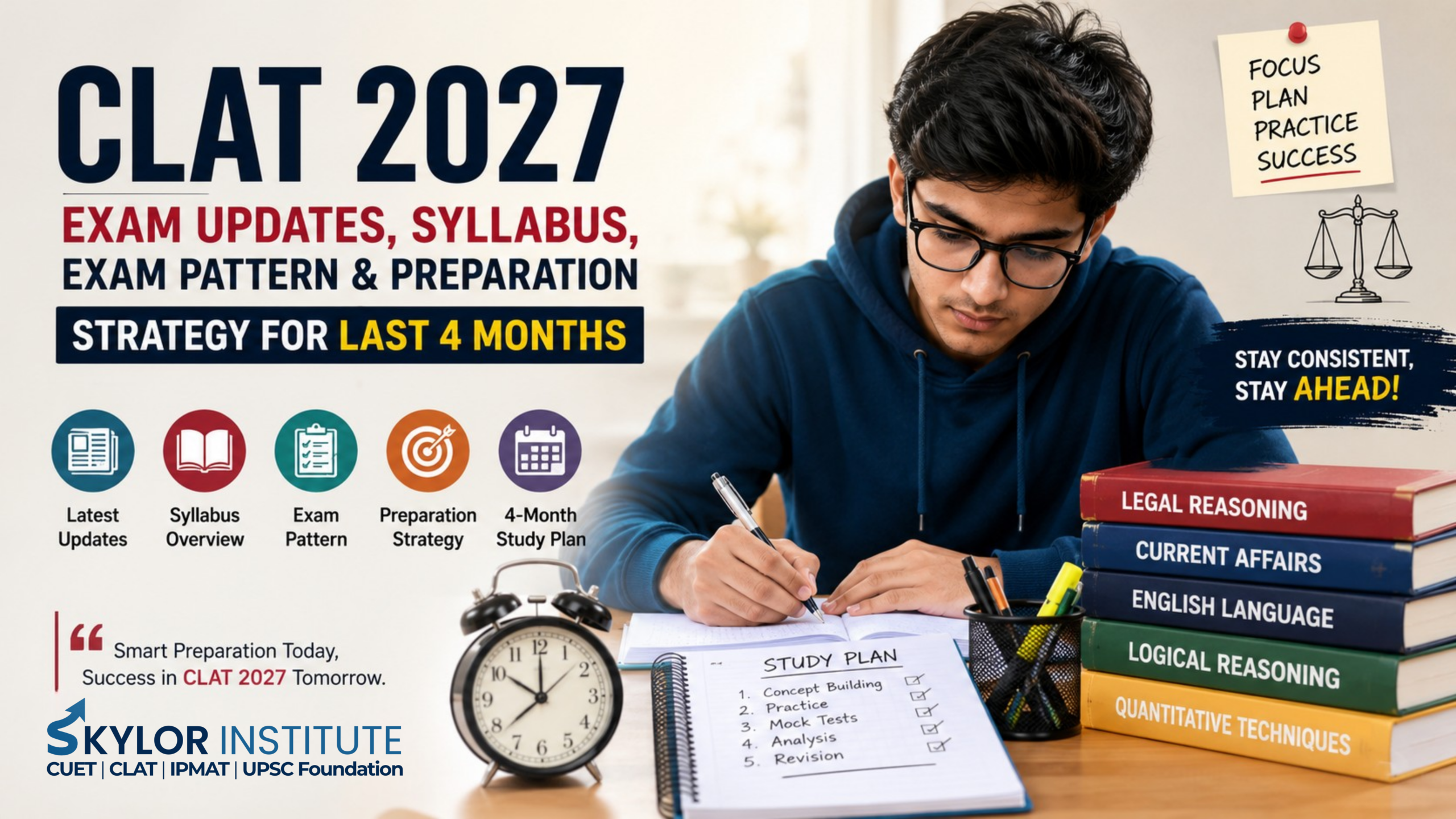
If you are preparing for CLAT 2027, you should not treat the final four months as a period for simply "finishing the syllabus." At this stage, the priority should shift from learn...
If you are preparing for CLAT 2027, you should not treat the final four months as a period for simply "finishing the syllabus." At this stage, the priority should shift from learning everything to maximising accuracy, speed, reading ability, and mock-test performance.
There is also an important development that CLAT 2027 aspirants must watch closely: the Consortium of NLUs constituted an Expert Committee to review CLAT UG and PG, with its terms of reference including question quality, paper structure, syllabus, and comparisons with examinations such as LSAT and LNAT. Therefore, candidates should monitor official Consortium announcements rather than assuming that the CLAT 2026 pattern will automatically remain unchanged for CLAT 2027.
CLAT 2027 Exam Updates: What Aspirants Should Know
The biggest CLAT 2027 update is the ongoing review of the examination framework.
The Consortium of NLUs has formed an independent academic expert committee to examine:
- Quality of questions
- Structure of the CLAT paper
- Syllabus of the entrance examination
- Comparable international law entrance examinations, including LSAT and LNAT
This means that possible changes to CLAT 2027 cannot be ruled out. However, until the Consortium officially publishes the CLAT 2027 notification, syllabus and question-paper format, students should prepare using the latest officially available CLAT UG framework as their working baseline.
My advice: Don't panic about possible pattern changes. The core skills tested by CLAT - - reading comprehension, critical reasoning, legal reasoning, current affairs awareness and basic quantitative aptitude - are unlikely to become irrelevant. A student who develops these skills strongly will be better prepared even if the exact paper structure changes.
CLAT 2027 Expected Exam Pattern
Until the official CLAT 2027 notification is released, the latest available official UG question format provides the most reliable preparation benchmark.
The CLAT UG paper currently consists of:
| Section | Approx. Questions | Approx. Weightage |
|---|---|---|
| English Language | 22–26 | 20% |
| Current Affairs including GK | 28–32 | 25% |
| Legal Reasoning | 28–32 | 25% |
| Logical Reasoning | 22–26 | 20% |
| Quantitative Techniques | 10–14 | 10% |
| Total | 120 | 100% |
The paper is based on 120 MCQs carrying one mark each, with a duration of two hours and a negative marking of 0.25 marks for every incorrect answer. The latest official pattern is therefore a 120-mark, 120-question, two-hour examination.
Important
The above should be treated as the current preparation framework, not an officially confirmed CLAT 2027 pattern. The Consortium's ongoing review means candidates should remain alert for an official CLAT 2027 notification.
CLAT 2027 Syllabus
The CLAT UG examination is designed primarily to test comprehension and reasoning abilities, rather than requiring students to possess advanced prior knowledge of law. The Current Affairs and General Knowledge section, however, requires awareness of important national and international developments.
1. English Language
The English section primarily tests your ability to understand and analyse passages.
Key areas include:
- Reading comprehension
- Main idea and central theme
- Author's viewpoint
- Arguments and counterarguments
- Inference-based questions
- Conclusions
- Summary
- Comparison of viewpoints
- Meaning of words in context
- Meaning of phrases in context
The official syllabus describes passages drawn from contemporary or historically significant fiction and non-fiction. The focus is not simply on vocabulary or grammar - it is on understanding and interpreting written material efficiently.
Preparation focus
Don't spend most of your time memorising hundreds of vocabulary words. Instead:
Read → Understand → Analyse → Answer
Build a habit of reading:
- Editorials
- Long-form articles
- Opinion pieces
- Quality non-fiction
- Contemporary social and political writing
2. Current Affairs Including General Knowledge
This section is one of the most important components of CLAT because it carries approximately 25% of the paper under the current pattern.
The questions are passage-based and may involve:
- National current affairs
- International affairs
- Government policies
- Important appointments
- Awards and honours
- Sports
- Science and technology
- Environment
- Economy
- International organisations
- Important legal and constitutional developments
- Major Supreme Court and High Court developments
- Historical events connected with current affairs
The official syllabus indicates that questions may require awareness of current events and general knowledge, while legal information appearing in a passage may be tested without requiring prior legal knowledge beyond what is provided in the passage.
The correct strategy
Don't try to memorise the entire news cycle.
Instead, maintain:
Daily Current Affairs → Weekly Revision → Monthly Compilation → Repeated Testing
For the final four months, current affairs should become a revision-heavy subject, not a subject you keep postponing.
3. Legal Reasoning
Legal Reasoning is not the same as studying a law degree syllabus.
The section primarily tests your ability to:
- Understand legal principles
- Read legal passages
- Identify relevant facts
- Apply principles to situations
- Analyse legal issues
- Draw logical conclusions
- Understand constitutional and legal developments through passages
A strong CLAT aspirant should therefore focus on legal application, not merely memorising legal terminology.
Important areas to be familiar with
- Constitution and fundamental rights
- Fundamental duties
- Directive Principles
- Parliament and judiciary
- Executive
- Separation of powers
- Constitutional developments
- Important legal principles
- Major judgments
- Contemporary legal issues
- Basic concepts of criminal law
- Contracts and torts at a basic conceptual level
- Important legal and constitutional current affairs
The key question you should ask while practising is:
What principle is given in the passage, and how does it apply to the facts?
4. Logical Reasoning
Logical Reasoning tests your ability to critically analyse arguments and passages.
Important areas include:
- Main conclusion
- Premise and conclusion
- Arguments
- Assumptions
- Inferences
- Strengthening arguments
- Weakening arguments
- Cause and effect
- Contradictions
- Analogies
- Critical reasoning
- Identifying flaws in reasoning
The biggest mistake students make is solving questions mechanically without understanding the argument.
For the final four months, your objective should be to improve argument recognition speed.
5. Quantitative Techniques
Quantitative Techniques carries approximately 10% of the paper, making it the smallest section by weightage under the current pattern.
However, it should not be ignored.
Important areas include:
- Percentages
- Profit and loss
- Ratios and proportions
- Averages
- Simple and compound interest
- Time and work
- Time, speed and distance
- Basic algebra
- Data interpretation
- Tables
- Graphs
- Charts
- Caselet-based calculations
The emphasis should be on speed and accuracy.
You don't need to become a mathematics expert. You need to become efficient at solving CLAT-level numerical problems under time pressure.
CLAT 2027 Preparation Strategy for the Last 4 Months
If you have only four months remaining, your preparation should be divided into four distinct phases.
Month 1: Complete the Core Preparation
Objective:
Finish pending concepts and identify weaknesses.
During the first month, don't attempt to solve unlimited mocks. First, make sure your foundation is strong.
English
- Read one quality article every day.
- Solve 3–4 comprehension passages per week.
- Work on inference and main-idea questions.
- Revise vocabulary from your reading.
- Practise contextual vocabulary.
Current Affairs
Cover the most important current affairs of the previous months.
Create short notes under categories such as:
- National
- International
- Economy
- Science & Technology
- Environment
- Government Schemes
- Legal & Constitutional
- Awards
- Sports
- Important Appointments
Legal Reasoning
Focus on:
- Legal principles
- Constitutional basics
- Important legal developments
- Passage-based legal reasoning
Solve at least 3–4 legal reasoning sets every week.
Logical Reasoning
Focus on:
- Arguments
- Assumptions
- Conclusions
- Inferences
- Strengthen/Weaken questions
Quantitative Techniques
Revise all major arithmetic concepts.
Your goal should be to reach a stage where you can quickly identify:
Which formula or method is required?
Mock Target
Take approximately:
1–2 full-length mocks per week
Don't worry if your initial score is low.
At this stage, your mock analysis is more important than your mock score.
Month 2: Increase Practice and Speed
Now shift from learning to application.
Recommended weekly target
| Activity | Target |
|---|---|
| Full-length mocks | 2–3 |
| Sectional tests | 5–7 |
| English passages | 5–7 |
| Legal reasoning sets | 5–7 |
| Logical reasoning sets | 5–7 |
| Quantitative sets | 4–5 |
| Current affairs revision | Daily |
At this stage, maintain an Error Log.
For every incorrect question, record:
- What was the question testing?
- Why did I get it wrong?
- Was it a conceptual mistake?
- Was it a reading mistake?
- Was it a calculation error?
- Did I mismanage time?
- Did I make a careless guess?
This error log will become one of your most valuable revision resources.
Month 3: Full Mock-Test Phase
This is where your preparation should become highly exam-oriented.
Increase your mock frequency to:
3–4 full-length mocks per week
However, don't make the mistake of taking a mock every day and ignoring analysis.
A good cycle is:
Mock → Analysis → Error Identification → Concept Revision → Targeted Practice
For every mock, analyse:
- Attempted questions
- Correct answers
- Incorrect answers
- Unattempted questions
- Time spent per section
- Accuracy
- Guessing errors
- Easy questions missed
Your goal should be to improve:
Accuracy + Speed + Question Selection
Remember:
A high score is not only about knowing more. It is also about avoiding unnecessary negative marks.
Since the current official pattern has 0.25 negative marking per wrong answer, intelligent question selection is critical.
Month 4: Final Revision and Exam Simulation
The final month is not the time to start five new books.
Your preparation should become highly focused.
Focus on:
- Full-length mocks
- Current affairs revision
- Error-log revision
- Important legal developments
- Important constitutional topics
- Frequently tested logical reasoning patterns
- Quantitative shortcuts
- Reading speed
- Exam strategy
Take 3–5 mocks per week, depending on your stamina and ability to analyse them properly.
At least some mocks should be taken at the same time slot as your expected examination timing, once the official schedule is known.
Practise the complete exam environment:
2 hours → 120 questions → OMR-style marking → No distractions
A 4-Month CLAT 2027 Study Plan
| Month | Primary Objective | Mock Frequency |
|---|---|---|
| Month 1 | Concepts + Syllabus Completion | 1–2/week |
| Month 2 | Practice + Speed | 2–3/week |
| Month 3 | Performance Optimisation | 3–4/week |
| Month 4 | Revision + Exam Simulation | 3–5/week |
Ideal Daily Study Schedule
If you can dedicate approximately 6 hours per day, consider this structure:
| Activity | Time |
|---|---|
| Current Affairs | 60 min |
| English | 45 min |
| Legal Reasoning | 75 min |
| Logical Reasoning | 60 min |
| Quantitative Techniques | 45 min |
| Mock/Sectional Practice | 60 min |
| Revision & Error Log | 15 min |
This should be adjusted according to your strengths and weaknesses.
For example, if your Quantitative Techniques score is consistently high but Legal Reasoning is weak, shift more time towards Legal Reasoning.
Don't divide your time equally just because the timetable looks balanced. Divide your time according to your score gaps.
The Most Important Strategy: Analyse Your Mock, Don't Just Take It
Suppose you score:
- English: 18/24
- Current Affairs: 16/30
- Legal Reasoning: 20/30
- Logical Reasoning: 15/24
- Quantitative Techniques: 8/12
Your problem is not necessarily English or Quant.
Your biggest opportunity is Current Affairs and Logical Reasoning.
The objective should therefore be:
Identify the weakest scoring areas → Diagnose the reason → Practise targeted questions → Re-test
This is much more effective than randomly taking 30 mocks.
What Should You Do If You Are Starting CLAT Preparation Late?
If you have only four months left and haven't completed the syllabus, don't panic - but don't waste time either.
Follow this priority order:
Priority 1
Current Affairs + Legal Reasoning
These two areas together account for approximately half of the paper under the current pattern.
Priority 2
Logical Reasoning + English
These sections reward strong reading and comprehension skills and together represent another significant portion of the paper.
Priority 3
Quantitative Techniques
Cover the high-frequency arithmetic and DI concepts first.
Your objective should be to become exam-ready, not to achieve 100% theoretical mastery of every possible topic.
Common Mistakes to Avoid in the Last 4 Months
1. Waiting for the "perfect" syllabus completion
You don't need to finish every topic before starting mocks.
Start mocks early.
2. Taking mocks without analysing them
A mock without analysis is just a two-hour test.
The learning happens after the test.
3. Ignoring Current Affairs
Current Affairs is too significant to leave for the last few weeks.
4. Over-preparing for Quant
Don't spend disproportionate time on advanced mathematics that is unlikely to improve your CLAT score significantly.
5. Memorising legal information blindly
CLAT is not a law-school semester examination. Focus on reading, reasoning and application.
6. Attempting every question
Because of negative marking, reckless guessing can damage your score.
7. Constantly changing resources
Choose a limited set of reliable resources and revise them repeatedly.
Final 30-Day Rule
During the final month, follow this principle:
Revise more. Test more. Learn fewer new things.
Your final month should roughly look like:
- 30% Current Affairs & Static GK Revision
- 30% Mock Tests & Mock Analysis
- 20% Legal + Logical Reasoning Revision
- 10% English
- 10% Quantitative Techniques
Adjust these percentages based on your personal mock performance.
Final Advice for CLAT 2027 Aspirants
The biggest uncertainty for CLAT 2027 is the possibility of changes to the examination structure or syllabus following the Consortium's expert review. Therefore, students should prepare with the latest official pattern available while keeping an eye on the Consortium's official announcements.
But don't use the possibility of a new pattern as an excuse to delay preparation.
The fundamentals remain clear:
- Read faster
- Understand better.
- Reason logically.
- Apply legal principles.
- Stay updated with current affairs.
- Calculate accurately.
- Take mocks seriously.
- Analyse every mistake.
If you have four months, you still have enough time to make a significant improvement - but only if your preparation is structured, measurable and mock-driven.
The students who perform best in the final stretch are usually not the ones who simply study the longest. They are the ones who identify their weaknesses early, eliminate recurring mistakes, and continuously improve their mock-test performance.
Important: As of July 2026, the official Consortium material available for CLAT 2027 does not yet establish a final CLAT 2027 question-paper pattern in the sources I found. The Consortium's review committee makes it especially important to verify the final notification once released. For the most reliable updates, candidates should monitor the official Consortium of NLUs website.
Need Personalized Diagnostic Guidance?
Speak directly with Skylor's academic directors in Bathinda. Discuss batch schedules, test analytics, and personalized preparation strategies.