The Ultimate Guide to IPMAT: Why It Is a Game-Changer for Commerce Students After Class 12
As a parent, you want the absolute best for your child’s future. As a student in Class 12, you are likely facing the biggest question of your young life: "What should I do next?" ...
As a parent, you want the absolute best for your child’s future. As a student in Class 12, you are likely facing the biggest question of your young life: "What should I do next?"
For generations, the traditional path for a Commerce student was straightforward. You finish school, get a B.Com or BBA degree from a local college, study hard, and then spend months preparing for competitive MBA entrance exams like the CAT (Common Admission Test).
But what if you could skip that middle uncertainty completely? What if your child could secure a seat at India's most prestigious management institutes - the Indian Institutes of Management (IIMs) - right after high school?
This is exactly what IPMAT makes possible. It is not just another entrance exam; it is a golden ticket that is completely changing the landscape of undergraduate education in India.
Let us break down everything you need to know about IPMAT, why it is an exam of its own kind, and why it is the perfect match for Commerce students.
What is the IPMAT Exam?
IPMAT stands for the Integrated Program in Management Aptitude Test. It is a national-level entrance exam conducted individually by premier institutions like IIM Indore and IIM Rohtak.
Passing this exam grants admission into the Five-Year Integrated Program in Management (IPM). Instead of doing a three-year bachelor's degree and a separate two-year master's degree, students complete a single, continuous five-year course that blends undergraduate studies with a world-class MBA.
The Core Structure of the Program
The five-year journey is cleanly divided into two distinct halves:
- The First 3 Years (Foundation Stage): Students learn fundamental disciplines, building a broad intellectual foundation across economics, mathematics, statistics, social sciences, and humanities.
- The Final 2 Years (Management Stage): The student is directly integrated into the flagship, highly competitive Post Graduate Program (PGP) in Management - the standard IIM MBA.
Why IPMAT is an "Exam of Its Own Kind"
To truly appreciate IPMAT, you have to look at how different it is from any other traditional exam pattern in India. It breaks the mold of classic rote-learning evaluation systems.
1. It Completely Bypasses the "CAT Anxiety"
The traditional route to an IIM is notoriously brutal. Every year, hundreds of thousands of graduates fight for a handful of seats through the CAT exam. The competition includes experienced engineers, doctors, and professionals.
IPMAT allows Class 12 students to compete exclusively against their actual peers (other school-leaving students) rather than older, experienced working professionals. Once you clear IPMAT, your path to an IIM MBA is safe and secure. There is no need to take the CAT exam later.
2. Built-In Flexibility: The Dual-Exit Option
Parents often ask: "Committing to five years at age 17 is a big deal. What if my child's interests change?"
The IIMs designed the IPM with built-in academic flexibility. If a student decides they want to pursue a different path, study abroad, or start a venture after three years, they can exit the program safely. At the end of the third year, they are awarded a fully accredited Bachelor of Business Administration (BBA) degree, allowing them to step into the corporate world or switch paths without wasting any time.
3. Comprehensive Selection Beyond Just Marks
IPMAT does not just judge a child based on a single computer test. The selection process is holistic. It includes the Aptitude Test, evaluation of past academic performance (Class 10 and 12 marks), and a Personal Interview (PI). This multi-layered process ensures that communication skills, confidence, and personality are valued just as much as mathematical ability.
Why Commerce Students Have a Distinct Edge
While IPMAT is open to students from all streams - Science, Commerce, and Humanities - Commerce students naturally find themselves right at home within this curriculum. Here is why the synergy works so well:
The Mindset Alignment
Commerce students spend their Class 11 and 12 years studying Accountancy, Business Studies, and Economics. They already think in terms of business logic, market structures, and corporate ecosystems. Transitioning into a professional management atmosphere right after school feels like a natural step forward rather than a jarring change of direction.
The Mathematics Match
A common myth is that IPMAT math is only for high-level Science students. In reality, a large portion of the quantitative section focuses on Arithmetic (percentages, profit and loss, averages, interest, time, and work). Commerce students, particularly those who took Mathematics or Applied Mathematics as an elective, are highly skilled at data interpretation, logical reasoning, and everyday business math.
Immediate Career Acceleration
For a long time, Science students had clear professional tracks right after school (like engineering or medicine), while Commerce students had to wait until after their post-graduation to land high-impact corporate jobs. IPMAT evens the playing field instantly. It gives business-minded students elite, professional status the moment they step out of high school.
Understanding the IPMAT Exam Pattern
To prepare effectively, parents and students must understand what the test looks like. The two primary exams - IIM Indore and IIM Rohtak - have unique structures, but both are computer-based tests lasting two hours.
IPMAT Indore Structure
IIM Indore focuses heavily on deep analytical skills. It is divided into three timed sections (40 minutes each):
| Section Name | Question Type | Number of Questions | Marking Scheme |
| Quantitative Ability | Short Answer (SA) - No Options | 15 Questions | +4 for correct / 0 for wrong |
| Quantitative Ability | Multiple Choice (MCQ) | 30 Questions | +4 for correct / -1 for wrong |
| Verbal Ability | Multiple Choice (MCQ) | 45 Questions | +4 for correct / -1 for wrong |
Note: The Short Answer section requires the student to type the numerical answer directly into the system, and it carries no negative marks.
IPMAT Rohtak Structure
IIM Rohtak tests speed, accuracy, and quick thinking across three balanced sections:
| Section Name | Question Type | Number of Questions | Marking Scheme |
| Quantitative Ability | MCQs | 40 Questions | +4 for correct / -1 for wrong |
| Logical Reasoning | MCQs | 40 Questions | +4 for correct / -1 for wrong |
| Verbal Ability | MCQs | 40 Questions | +4 for correct / -1 for wrong |
Life and Career After IPMAT: The Return on Investment
Let us address the most practical concern for any parent: What is the long-term value of this program?
Choosing an IIM for undergraduate education means placing your child in an environment of absolute excellence. The return on investment (ROI) shows clearly in the personal development of the student and their career placements.
The Power of the IIM Campus
An integrated student spends five years living on a premium residential campus. They learn from the finest management professors in the country. They participate in case-study competitions, lead college festivals, and build a massive network of lifelong peers. The maturity, corporate etiquette, and leadership qualities they develop by age 22 are unmatched.
Equal Footing in Placements
During the final two years, IPM students study the exact same courses, sit in the exact same classrooms, and participate in the exact same placement drives as the postgraduate MBA students who entered through the CAT exam.
The placement statistics highlight the exceptional quality of these programs:
- Top Recruiter Networks: Major global brands like Goldman Sachs, Deloitte, McKinsey, Barclays, and Kotak Mahindra Bank recruit directly from these campuses.
- Premium Compensation: The average domestic salary packages regularly range between INR 18 Lakhs to 29 Lakhs per annum, with highest international and domestic packages scaling much higher.
Actionable Tips to Kickstart Your Preparation
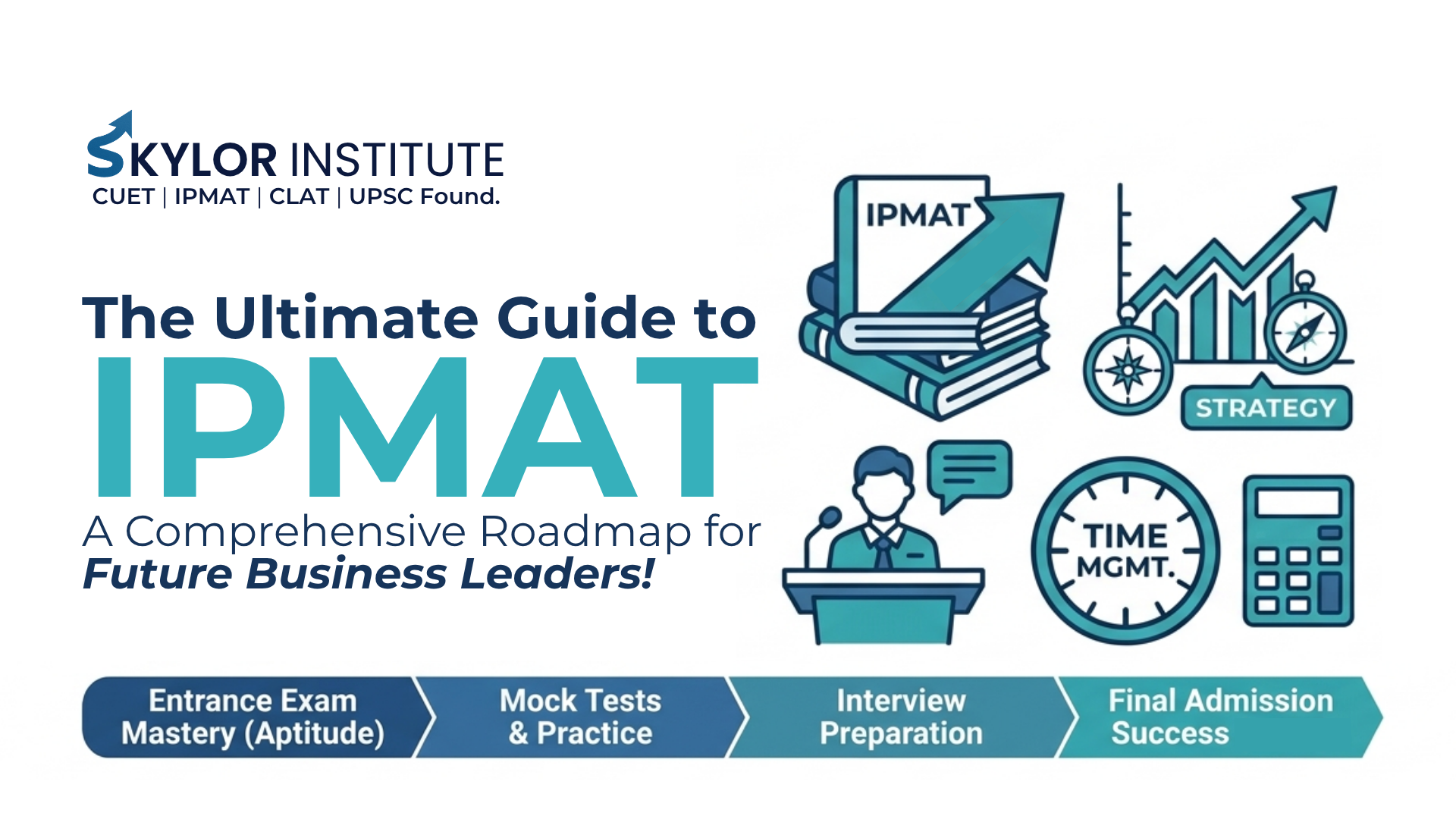
If you are convinced that IPMAT is the right path, here is a practical, step-by-step roadmap to start preparing during Class 11 or 12:
- Build a Strong Reading Habit: The Verbal Ability section requires strong vocabulary and fast reading comprehension skills. Encourage reading quality editorials, newspapers (like The Hindu or The Economic Times), and diverse non-fiction books daily.
- Master Core School Mathematics: Revisit and solidify fundamental Class 9 and 10 mathematics concepts. Focus deeply on speed-math tricks, percentages, ratios, number systems, and basic algebra.
- Practice Time Management: Because the exam features tight sectional time limits, practicing with full-length online mock tests is critical. It trains the brain to solve questions under pressure and helps identify weak spots early.
Final Thoughts for Parents and Students
The days when an elite business career required waiting until your mid-20s are gone. IPMAT has successfully broken that barrier down. It rewards raw aptitude, logical thinking, and communication over textbook memorization.
For parents, it offers peace of mind, knowing your child’s higher education is secured by one of India’s premier institutions. For Commerce students, it provides a direct, clear launchpad to fulfill corporate ambitions early in life.
If your goal is to lead, manage, and excel in the global business world, IPMAT is the absolute best step you can take right after Class 12.
- Optimize the article structure with custom subheadings tailored for a target educational audience.
- Create a detailed printable 12-week study blueprint balancing Class 12 board prep with IPMAT prep.
- Draft an informational flyer design template for parents summarizing key deadlines and eligibility.
Need Personalized Diagnostic Guidance?
Speak directly with Skylor's academic directors in Bathinda. Discuss batch schedules, test analytics, and personalized preparation strategies.