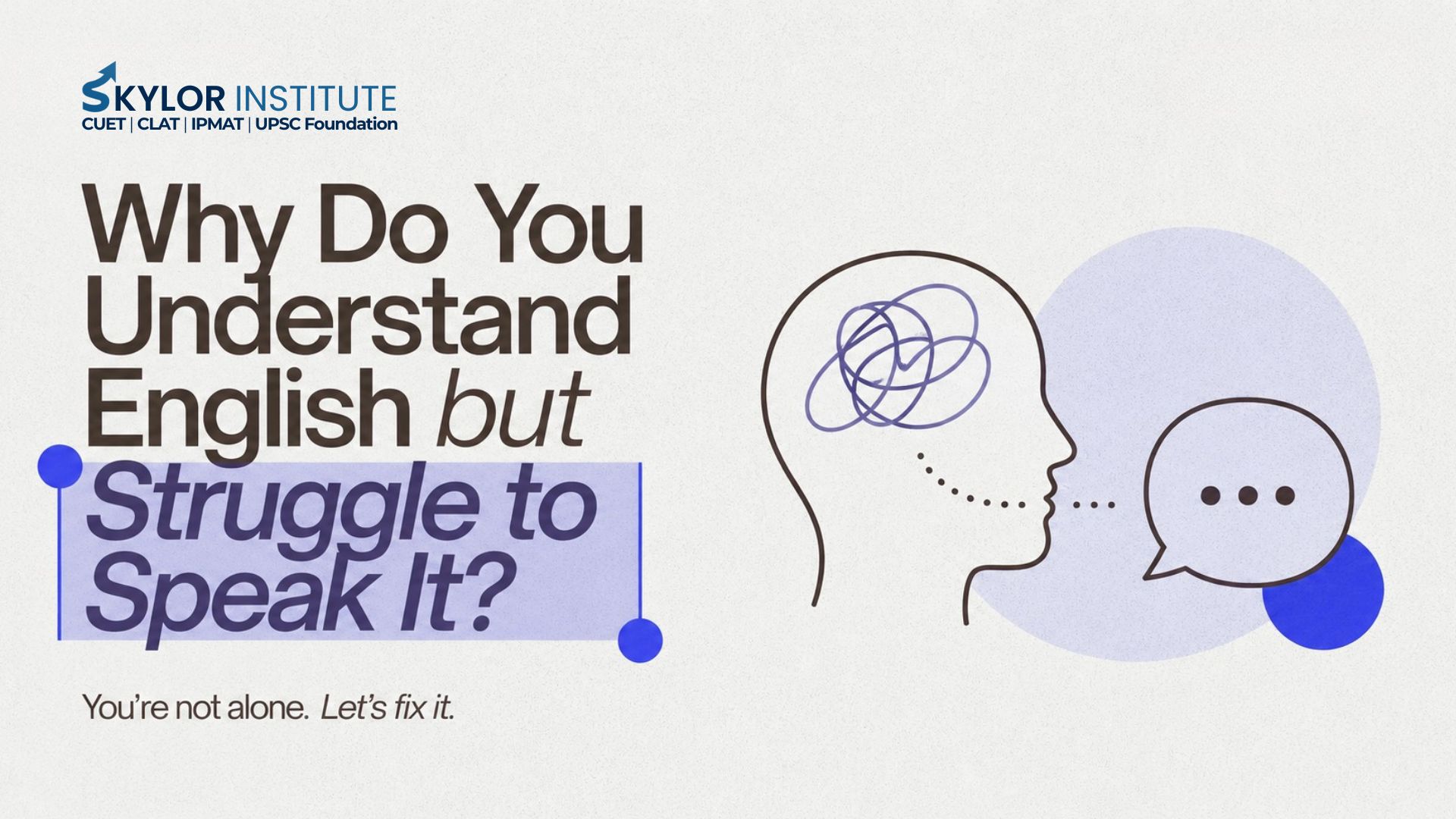
Why Do You Understand English but Struggle to Speak It?
Have you ever watched an English movie and understood almost everything, followed an English YouTube video without subtitles, or read an English article comfortably, only to sudde...
Have you ever watched an English movie and understood almost everything, followed an English YouTube video without subtitles, or read an English article comfortably, only to suddenly freeze when someone asks you a simple question in English? If your answer is yes, you are not alone. Many English learners experience exactly this frustrating gap: they understand English much better than they can speak it. You may recognise hundreds or even thousands of English words, understand different accents, follow conversations, and know the rules of grammar, yet when it is your turn to speak, the right words seem to disappear. This can make you wonder whether your English is actually good enough. The problem, however, is usually not a lack of intelligence or even a complete lack of English knowledge. It is often a difference between understanding a language and producing it in real time. Cambridge Dictionary defines fluency as the ability to speak or write a language easily, well and quickly, which highlights an important point: knowing English and being able to use English spontaneously are not exactly the same thing.
Understanding English and Speaking English Are Different Skills
The first thing to understand is that English comprehension and English speaking are separate abilities. When you listen to someone speak, your brain receives information and works out its meaning. When you read, you have even more time to process vocabulary, grammar and sentence structure. Speaking reverses the process. You have to decide what you want to say, find the appropriate words, arrange them into a sentence, pronounce them and continue the conversation—all while another person is waiting for your response. That is a much more demanding task in real time. Research and teaching literature distinguish between receptive and productive language knowledge, and this difference helps explain why recognising a word does not automatically mean you can retrieve and use it naturally while speaking. Think of your English knowledge as a large library. When you read, someone hands you the correct book and points to the relevant page. When you speak, you have to locate the book, find the page and read the sentence aloud within seconds. Your knowledge may be there, but your retrieval speed has not yet caught up with your understanding.
Receptive Skills vs Productive Skills
Listening and reading are generally called receptive skills because you receive and interpret language. Speaking and writing are productive skills because you have to create language yourself. A learner can therefore have strong receptive English while still having relatively weak productive English. Imagine someone who watches English interviews every evening, reads newspapers in English and understands conversations at work but rarely speaks English outside formal situations. That person is constantly feeding the brain English, but the brain may not be getting enough opportunities to practise retrieving and producing it. This is one reason simply consuming more English does not always solve a speaking problem. Your input can expand your vocabulary and improve your comprehension, but your output needs separate training. Cambridge teaching resources specifically distinguish activities designed to extend productive skills, while speaking-practice guidance emphasises actually using language rather than simply understanding it. The solution, therefore, is not necessarily to study another hundred vocabulary words. Sometimes the better question is: How many of the words I already know can I use naturally in a conversation?
Why Your Vocabulary Disappears During Conversation
One of the most common complaints from English learners is, “I know the word, but I cannot remember it when I need it.” This does not necessarily mean the word has vanished from your memory. You may recognise it immediately when somebody else says it, but producing it yourself requires active retrieval. The difference can feel surprisingly large. You might read the word “opportunity” and instantly understand it, yet when someone asks, “Why did you choose this course?”, your brain may temporarily offer only simpler words such as “chance” or “reason.” That is because speaking demands rapid access to vocabulary rather than simple recognition. Current discussions among English learners repeatedly describe this exact gap between high comprehension and lower speaking ability, although personal experiences should not be treated as scientific evidence. The good news is that active vocabulary can be developed. Instead of only learning “opportunity = chance,” practise using it in several sentences: “This course gave me an opportunity to improve,” “I am looking for a new opportunity,” and “It was a great opportunity for me.” Repeated production makes the word easier to retrieve when you actually need it.
You Have Learned English Mostly Through Input
Many learners unknowingly build their English around input. They watch videos, listen to podcasts, read books, complete grammar exercises and memorise vocabulary lists. These activities are useful and should not be abandoned. The problem begins when they become almost the entire learning routine. You cannot expect your speaking ability to grow at the same speed as your comprehension if you rarely give yourself opportunities to speak. Imagine learning to swim by watching hundreds of swimming videos but never getting into the water. You could understand the techniques perfectly, identify different strokes and explain how breathing works, but your body would still not know how to perform the movements naturally. Speaking English works in a similar way. Your brain needs repeated opportunities to convert knowledge into action. British Council guidance on building speaking confidence makes a similar practical point: avoiding speaking makes it difficult to build confidence, while actively taking opportunities to speak creates experience that can strengthen confidence.
Reading and Listening Are Not Enough
Reading and listening are extremely valuable because they expose you to vocabulary, pronunciation, sentence patterns, expressions and natural ways of communicating. The mistake is assuming that exposure automatically creates fluency. You might hear “That makes sense” hundreds of times and understand it perfectly, but if you never use the expression yourself, it may remain passive knowledge. The same thing happens with grammar. You may understand the difference between “I have been working” and “I worked,” yet hesitate when you need to choose between them during a real conversation. This is why a balanced learning routine should include input and output. Read something, listen to something, and then do something with that language. Explain what you read. Summarise the video. Answer questions aloud. Use five new expressions in your own sentences. Tell someone about your day. The goal is to make English move from something you recognise into something you can control. Even traditional grammar and vocabulary activities can become speaking practice when learners answer aloud and repeat their responses more smoothly, an approach discussed in Cambridge's teaching guidance.
The Missing Link Is Active Practice
Active speaking practice is the bridge between “I know English” and “I can speak English.” The key word is active. Watching someone speak English is passive for you; responding to that person is active. Reading a dialogue silently is passive; performing it aloud is active. Learning the phrase “Could you explain that?” from a vocabulary list is passive; actually using it when you need clarification is active. This distinction matters because speaking requires automaticity. You do not want to mentally construct every sentence from individual grammar rules during a conversation. You want familiar structures to become readily available so your attention can focus on the meaning of what you are communicating. This is also why repetition matters. Repeating useful phrases in different situations creates stronger associations between an idea and the language needed to express it. British Council's current English-learning offerings similarly emphasise realistic speaking situations and practice that helps learners use grammar and vocabulary in everyday communication.
Fear of Making Mistakes Can Block Your Speech
Sometimes the problem is not knowledge at all. It is fear. You may know exactly what you want to say, but a voice inside your head says, “What if my grammar is wrong?” “What if they laugh at my pronunciation?” “What if I use the wrong word?” “What if the other person speaks faster than me?” Suddenly, instead of communicating your idea, your brain starts monitoring every sentence. This can make speaking feel exhausting. The more you monitor yourself, the less attention you have available for the actual conversation. British Council guidance on speaking confidence highlights that learners who avoid speaking can reinforce the very lack of confidence they are trying to escape. The uncomfortable truth is that you cannot become confident at speaking English without experiencing some imperfect speaking. Mistakes are not proof that you should stop. They are part of the process through which speaking becomes more automatic.
Perfectionism Makes Speaking Harder
Perfectionism is particularly damaging when learning a spoken language. If your personal rule is “I will speak only when my grammar is perfect,” you have created a condition that may never be satisfied. Even advanced speakers make mistakes, reformulate sentences, forget words and occasionally say something awkward. The objective of everyday communication is not to produce a flawless English examination answer every time you open your mouth. It is to communicate meaning clearly and naturally. Consider the difference between these two learners. The first learner spends ten minutes mentally preparing a perfect answer and eventually says two sentences. The second learner speaks immediately, makes three grammatical mistakes, corrects one, and communicates the entire idea. Which learner is getting more speaking practice? The second one. Cambridge teaching material on speaking activities specifically identifies shyness, fear of mistakes and fear of losing face as reasons learners may avoid speaking, while recommending structured activities that make participation easier. Your goal should therefore be progress before perfection.
Confidence Comes From Repeated Speaking
Many people think confidence comes first and speaking comes second. In reality, the relationship often works in the opposite direction. Speaking creates experience, and experience creates confidence. Think about driving a car. You do not become confident because somebody tells you, “You should believe in yourself.” You become confident after driving repeatedly, making small mistakes, learning how the controls work and discovering that you can handle different situations. English speaking develops in much the same way. The first conversation may feel uncomfortable. The tenth may feel easier. After dozens of conversations, common questions and answers begin to feel familiar. British Council recommends speaking up, talking with classmates or other English speakers, and creating opportunities such as language exchanges as ways to build speaking experience and confidence. You do not need to wait until you feel confident. Start speaking while you are still uncomfortable.
You May Know Grammar but Cannot Use It Automatically
Another common problem is having a strong understanding of grammar rules but struggling to use them spontaneously. You might know the rules for tenses, articles, prepositions, conditionals and question formation. You may even score well on grammar exercises. Yet when somebody suddenly asks you a question, your carefully studied grammar seems to disappear. This happens because knowing a rule intellectually is different from applying it automatically while managing a live conversation. During speaking, you cannot pause after every sentence and open your mental grammar textbook. You need language patterns that are available quickly. This is why spoken practice should not focus exclusively on correcting every grammatical error. Learners also need opportunities to repeat, manipulate and reuse common sentence structures until those structures become easier to produce. Fluency itself concerns speaking or writing with relative ease, and fluency-focused activities deliberately move learners toward smoother production rather than constant conscious analysis.
Grammar Knowledge vs Grammar Fluency
Suppose you have studied the present perfect tense. You know the formula, understand when it is used and can complete a worksheet correctly. Now someone asks, “How long have you lived here?” If you immediately respond, “I have lived here for five years,” your grammar knowledge has become usable. But if you spend ten seconds thinking about the tense before answering, the grammar may still be primarily conscious knowledge. The goal is to gradually reduce that delay. One effective approach is to practise grammar through speaking patterns rather than isolated rules. Instead of studying twenty examples silently, create questions that require you to answer using the target structure. “How long have you studied English?” “What have you learned this week?” “Have you ever travelled alone?” Answer them aloud. Then ask yourself similar questions. This converts grammar from an academic subject into a communication tool. Productive practice has an important role in developing the ability to use language, which is why speaking tasks should be integrated into language learning rather than treated as an optional extra.
Why Translating From Your Mother Tongue Slows You Down
If you first formulate every thought in your mother tongue and then translate it into English, speaking can become painfully slow. Imagine your brain running three programs simultaneously: first, decide what you want to say in your native language; second, translate it into English; third, check whether the English grammar is correct. That is a lot of mental work for a simple conversation. The solution is not to stop using your mother tongue completely. Instead, gradually train yourself to connect ideas directly with English expressions. For example, when you see rain outside, instead of mentally thinking in your first language and translating, practise the immediate English thought: “It looks like it is going to rain.” When someone asks how your day was, build familiar English responses directly: “It was pretty busy, but I managed to finish everything.” This does not happen overnight. You create it through repetition. The more familiar phrases and sentence patterns become, the less translation your brain needs during everyday conversations.
How to Turn Passive English Into Active English
The shift from passive to active English begins when you stop asking, “How many English words do I know?” and start asking, “How many English words can I actually use?” This is a completely different way of measuring progress. If you learn ten new words today but never use them, their immediate value for speaking may be limited. If you learn three useful expressions and deliberately use each of them five times in different sentences, those expressions have a much better chance of becoming part of your active vocabulary. This is why speaking practice should be connected to real situations. Instead of memorising random vocabulary, learn language you are likely to need at school, college, work, interviews, travel, presentations or everyday conversations. Build around topics that matter to you. When language has a practical purpose, it becomes easier to retrieve because you have a reason to use it.
Build an Everyday Speaking Routine
You do not need to spend three hours every day speaking English to make progress. What matters is consistency and deliberate practice. Start with a manageable routine that you can actually maintain. For example, spend five minutes describing your day aloud, five minutes retelling something you watched or read, and another five minutes answering questions about a familiar topic. Once that becomes comfortable, increase the duration. You can also choose one topic per day: your studies, your job, your family, a recent film, a news story, a hobby or a future goal. Record yourself occasionally and listen back without judging yourself too harshly. Look for patterns: Do you pause excessively? Do you repeat the same words? Are your sentences very short? Do you pronounce certain sounds inconsistently? This gives you concrete targets for improvement. Modern English-learning programmes increasingly incorporate realistic speaking tasks and personalised feedback because learners need opportunities to practise language in situations that resemble actual communication.
Use English Without Waiting to Become Perfect
One of the biggest mistakes English learners make is waiting for a magical moment when they suddenly feel “ready.” That moment usually does not arrive. Speaking ability develops through speaking, not through waiting for more knowledge. You can start with simple English and gradually make it more sophisticated. If you cannot explain an idea in a complex sentence, explain it in three simple sentences. If you forget a word, describe it using other words. If you make a grammatical mistake, keep going unless the mistake prevents communication. This ability to keep communicating is an important part of practical fluency. A speaker who knows fewer words but can explain, clarify, ask questions and continue a conversation may communicate more effectively than someone with a huge vocabulary who becomes silent whenever they cannot find the perfect expression. Your objective is not to sound like a native speaker overnight. Your objective is to make English usable.
Practical Exercises to Improve English Speaking
If you understand English but struggle to speak it, your practice should directly target speaking. Start by taking ordinary English content and converting it into output. Read a short article and close it. Then explain the article in your own words. Watch a three-minute video and retell what happened without replaying it. Read a dialogue and perform both sides aloud. Pick a photograph and describe everything you can see. Explain how to make your favourite food. Pretend you are answering questions in a job interview. These exercises force your brain to retrieve vocabulary, construct sentences and organise ideas. They also reveal gaps that passive learning can hide. If you repeatedly cannot find a word while speaking, that is useful information because now you know exactly what to practise. Speaking exercises do not have to be complicated. What matters is that they require you to produce language rather than simply recognise it.
Shadowing and Retelling
Two particularly useful techniques are shadowing and retelling. In shadowing, you listen to a short piece of natural English and repeat it almost immediately, trying to copy the speaker's rhythm, pronunciation and intonation. This can help you become more comfortable with the physical process of speaking English because you are not inventing every sentence from scratch. Retelling works differently. You listen to or read something and then explain the content using your own words. This forces you to retrieve vocabulary and build sentences independently. Start with very short material. Do not choose a twenty-minute lecture if you are struggling to speak for one minute. Choose a short clip, listen carefully, and then explain the main idea for sixty seconds. Repeat the exercise several times. The first attempt may contain pauses and mistakes. The second should be smoother. By the third, you may discover that words which felt inaccessible suddenly become easier to retrieve. This kind of repeated productive practice can help bridge the gap between recognition and spontaneous use.
Self-Talk and Voice Recording
You can also practise speaking when nobody else is available. Self-talk may sound strange initially, but it is a simple way to create additional English-speaking opportunities. Describe what you are doing: “I am making tea. I need to reply to this email. After that, I am going to work on my presentation.” Talk through your plans, opinions and decisions. You can even challenge yourself with questions: “What would I do if I had a free month?” “Which skill do I want to improve this year?” “What makes a good teacher?” The purpose is not to perform. The purpose is to make your brain produce English. Recording yourself adds another layer. When you listen back, you may notice that your English is actually better than you thought, or you may identify specific areas to improve. You can then record the same topic again after a week. This gives you something more useful than a vague feeling of progress: evidence of improvement.
How an English Speaking Course Can Help
An English speaking course can be particularly useful when you understand English but lack a structured environment in which to use it. The biggest advantage is not simply learning more grammar or vocabulary. A good course should create repeated opportunities for guided speaking, correction, conversation, pronunciation practice and real-world communication. It can also solve a problem many independent learners face: they do not know what to practise or how to measure improvement. A structured programme can take learners from controlled conversations to increasingly spontaneous communication. For example, a learner might first practise introductions, then everyday conversations, then opinion-based discussions, presentations, interviews and workplace communication. The teacher can identify recurring errors and provide targeted feedback while the learner continues speaking rather than stopping after every mistake. British Council's current English-learning approach similarly combines teacher guidance with additional speaking practice, including realistic scenarios and feedback on areas such as grammar, vocabulary, fluency and clarity. For learners who have knowledge but lack speaking confidence, the right environment can turn English from something they study into something they actually use.
Conclusion
If you understand English but struggle to speak it, your English is not necessarily bad. You may simply have developed stronger receptive skills than productive skills. You have spent years listening, reading, studying grammar and recognising vocabulary, but perhaps not enough time retrieving that knowledge under real conversational conditions. Speaking requires a different kind of practice because your brain must find words, construct sentences, manage pronunciation and communicate meaning in real time. Fear of mistakes can make the situation worse, while excessive translation and perfectionism can slow you down even further. The answer is not to wait until you know enough English. It is to start activating the English you already know. Speak aloud every day, retell stories, practise useful phrases, record yourself, have conversations, accept mistakes and gradually increase the difficulty. Confidence will not magically appear before practice; confidence is one of the results of practice. If your understanding is already strong, you have an important foundation. Now you need to build the bridge between understanding English and using it.
FAQs
1. Why can I understand English but not speak it?
Understanding and speaking involve different language skills. You may have strong listening and reading abilities but limited experience producing English spontaneously. Speaking requires rapid vocabulary retrieval, sentence formation, pronunciation and decision-making at the same time. Regular speaking practice helps convert passive knowledge into active language.
2. Does learning more vocabulary improve English speaking?
Vocabulary helps, but simply memorising more words is not enough. You also need to practise using those words in sentences and conversations. A smaller vocabulary that you can retrieve quickly is often more useful for everyday speaking than a large vocabulary that you can only recognise while reading.
3. How can I stop translating English in my head?
Start connecting common situations directly with English expressions. Practise simple thoughts in English throughout the day and memorise useful phrases rather than translating every individual word. With repeated exposure and speaking practice, familiar expressions can become easier to retrieve without consciously translating them.
4. How long does it take to speak English fluently?
There is no fixed timeline because progress depends on your current level, practice frequency, exposure, motivation and opportunities to communicate. Someone who speaks regularly may progress faster than someone who studies grammar for hours but rarely speaks. Consistent, purposeful speaking practice is more important than waiting for a particular number of months.
5. Is an English speaking course better than learning English alone?
It depends on the learner and the quality of the course. Self-study can work well when you are disciplined and have regular opportunities to practise speaking. A structured English speaking course can be valuable because it provides guided practice, feedback, accountability and conversation opportunities. The most effective approach is usually the one that gives you consistent opportunities to actually use English.
Need Personalized Diagnostic Guidance?
Speak directly with Skylor's academic directors in Bathinda. Discuss batch schedules, test analytics, and personalized preparation strategies.