Is NIOS Valid for IPMAT? A Complete Guide for NIOS Students Appearing for IPMAT
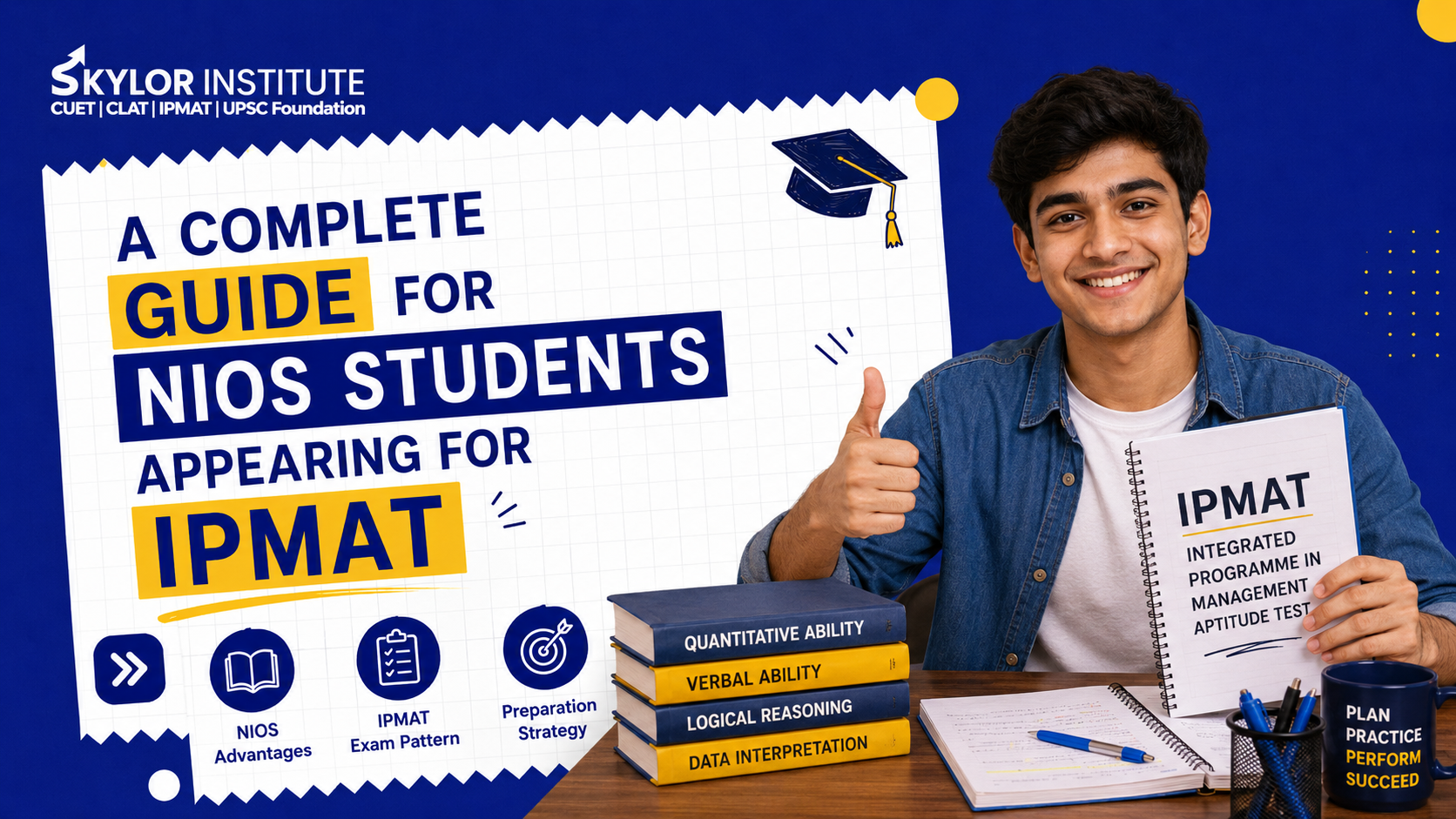
Yes, NIOS students can appear for IPMAT, provided they satisfy the eligibility requirements prescribed by the particular institute conducting or accepting the IPMAT score. The key...
Yes, NIOS students can appear for IPMAT, provided they satisfy the eligibility requirements prescribed by the particular institute conducting or accepting the IPMAT score. The key point is that the eligibility wording generally refers to Class 10 and Class 12/HSC or an equivalent examination from a recognised board, rather than restricting applicants to students who studied in CBSE, ISC, or a state board. For example, the official IIM Indore admission procedure for the IPM 2026–31 batch requires candidates to have passed Standard X/SSC and Standard XII/HSC or an equivalent examination, while also specifying the relevant passing-year and age conditions. NIOS itself describes its Senior Secondary qualification as equivalent to Class XII, which is highly relevant when assessing whether an NIOS student can meet an institute's "equivalent examination" requirement.
This means that choosing NIOS does not automatically close the door to IPMAT or an IIM's Integrated Programme in Management. However, students should not make the mistake of treating "NIOS is valid" as the entire eligibility test. Admission rules can change from one year to another, and different IPM institutes may have different requirements relating to minimum marks, age, passing year, and documentation. IIM Indore, for instance, explicitly states in its 2026 admission document that it reserves the right to determine conditions concerning equivalence and recognition of qualifying examinations. So, if you are an NIOS student targeting IPMAT, the smart approach is not simply to ask, "Is NIOS accepted?" but to ask, "Does my NIOS qualification satisfy this year's exact eligibility conditions for the IPM programme I am targeting?" That distinction can save you from a very unpleasant surprise at the admission stage.

Why NIOS Students Are Often Confused About IPMAT Eligibility
The confusion around NIOS and IPMAT eligibility is understandable because NIOS follows an open-schooling model that is different from the conventional school system. A student studying through CBSE or a state board usually spends two years attending a physical school before receiving a Class 12 certificate, whereas an NIOS learner may choose a more flexible academic pathway. Parents sometimes interpret this difference as meaning that IIMs might treat NIOS qualifications differently. That assumption, however, does not automatically follow from the admission language used by IIMs. When an eligibility notification says "Class XII/HSC or equivalent," the important question becomes whether the student's qualification is recognised as equivalent and whether all other conditions have been met. NIOS officially identifies its Senior Secondary course with the Class XII level, which is why NIOS students should focus on the specific admission notification, rather than relying on rumours circulating among students or coaching communities.
There is another reason this question keeps appearing online: students often confuse eligibility for the entrance test with final admission eligibility. These are related but not necessarily identical stages. A student appearing for Class 12 may be allowed to apply provisionally, but the candidate must eventually produce the required academic documents and satisfy the institute's conditions. IIM Indore's 2026 notification, for example, allows candidates who are expected to complete Class XII/HSC or an equivalent qualification by July 31, 2026, to apply subject to the stated conditions; selected candidates then have to produce the required Class X and XII documentation at registration. For an NIOS student, therefore, the timing of the examination, declaration of results, availability of the marksheet, and fulfilment of the institute's documentation requirements deserve as much attention as preparation for the aptitude test itself.
NIOS Students Can Target IIM Indore IPMAT
For students specifically targeting IIM Indore's Integrated Programme in Management, the 2026 admission procedure provides a useful reference point. IIM Indore's official notification says domestic candidates must have passed Standard XII/HSC or an equivalent examination in 2024 or 2025, or be appearing in 2026, and must also have passed Standard X/SSC. The 2026 criteria also prescribe an age condition: candidates generally need to have been born on or after August 1, 2006, while a five-year relaxation applies to SC, ST, and PwD candidates. The notification does not say that the candidate must have completed Class XII through a conventional day school or through a particular board such as CBSE. Instead, it uses the broader qualification language of XII/HSC or equivalent.
That distinction is important for NIOS aspirants. If your NIOS Senior Secondary qualification satisfies the institute's recognition and equivalence requirements, the fact that you studied through open schooling is not, by itself, a reason to assume that you cannot apply. At the same time, students should avoid interpreting this as a permanent guarantee for every future IPMAT cycle because eligibility notifications are published for specific admission batches. IIM Indore itself explicitly reserves the right to decide matters relating to recognition and equivalence. Therefore, an NIOS student planning for IPMAT 2027 or a later cycle should use the official notification released for that particular admission year as the final authority rather than relying entirely on a previous year's criteria.

What Are the Eligibility Requirements for NIOS Students?
The simplest way to understand IPMAT eligibility for NIOS students is to divide the requirements into four areas: academic qualification, minimum marks where prescribed, age, and passing year. Meeting only one or two of these conditions is not enough. For IIM Indore's 2026 admission cycle, the official document specifies Class X and Class XII/HSC or equivalent qualifications, along with a particular age window and qualifying-examination years. Students should therefore create an eligibility checklist before investing months in preparation. This is especially important for NIOS students because the flexibility of open schooling can sometimes lead students to take examinations in a timeline that does not match an institute's prescribed passing-year window.
| Eligibility factor | What NIOS students should check |
|---|---|
| Class 10 | Passed Standard X/SSC or equivalent from a recognised board |
| Class 12 | Passed Senior Secondary/Class XII or equivalent qualification |
| Recognition | Confirm that the qualification satisfies the institute's recognition/equivalence requirements |
| Passing year | Match the specific IPMAT admission notification |
| Age | Check the exact age cut-off for the admission year |
| Documents | Keep Class 10 and Class 12/NIOS records ready |
| Marks | Check the institute's current minimum-percentage rules, if applicable |
| Entrance test | Meet the requirements and qualify through the relevant IPMAT selection process |
The important lesson is simple: NIOS qualification is only one part of the eligibility equation. A student can have a valid Class 12 qualification and still become ineligible if the age or passing-year requirement is not satisfied. Conversely, being an NIOS student does not automatically mean that the student is disqualified. For the 2026 IIM Indore cycle, the official notification is particularly useful because it explicitly recognises the broader category of "equivalent examination" while leaving recognition and equivalence to the institute's determination. This is exactly why serious aspirants should verify the official admission document every year instead of using screenshots of old eligibility criteria found on social media.
Does IIM Indore Accept NIOS Class 12?
The practical answer for an NIOS student is yes, an NIOS Class 12 qualification can be considered under the "equivalent" qualification route, subject to IIM Indore's applicable recognition requirements and the eligibility rules of the relevant admission year. NIOS itself states that its Senior Secondary course is equivalent to Class XII. IIM Indore's 2026 admission document does not restrict the qualifying examination to a named school board; instead, it requires Standard XII/HSC or an equivalent examination and gives the institute authority regarding recognition and equivalence. This combination is why NIOS students should not automatically assume that open schooling makes them ineligible for IPMAT Indore.
There is an important practical point here, though. Students should keep their documentation completely consistent and avoid last-minute uncertainty about how their NIOS qualification will be presented during admission. The safest route is to maintain the original NIOS marksheet/certificate and all relevant Class 10 documents, and to check the exact document requirements mentioned in the current IIM Indore admission notification. If a student is still pursuing Class 12 through NIOS, the timing of the NIOS examination and result declaration should also be checked against the institute's deadline. The entrance examination is only one gate; after clearing it, the candidate still has to demonstrate that the underlying academic qualification satisfies the admission conditions.

What About IIM Rohtak IPM for NIOS Students?
NIOS students should also consider IIM Rohtak's Integrated Programme in Management rather than assuming that IPMAT means only IIM Indore. IIM Rohtak's official 2026 admission information states that candidates need a minimum of 60% in Standard X/SSC and Standard XII/HSC or equivalent examinations, with 55% for SC, ST and DAP candidates. It also specifies a maximum age of 20 years as of June 30, 2026, with a stated relaxation for SC and ST candidates. The use of "HSC or equivalent" again makes the qualification itself an important factor, meaning an NIOS student should examine the current admission notification and recognition requirements rather than ruling themselves out simply because they studied through open schooling.
The bigger lesson is that IPMAT eligibility is institute-specific. IIM Indore and IIM Rohtak may have different rules, dates, selection processes, and academic conditions. Some other institutions also use IPMAT scores for their own management programmes, which creates additional opportunities for students who want an integrated management education after Class 12. A Government of India document published in 2025, for example, noted that the IPMAT conducted by IIM Indore was accepted by IIM Indore, IIM Ranchi, IIM Shillong and IIM Amritsar for their respective programmes. This means students should think beyond one exam and build a target list of programmes whose eligibility criteria they can satisfy.
Can NIOS Students Apply for IPMAT After Class 12?
Absolutely, provided they meet the relevant eligibility criteria for the institute and admission year. An NIOS student does not need to treat open schooling as a barrier that automatically prevents participation in management entrance examinations. The bigger challenge is usually planning. Because IPMAT preparation involves quantitative aptitude, verbal ability, logical thinking, reading, mock tests, and interview or selection-stage preparation depending on the institute, students need to plan their academic schedule and entrance preparation together. An NIOS student can potentially have more flexibility than a conventional school student, but flexibility becomes useful only when it is converted into a disciplined preparation routine.
This is where NIOS can become an advantage rather than merely a different schooling route. Students who manage their schedule effectively may have additional time to build mathematical fundamentals, read newspapers and quality articles, improve vocabulary, practise data interpretation, solve reasoning problems, and take full-length mocks. But there is a trap: having more flexible academic hours does not automatically produce a higher IPMAT score. A student who wastes those hours on inconsistent preparation can easily fall behind a student attending regular school who follows a structured timetable. The right mindset is to treat NIOS flexibility as extra preparation capacity, not as an excuse to postpone serious preparation.
Is Mathematics Compulsory for NIOS Students Appearing for IPMAT?
Being an NIOS student does not create a special mathematics requirement simply because the student comes through open schooling. The question of whether Mathematics is required depends on the specific IPM programme's eligibility rules, while the entrance examination itself may contain a substantial quantitative section. For IIM Indore, the 2026 IPMAT is structured around Quantitative Ability–Short Answer, Quantitative Ability–MCQ and Verbal Ability–MCQ sections. That means a student may not necessarily need to have studied Mathematics as a Class 12 subject to satisfy the academic eligibility condition, but quantitative ability remains a major part of the entrance examination.
This creates an important distinction for Arts and Commerce students, including NIOS learners who did not take advanced mathematics. Eligibility and preparation difficulty are two different questions. You can be eligible without having Mathematics in your Class 12 subject combination and still find the quantitative section challenging. The solution is not to panic about your NIOS background; it is to start quantitative preparation early. Focus first on arithmetic fundamentals such as percentages, ratios, averages, profit and loss, time and work, mixtures, simple and compound interest, speed-distance-time, and basic algebra, then gradually move towards higher-level questions and timed practice.

NIOS vs CBSE for IPMAT: Does the Board Matter?
When students compare NIOS vs CBSE for IPMAT, they often ask which board gives them a better chance of getting into an IIM. That question is slightly misleading. An entrance examination does not award extra IPMAT marks simply because a candidate studied under CBSE, and studying through NIOS does not automatically reduce the candidate's aptitude-test score. What matters is whether the student meets the institute's eligibility conditions and how well they perform in the relevant selection process. For IIM Indore, the 2026 official eligibility language focuses on Standard X and Standard XII/HSC or equivalent qualifications, along with the prescribed age and passing-year conditions.
The real comparison should therefore be about learning environment and preparation strategy, not prestige. CBSE may provide a conventional school structure, regular classroom interaction, internal assessments, and a familiar academic routine. NIOS can offer flexibility and may suit students who need a non-traditional schooling pathway. Neither route substitutes for IPMAT preparation. If a student chooses NIOS specifically to create more time for competitive-exam preparation, that time needs to be used intelligently; otherwise, the perceived advantage disappears. The best board for an IPMAT aspirant is ultimately the route that allows the student to satisfy eligibility requirements while maintaining strong academic performance and enough time for serious aptitude preparation.
How Should NIOS Students Prepare for IPMAT?
An NIOS student preparing for IPMAT should treat preparation as a two-track mission: stay safely within board requirements while simultaneously building aptitude skills. The first track protects eligibility; the second builds competitiveness. This is important because a candidate cannot afford to sacrifice Class 12 performance while preparing for the entrance examination. At the same time, simply scoring well in NIOS examinations does not guarantee success in an aptitude test that demands speed, accuracy, comprehension, numerical reasoning, and strategic decision-making. A balanced timetable should therefore divide the week between academic subjects and entrance preparation instead of pushing IPMAT preparation entirely into the final months.
A practical preparation framework can look like this:
- Build quantitative fundamentals from the beginning rather than waiting until the final months.
- Develop a daily reading habit using editorials, essays, business news and analytical articles.
- Practise verbal ability through vocabulary, grammar, reading comprehension and para-based questions.
- Solve logical and quantitative questions under time pressure.
- Take sectional tests before moving heavily into full-length mocks.
- Analyse every mock rather than merely recording the score.
- Track recurring mistakes in a dedicated error notebook.
- Keep the NIOS academic schedule and examination dates clearly mapped against the IPMAT calendar.
The goal is not to study for ten or twelve hours simply because NIOS provides flexibility. The goal is to build a repeatable system. Three or four highly focused hours of aptitude preparation every day can be far more valuable than sitting with books for an entire day without measuring performance. As the exam approaches, the emphasis should shift from learning individual concepts to speed, selection of questions, accuracy and mock-test analysis. That is the point at which preparation begins to resemble an actual competitive advantage rather than ordinary classroom study.

Common Mistakes NIOS Students Should Avoid
One of the biggest mistakes NIOS students make is assuming that someone else's experience automatically applies to them. A student may say, "My friend got into IPM through NIOS," while another may claim, "I heard IIMs don't accept open-school students." Neither statement should replace the official admission notification. Eligibility is determined by the institute's rules for the relevant admission cycle, and those rules can change. IIM Indore's 2026 document itself makes clear that the institute retains authority regarding recognition and equivalence, which is a strong reason to verify the current notification before submitting an application.
Another mistake is ignoring age and passing-year criteria. Students often focus so intensely on whether NIOS is recognised that they forget these separate conditions. A candidate could have a perfectly valid Class 12 qualification but still fail an age or passing-year requirement. NIOS students should also avoid waiting until the application deadline to check whether their marksheets, certificates and other documents are available and acceptable. Treat eligibility verification like checking your boarding pass before reaching the airport: doing it early costs almost nothing, while discovering a problem at the last moment can derail the entire journey.
NIOS Students and IPMAT: A Smart Eligibility Checklist
Before applying for IPMAT, an NIOS student should sit down with the latest official admission notification and verify every condition individually. Do not rely on a generic "NIOS is accepted" statement from a coaching advertisement, YouTube video, social media post or discussion forum. Check the official institute website, download the admission document, and compare your personal academic timeline with the stated requirements. For IIM Indore, the official admissions page provides the current admission procedure and related documents for the 2026–31 batch, making it the appropriate place to verify the rules for that cycle.
A useful checklist is:
- Class 10 qualification: Confirm that you have passed the required Standard X/SSC or equivalent examination.
- Class 12 qualification: Confirm that your NIOS Senior Secondary qualification meets the institute's Class XII/HSC or equivalent requirement.
- Passing year: Match your NIOS Class 12 examination year with the applicable IPMAT notification.
- Age: Check the exact date-of-birth requirement.
- Minimum marks: Verify the current percentage requirement for your category and programme.
- Documents: Keep your marksheets, certificates and category documents, where applicable, organised.
- Application timeline: Do not confuse the NIOS academic calendar with the IPMAT registration calendar.
- Final verification: Recheck the official admission notice before submitting the application.
This process may sound excessive, but it takes far less time than recovering from an eligibility mistake after months of preparation. The official IIM Indore 2026 process, for instance, included a defined application window from February 2 to March 14, 2026, while the aptitude test was scheduled for May 4, 2026. These dates demonstrate why aspirants need to monitor the entrance-exam calendar separately from their school-board calendar.
Can NIOS Students Get Into IIMs Through IPMAT?
Yes, NIOS students can pursue the IIM IPM route when they satisfy the applicable eligibility requirements and clear the selection process. The bigger question is not whether the student comes from NIOS but whether the student is academically eligible, meets the age and passing-year conditions, and can compete effectively in the entrance examination and subsequent admission stages. IIM Indore's IPM is highly competitive: a Government of India document reported 26,838 applicants for the IIM Indore IPM process in 2025 against 150 seats. That kind of competition makes preparation quality far more important than the label of the school board.
Think about the admission process as a series of gates. Your NIOS qualification helps you clear the academic-eligibility gate if it satisfies the institute's recognition and equivalence conditions. Your age and passing year determine whether you can move through the next gate. Your IPMAT performance then determines how strongly you compete for a place. At later stages, depending on the institute and programme, additional components can matter. The lesson for NIOS aspirants is straightforward: do not spend your preparation years worrying about whether your board is "good enough." Spend them becoming good enough for the exam.

NIOS and IPMAT: What Parents Should Know
Parents of NIOS students often worry that choosing open schooling will permanently limit their child's higher-education options. That concern should be replaced with a more practical question: Is the student's chosen NIOS pathway recognised, academically appropriate, and compatible with the target universities and entrance examinations? For IPMAT, parents should monitor the eligibility rules of the specific IIM programmes their child wants to target. They should also understand that different institutes can publish different conditions. IIM Indore and IIM Rohtak, for example, publish their own programme-specific eligibility requirements, including different details concerning marks and age.
Parents should also avoid creating unnecessary pressure around the idea that a conventional school is automatically superior for IPMAT. A motivated NIOS student can use the flexibility of open schooling to build a strong preparation schedule, but only if the student is disciplined. Parents should focus on measurable indicators: mock-test performance, reading ability, quantitative fundamentals, consistency, academic marks and progress against a realistic preparation plan. If those indicators are improving, the route is working. If they are not, simply changing the label of the educational board will not solve the underlying problem.
Conclusion
NIOS is not a reason for students to give up on IPMAT. NIOS students can pursue IPMAT and target integrated management programmes when they satisfy the exact eligibility conditions laid down by the relevant institute for the relevant admission year. IIM Indore's 2026 admission procedure requires Standard X and Standard XII/HSC or equivalent qualifications and specifies age and qualifying-examination conditions; NIOS itself identifies its Senior Secondary qualification as equivalent to Class XII. IIM Rohtak also uses the "HSC or equivalent" framework in its 2026 eligibility requirements.
The smartest approach for an NIOS student appearing for IPMAT is therefore simple: verify eligibility from the official notification, keep your documentation ready, track age and passing-year requirements carefully, maintain strong Class 12 performance, and start aptitude preparation early. Do not let online rumours convince you that NIOS automatically puts you at a disadvantage. At the same time, do not assume that NIOS acceptance means every candidate is automatically eligible; the institute's latest official admission notification always takes priority. If IIMs are your goal, your board is only one part of the story. Your preparation, performance, eligibility compliance and consistency will ultimately determine how far you go.

FAQs About NIOS Students Appearing for IPMAT
1. Is NIOS valid for IPMAT?
Yes, NIOS students can be eligible for IPMAT when their Senior Secondary qualification satisfies the relevant institute's Class XII/HSC or equivalent requirement and they meet all other conditions. IIM Indore's 2026 admission procedure uses the qualification category of Standard XII/HSC or equivalent and separately requires Standard X/SSC. NIOS describes its Senior Secondary course as equivalent to Class XII.
2. Can an NIOS student get admission to IIM Indore through IPMAT?
An NIOS student can pursue IIM Indore's IPM if they satisfy the current admission criteria, including the required Class X and Class XII/equivalent qualifications, applicable age requirement, qualifying-examination year and any other conditions specified by IIM Indore. The institute's current admission notification should always be checked before applying because eligibility rules can change.
3. Is Mathematics compulsory for NIOS students appearing for IPMAT?
Being an NIOS student does not by itself create a separate Mathematics requirement. However, candidates should carefully check the academic eligibility rules of their target programme and remember that the IPMAT examination can contain significant quantitative aptitude content. For IIM Indore's 2026 test, Quantitative Ability appears in both Short Answer and MCQ formats.
4. Can NIOS students apply to IIM Rohtak IPM?
NIOS students who satisfy IIM Rohtak's current eligibility requirements can consider its IPM programme. For 2026, IIM Rohtak states a minimum of 60% in Standard X/SSC and Standard XII/HSC or equivalent, with 55% for SC, ST and DAP candidates, along with an age requirement. Students should verify the latest notification before applying.
5. Is NIOS better or worse than CBSE for IPMAT preparation?
Neither board automatically guarantees IPMAT success. CBSE provides a conventional school structure, while NIOS can provide greater flexibility. The more important factors are whether the student meets the institute's eligibility requirements, performs well academically and develops the quantitative, verbal, reasoning and reading skills required for the entrance examination. For a serious NIOS aspirant, the right strategy is to use the flexibility of the system productively rather than worrying about the board label.
Need Personalized Diagnostic Guidance?
Speak directly with Skylor's academic directors in Bathinda. Discuss batch schedules, test analytics, and personalized preparation strategies.