Choosing NIOS and BOSSE Over Traditional Boards: A Guide for Top Students and Parents
For decades, Indian families have followed a singular, unwritten rule: success means surviving the high-stakes, high-pressure environments of traditional schooling. We have condit...
For decades, Indian families have followed a singular, unwritten rule: success means surviving the high-stakes, high-pressure environments of traditional schooling. We have conditioned ourselves to believe that the only path to a bright future runs through a rigid, 7:30 AM to 2:30 PM routine dictated by traditional central or state boards.
But the modern world doesn't reward assembly-line thinking anymore. Today, high-achieving students, competitive exam aspirants, elite athletes, and creative prodigies are finding that the traditional classroom structure can actually hold them back.
If your child is spending seven hours a day sitting through mandatory lectures, commuting in traffic, and then rushing to intensive coaching centers for JEE, NEET, or CLAT, you have likely asked yourself: Is there a more efficient way?
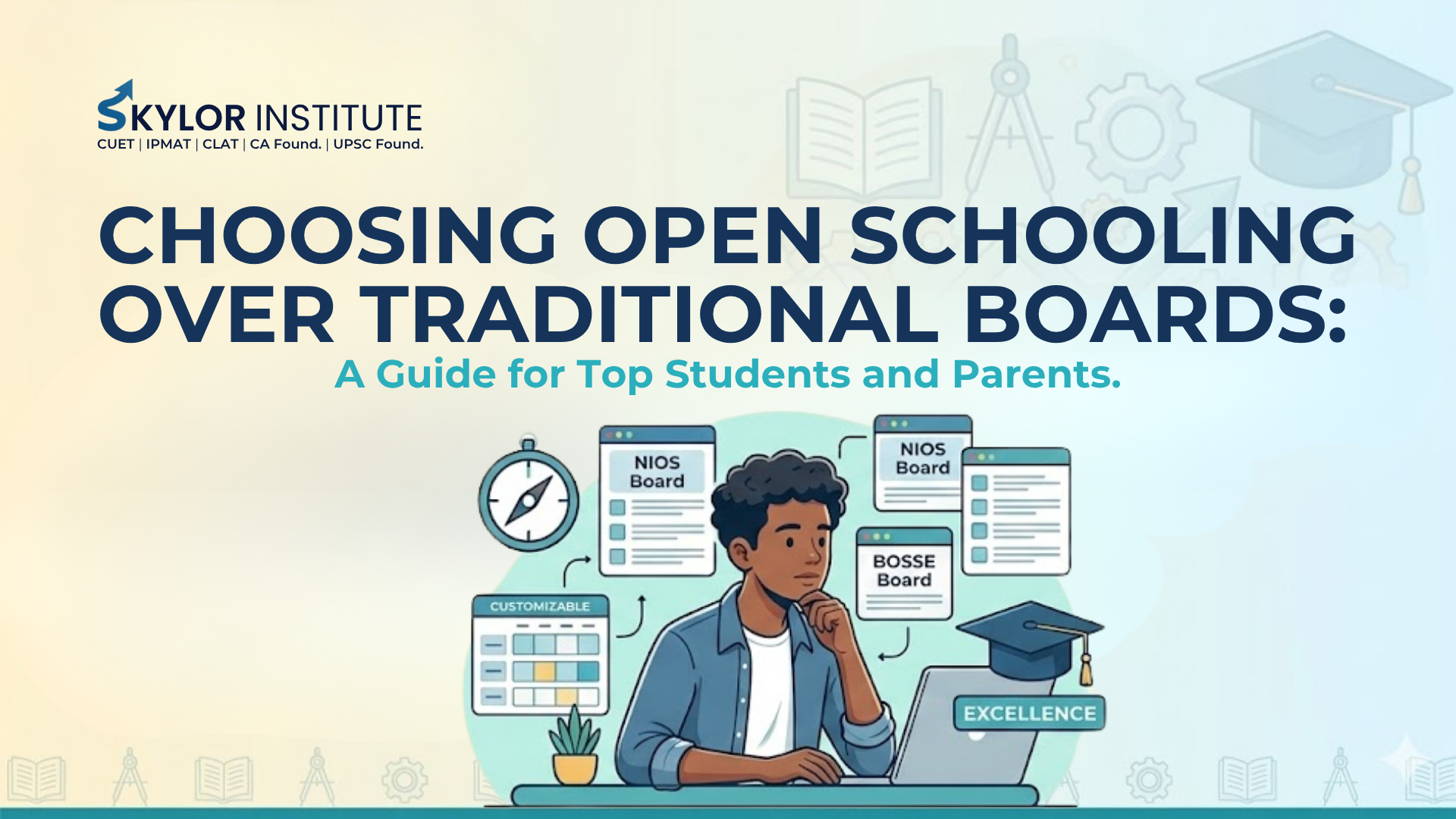
The answer is yes. Open educational frameworks like the National Institute of Open Schooling (NIOS) and the Board of Open Schooling and Skill Education (BOSSE) offer flexible, self-paced alternatives with the exact same legal validity as traditional boards, but with vastly superior operational efficiency.
This guide strips away the myths and breaks down the real data to help your family make a smart, strategic decision.
1. The Core Architectures: How the Boards Compare
To make the right choice, you first need to understand how these boards operate. Traditional boards are built on synchronous learning (everyone learns the same thing at the same pace at the same time). Open boards operate on asynchronous learning (your child learns at their own pace, on their own schedule).
National Institute of Open Schooling (NIOS)
Established in 1989 by the Ministry of Education, Government of India, NIOS is a premier central autonomous institution. Think of it as the national gold standard for distance schooling. Because its curriculum framework is tightly aligned with national standards, it matches up perfectly with the syllabi of national-level competitive exams.
Board of Open Schooling & Skill Education (BOSSE)
BOSSE is a state-legislated open board established by the Government of Sikkim in 2020. It was architected from the ground up to reflect India's National Education Policy (NEP) 2020. BOSSE’s superpower is its dual-track framework, which lets students mix standard academic subjects with practical, industry-aligned vocational skills to boost early employability.
Traditional Benchmarks: CBSE, ICSE & State Boards
These are the classroom-based boards we all grew up with. They are highly structured, deeply disciplined, and emphasize group-paced, theoretical learning. They work beautifully for students who thrive on social learning and competitive peer environments, but they demand complete conformity of time and focus.
2. Side-by-Side Comparison Matrix
Let's look at the hard metrics. How do these options stack up when it comes to your child's daily life, flexibility, and stress levels?
| Evaluation Metric | NIOS | BOSSE | Traditional Boards (CBSE / ICSE / State) |
| Regulatory Authority | Central Government (Ministry of Education, India) | State Legislative Act, Recognized Nationally via COBSE | Central or Respective State Governments |
| Attendance Requirement | 0% (Complete time freedom) | 0% (Hybrid online modules available) | Minimum 75% mandatory physical presence |
| Assessment Model | Public exams twice a year + On-Demand Testing | Block exams twice a year | Single, high-stakes annual board exam |
| Stream Flexibility | High (Mix humanities with sciences) | Exceptionally High (Mix academics with vocational skills) | Rigidly siloed streams (Medical, Non-Medical, Commerce, Arts) |
| Exam Window Security | Up to 5 years across 9 separate attempts | Flexible multi-session validation | Single-year, all-or-nothing completion |
3. Debunking the Myth: Legal Equivalency & Recognition
The biggest hesitation parents have is simple: "Will this certificate be accepted?"
Let’s be absolutely direct: Legally, a certificate from NIOS or BOSSE carries identical weight to one from CBSE, ICSE, or any state board.
Both NIOS and BOSSE are recognized members of the Council of Boards of School Education in India (COBSE) and are validated by the Association of Indian Universities (AIU). Here is how that plays out in the real world:
Higher Education Integration
Universities across India - both premier public institutions and top-tier private universities - are legally mandated to treat open school graduates on equal footing. Whether your child wants to pursue a B.Tech, B.Com, or B.A., their open board transcript is fully accepted, provided they meet the college's standard cut-off percentages.
National Entrance Exam Eligibility (JEE, NEET, CLAT)
If your child is targeting top-tier professional institutes, open schooling isn't just "acceptable" - it is a recognized strategic advantage. The governing bodies for major national tests, including the National Testing Agency (NTA), explicitly welcome open board students.
The 1,200-Hour Advantage: By eliminating mandatory attendance, open boards allow your child to reallocate up to 1,200 hours of annual commuting and routine classroom time directly toward targeted self-study and coaching preparation.
Government Jobs & Defense Services
Open school credentials are completely valid for federal and state public sector employment, including Staff Selection Commission (SSC) tracks and banking exams. Furthermore, both NIOS and BOSSE are officially recognized by the Ministry of Defence for direct entry into the Indian Army, Navy, and Air Force.
Global Mobility & International Study
If your child dreams of studying abroad, their pathway is completely secure. NIOS transcripts are recognized by major global credential evaluators like World Education Services (WES), facilitating seamless admissions into universities across the US, UK, Canada, and Australia. Similarly, BOSSE certificates are verified by the Ministry of External Affairs (MEA) for apostille and ECNR passport status.
4. The Three Strategic Superpowers of Open Schooling
When you look at education through the lens of efficiency and your child's mental well-being, the open framework solves several structural flaws of traditional schools.
Superpower 1: Reclaiming Cognitive Energy
Traditional schooling consumes a massive amount of physical and mental energy on administrative routines: uniforms, morning assemblies, commuting, and navigating classroom distractions. Open schooling converts this fixed overhead into a flexible asset. Your child can study when their focus peaks, ensuring deep, high-quality learning while drastically reducing chronic fatigue and academic burnout.
Superpower 2: Custom Curriculum Design
Traditional boards force students into rigid boxes: Medical, Non-Medical, or Commerce. But what if your child is great at advanced physics but also deeply passionate about digital marketing or entrepreneurship?
Open boards break down these walls. A student can pair core sciences with modern, market-driven vocational courses like Data Entry Operations, Web Design, or Financial Literacy. This multi-disciplinary approach keeps students engaged and builds practical, real-world skills.
Superpower 3: De-risking the Examination Process
The traditional system introduces an immense amount of personal risk. A sudden illness, a family crisis, or a bad bout of exam anxiety during the brief March testing window can compromise an entire year of hard work. Open boards mitigate this risk through brilliant structural design:
- Credit Accumulation: Students don’t have to clear all five or six subjects at once. They can split their papers across multiple exam windows, mastering two or three subjects at a time.
- On-Demand Examinations (ODE): Pioneered by NIOS, this system lets a student register for an exam whenever they feel they have mastered the subject, completely decoupling their progress from a rigid calendar.
- Transfer of Credit (TOC): If a student is transferring from a traditional board after a setback or an incomplete year, both NIOS and BOSSE allow them to transfer passing marks for up to two subjects, saving their academic year from being lost.
5. Is This the Right Move? Your 4-Step Decision Framework
Transitioning away from a traditional school is a major step. Use this analytical roadmap to decide if an open framework fits your child:
Step 1: Quantify the Time Deficit.
Track your child's weekly schedule. If they are losing 35–40 hours a week to mandatory attendance, school events, and travel - and this overhead is actively hurting their health or their core goals (like entrance coaching or elite sports training) - the data clearly favors an open board.
Step 2: Assess Self-Regulation & Focus.
Be honest about your child's learning style. Traditional schools excel at providing external discipline for kids who need constant, peer-driven structure. If your child is highly self-motivated, or conversely, if the traditional environment is causing severe, counterproductive stress, an asynchronous open board is a healthier, more productive fit.
Step 3: Design the Target Subject Profile.
Look at your child's long-term career goals. Review the subject directories of NIOS or BOSSE. Check whether a custom mix of core academics and practical vocational skills better aligns with their future profile than a generic, rigid school stream.
Step 4: Perform a Target-College Audit.
Before final enrollment, shortlist 3–5 higher education institutions your child might want to attend. While legal equivalency is ironclad, verifying specific prerequisite combinations (e.g., ensuring exact lab science credits for medical or engineering programs) directly with admissions offices guarantees a seamless transition.
Conclusion: Shifting from Institutional Identity to Educational ROI
Ultimately, an educational board should be a tool that serves your child - not an identity that confines them. While traditional schools remain a great fit for students who thrive in highly structured, social environments, they are no longer the only path to a successful future.
Boards like NIOS and BOSSE offer a rational, human-centric alternative. By aligning your child’s academic structure with their true learning style, career goals, and mental bandwidth, you eliminate systemic stress. This ensures their final grades reflect their genuine capabilities, positioning them for a robust, highly competitive future.
Need Personalized Diagnostic Guidance?
Speak directly with Skylor's academic directors in Bathinda. Discuss batch schedules, test analytics, and personalized preparation strategies.