How to Read Newspapers for Competitive Exams Without Getting Burned Out
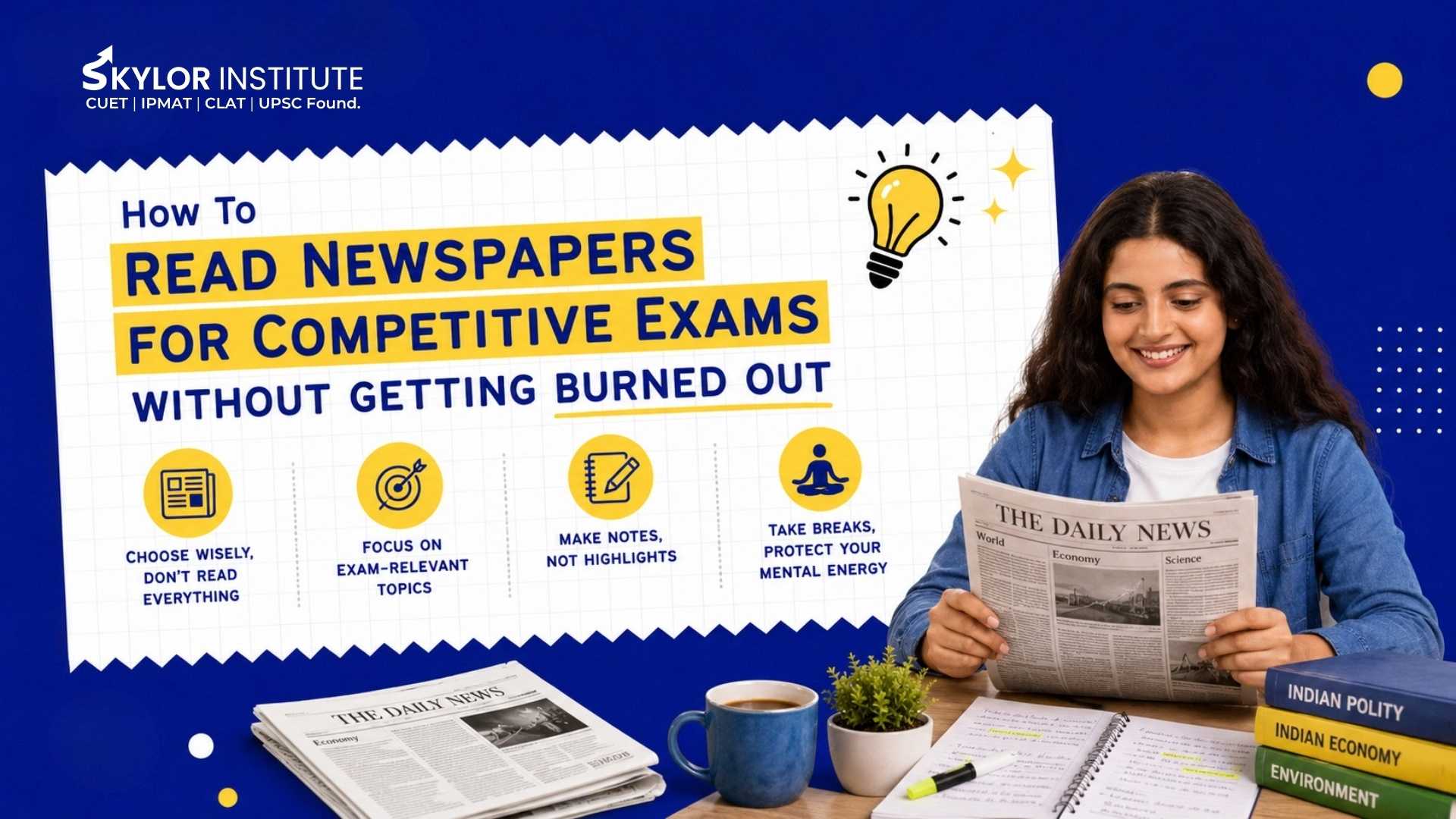
Why Newspaper Reading Matters for Competitive Exams Newspaper reading has become one of the most recommended habits for competitive exam aspirants, yet it remains one of the most ...
Why Newspaper Reading Matters for Competitive Exams
Newspaper reading has become one of the most recommended habits for competitive exam aspirants, yet it remains one of the most misunderstood. Many students either avoid newspapers completely or spend several exhausting hours reading every page. Neither approach works. The reality is that newspapers are not merely a source of current affairs; they are a tool for developing awareness, comprehension, analytical thinking, vocabulary, and opinion-building skills. These abilities directly influence performance in exams such as UPSC, SSC, Banking, CLAT, CDS, State PSCs, and various entrance examinations.
Recent exam preparation reports indicate that current affairs contribute significantly to competitive exams. According to preparation experts, current affairs sections can account for 15–40 marks depending on the examination, making newspaper reading a high-return activity when done correctly. Many successful candidates consistently mention newspapers among their most important preparation resources. Even UPSC toppers frequently emphasize daily newspaper reading as a foundation for developing a deeper understanding of governance, economics, international relations, and social issues.
The key lies in strategic reading. Newspapers should not become a burden that drains your energy and motivation. Think of them as a compass rather than a map. A compass helps you stay oriented and focused, while a map contains too much detail. Your goal is not to memorize every news article but to identify and absorb information that aligns with your exam syllabus.
The Role of Current Affairs in Modern Exams
Competitive examinations have evolved significantly over the years. Examiners are increasingly testing candidates' understanding of contemporary issues rather than isolated facts. Questions often connect current events with historical background, constitutional provisions, economic implications, and social consequences. This is particularly evident in exams like UPSC, where current affairs influence Prelims, Mains, and Interview stages simultaneously.
Newspapers provide this contextual understanding naturally. When you regularly read about government schemes, international summits, economic policies, environmental developments, and scientific innovations, you begin seeing patterns rather than disconnected facts. This deeper comprehension helps in essay writing, descriptive answers, group discussions, interviews, and comprehension-based questions.
Skills Beyond Current Affairs
Many students mistakenly believe newspapers are only useful for current affairs. In reality, they improve reading speed, vocabulary, writing style, analytical thinking, and decision-making skills. Educational initiatives promoting newspaper reading in schools have highlighted improvements in language development, comprehension abilities, and critical thinking among students.
Editorial pages are particularly valuable because they expose readers to structured arguments and balanced perspectives. Over time, this habit helps candidates construct better answers and participate confidently in interviews. Newspaper reading also trains attention spans in an era dominated by short-form content and social media distractions. Research has suggested that deeper reading habits contribute to stronger comprehension and information retention.
The Biggest Mistake Aspirants Make
Reading Everything Instead of Reading Smart
The most common reason students get burned out is simple: they try to read the entire newspaper. They start enthusiastically, reading political gossip, entertainment stories, sports updates, local incidents, advertisements, and opinion columns. After a few weeks, they feel overwhelmed and abandon the habit completely.
Many preparation experts estimate that reading a newspaper from beginning to end can consume several hours daily, which is unrealistic for serious aspirants. Smart candidates focus only on exam-relevant content and finish within 30–60 minutes.
Imagine entering a library to find one book and deciding to read every book on every shelf. That is exactly what happens when students attempt to consume every newspaper article. Competitive exams do not reward volume; they reward relevance. Learning to filter information is one of the most valuable skills an aspirant can develop.
The solution is to approach newspapers with a purpose. Before reading any article, ask yourself a simple question: "Can this topic be connected to my syllabus?" If the answer is no, move on immediately. This small habit can save hours every week and prevent mental exhaustion.
Choosing the Right Newspaper
The Hindu vs Indian Express
Among Indian competitive exam aspirants, two newspapers dominate recommendations: The Hindu and The Indian Express. Both offer excellent coverage of national and international issues, editorials, economics, governance, and public policy.
| Feature | The Hindu | Indian Express |
|---|---|---|
| Editorial Depth | Excellent | Excellent |
| Language Improvement | Strong | Strong |
| Current Affairs Coverage | Detailed | Analytical |
| UPSC Suitability | Very High | Very High |
| Beginner Friendliness | Moderate | High |
The choice ultimately depends on personal preference. Consistency matters more than selecting the "perfect" newspaper.
Digital vs Print Editions
The debate between digital and print newspapers continues among aspirants. Digital versions offer convenience, search functionality, and easy note-taking. Print editions reduce distractions and encourage deeper reading.
Studies suggest that excessive screen reading can contribute to shallow information processing and lower comprehension levels. If possible, use print editions for focused reading sessions. If you prefer digital newspapers, disable notifications and avoid multitasking while reading.
What Sections Should You Read?
Must-Read Sections
Aspirants often wonder which sections deserve attention. Fortunately, only a few areas consistently provide high exam value.
Focus primarily on:
- National news
- International relations
- Economy and business
- Science and technology
- Environment
- Government policies
- Supreme Court judgments
- Editorials and opinion pages
- Important reports and surveys
These sections frequently generate questions in competitive exams and provide valuable context for descriptive answers.
Sections You Can Skip
Learning what to skip is equally important. Many candidates waste precious time on content with little or no exam relevance.
Generally skip:
- Celebrity news
- Entertainment coverage
- Local crime stories
- Political accusations and counter-accusations
- Advertisements
- Lifestyle pages
- Routine sports updates
Filtering unnecessary information protects your mental energy and improves retention of important content.
Creating a Sustainable Newspaper Reading Routine
The 30-Minute Strategy
If you are preparing for exams like SSC, Banking, Railways, or CLAT, a 30-minute newspaper routine is often sufficient.
Suggested breakdown:
| Activity | Time |
|---|---|
| Headlines Scan | 5 Minutes |
| National & International News | 10 Minutes |
| Economy & Important Updates | 5 Minutes |
| Editorial Reading | 10 Minutes |
This structure ensures exposure to critical information without overwhelming your schedule.
The 60-Minute Strategy
UPSC and State PCS aspirants may benefit from a more comprehensive 60-minute approach.
Suggested schedule:
| Activity | Time |
|---|---|
| Headlines Overview | 10 Minutes |
| National Affairs | 15 Minutes |
| Economy & Governance | 10 Minutes |
| Editorial Analysis | 15 Minutes |
| Note Making | 10 Minutes |
Experts frequently recommend limiting newspaper reading to approximately 45–60 minutes daily rather than spending several hours on it.
The secret is consistency. Reading for 45 minutes every day for one year produces far better results than reading for three hours daily for two weeks and then quitting.
How to Take Effective Notes
Digital Notes
Digital note-making has become increasingly popular due to its flexibility and searchability. Applications such as Notion, OneNote, and Evernote allow candidates to categorize information by subjects like Polity, Economy, Environment, and International Relations.
Keep notes concise. Record only:
- Key facts
- Important data
- Government initiatives
- Constitutional references
- Expert opinions
- Relevant examples
Avoid copying entire articles. Notes should act as triggers for memory, not replacements for newspapers.
Handwritten Notes
Many aspirants still prefer handwritten notes because writing enhances retention. If you choose this method, use a structured notebook divided according to syllabus topics.
Remember that the goal is revision. If your notes become longer than the original article, you are doing it wrong. Several experienced aspirants argue that excessive note-making creates unnecessary workload and reduces revision efficiency.
Keep every note brief enough to revise within minutes.
Avoiding Information Overload
The 80/20 Rule
The 80/20 Rule is one of the most powerful principles for newspaper reading. Approximately 20% of news content contributes to 80% of exam-relevant learning.
Many experienced aspirants point out that only a small percentage of current affairs ultimately become important examination topics. Significant developments in governance, economy, environment, science, and international relations deserve attention, while much of the daily noise can safely be ignored.
Whenever you feel overwhelmed, remember this principle:
- Not every headline matters.
- Not every debate deserves attention.
- Not every event requires notes.
Focus on recurring themes and major developments. Exams reward depth of understanding, not the ability to memorize thousands of isolated events.
Another effective strategy is to combine newspaper reading with monthly current affairs compilations. Newspapers help build understanding, while compilations support revision. Together, they create a balanced approach without causing burnout.
Using Newspapers for Different Competitive Exams
UPSC Aspirants
For UPSC candidates, newspapers are almost indispensable. They contribute to Prelims, enrich Mains answers, and prepare candidates for interviews. Editorials, government reports, constitutional developments, economic policies, and international relations deserve special attention.
Link every article to the syllabus. This habit transforms newspaper reading from passive consumption into active preparation.
CLAT, SSC, Banking, and Other Exams
CLAT aspirants should prioritize editorials, legal developments, constitutional issues, and international affairs. Newspaper reading also strengthens reading comprehension and critical reasoning.
SSC and Banking candidates should focus on current affairs, government schemes, economic developments, awards, reports, and major national events. Since these exams are generally more fact-oriented, concise reading combined with monthly revision magazines can be highly effective.
The approach differs, but the principle remains the same: read selectively, not obsessively.
Common Newspaper Reading Mistakes
Many aspirants unknowingly sabotage their preparation through avoidable mistakes.
Common errors include:
- Reading multiple newspapers daily.
- Taking excessively detailed notes.
- Reading without connecting the news to the syllabus.
- Spending more than one hour daily.
- Trying to memorize every fact.
- Ignoring revision.
- Following sensational news stories.
Think of newspaper reading like exercising. A sustainable workout plan produces results. An extreme routine causes exhaustion and eventually leads people to quit. The same principle applies here. Consistency beats intensity every time.
Conclusion
Newspaper reading is one of the most powerful habits for competitive exam preparation when approached strategically. It strengthens current affairs knowledge, enhances vocabulary, develops analytical thinking, improves writing skills, and prepares candidates for interviews and discussions. Yet its greatest benefit emerges only when it becomes sustainable.
You do not need to read every article. You do not need to spend hours every day. You do not need dozens of notebooks filled with notes.
Read with purpose. Focus on relevance. Connect news to your syllabus. Revise regularly. Follow a manageable routine that fits your schedule.
The goal is not to become a news expert. The goal is to become an exam-ready candidate who can understand, analyze, and apply information effectively. Once you adopt that mindset, newspaper reading stops feeling like a burden and starts becoming one of the most rewarding parts of your preparation journey.
FAQs
1. Which newspaper is best for competitive exams?
The Hindu and The Indian Express are widely considered the best newspapers for competitive exam preparation due to their quality editorials and comprehensive coverage of national and international issues.
2. How much time should I spend reading newspapers daily?
Most aspirants can complete effective newspaper reading in 30–60 minutes per day, depending on the examination and preparation stage.
3. Should I make notes from newspapers?
Yes, but only concise notes. Focus on important facts, government schemes, data, reports, and analytical points rather than copying entire articles.
4. Can I rely only on monthly current affairs magazines?
Monthly magazines are useful for revision, but newspapers help develop analytical thinking, context, and understanding that magazines alone cannot fully provide.
5. Is newspaper reading necessary for CLAT and SSC exams?
Yes. Newspaper reading improves current affairs knowledge, comprehension skills, vocabulary, and analytical abilities, all of which are valuable for CLAT, SSC, Banking, and other competitive examinations.
Need Personalized Diagnostic Guidance?
Speak directly with Skylor's academic directors in Bathinda. Discuss batch schedules, test analytics, and personalized preparation strategies.