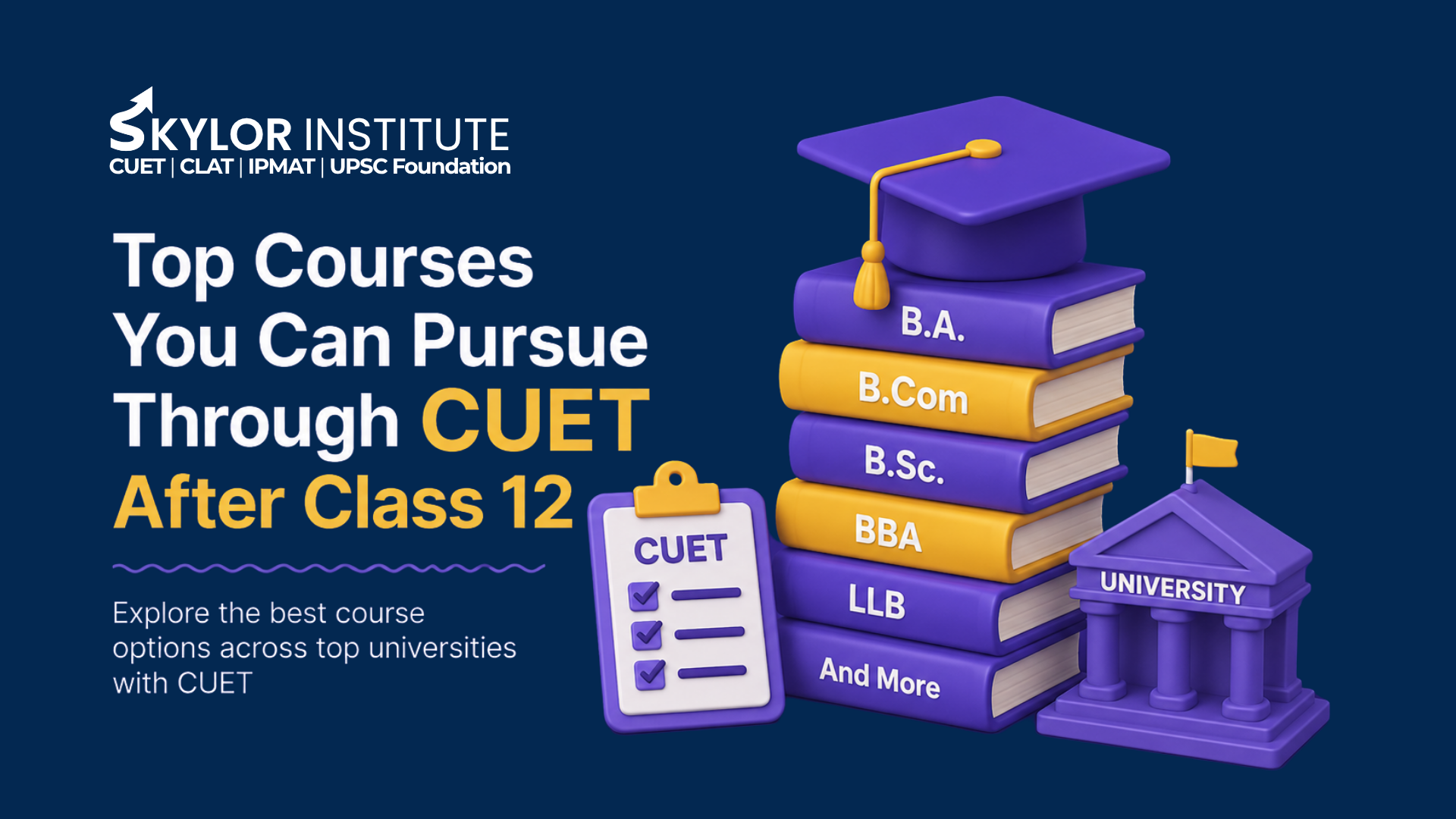
Top Courses You Can Pursue Through CUET After Class 12
Choosing a course after Class 12 can feel like standing at a crossroads with too many signboards and no clear map. One option promises a good career, another looks interesting, an...
Choosing a course after Class 12 can feel like standing at a crossroads with too many signboards and no clear map. One option promises a good career, another looks interesting, and a third seems attractive simply because everyone else is choosing it. The Common University Entrance Test (CUET-UG) has made this decision even more important because students can use a single national-level entrance examination to compete for undergraduate admission across a wide range of participating universities and programmes. The official CUET 2026 Information Bulletin states that the examination is conducted for admission to undergraduate programmes offered by Central Universities and other participating universities and institutions.
The important point, however, is that CUET is not a course. It is an entrance examination. The course you eventually study depends on your Class 12 subjects, CUET subject combination, university-specific eligibility requirements, score, and the admission process followed by the university. For example, the University of Delhi states that eligibility for its CUET-UG 2026 programme depends on the specific programme and that candidates must check the programme-specific requirements before selecting their CUET subjects.
So, what can you actually study through CUET after Class 12? The answer is much broader than just B.Com or B.A. Students can explore programmes in commerce, economics, management, humanities, social sciences, science, computer-related disciplines, journalism, languages, fine arts, performing arts, agriculture, and several integrated programmes, depending on the university. The exact availability varies from institution to institution.
What Is CUET and Why Does It Matter After Class 12?
CUET-UG is conducted by the National Testing Agency (NTA) and is used by participating universities as part of their undergraduate admission process. The 2026 information bulletin confirms that the NTA score is valid for admission to the academic year 2026–27.
This creates an interesting opportunity for students. Instead of treating every university as an entirely separate entrance ecosystem, students can prepare for CUET and then explore multiple participating institutions. The official participating-university information includes Central Universities as well as state, deemed, private, and other participating institutions.

How CUET Opens Multiple Undergraduate Pathways
Think of CUET as a common gateway rather than a single destination. A student interested in economics, for instance, may look at B.A. Economics or related programmes at different universities. A commerce student may consider B.Com, B.Com (Hons.), management or finance-related programmes. A humanities student could explore history, political science, psychology, sociology, languages, journalism or multidisciplinary degrees.
But there is a catch: you cannot assume that every CUET university offers every course. More importantly, universities can specify different combinations of CUET subjects for different programmes. BHU's 2026 admission information, for example, specifies different subject requirements for B.Com, B.Sc., B.A. and professional programmes.
That is why students should reverse the usual approach. Don't start with, "Which CUET subjects should I take?" Start with, "Which courses and universities am I targeting?" Then work backwards to determine the required CUET subjects.
Top Courses You Can Pursue Through CUET
CUET gives Class 12 students access to a remarkably broad collection of undergraduate programmes. The following categories represent some of the most relevant options, although the exact course list and eligibility criteria should always be checked against the latest university admission bulletin.
B.Com and B.Com (Hons.)
B.Com and B.Com (Hons.) remain among the most popular options for commerce students appearing for CUET. These programmes typically introduce students to accounting, finance, business law, taxation, economics, business management and related areas. They can provide a foundation for professional qualifications such as CA, CMA and CS while also preparing students for careers in banking, financial services, accounting, consulting, corporate operations and business.
The distinction between a regular B.Com and B.Com (Hons.) can vary by university, but generally an honours programme provides greater academic depth in the chosen discipline. Students interested in finance, investment, taxation or corporate careers should not automatically choose a course simply because it is popular. Instead, they should examine the curriculum, college, faculty, internships, societies, placement opportunities and the possibility of pursuing professional qualifications alongside the degree.
BHU's 2026 CUET admission information, for example, includes B.Com. (Hons.) and B.Com. (Hons.)–Financial Market Management among its undergraduate offerings, with specified CUET subject requirements.
B.A. and B.A. (Hons.)
The B.A. route is one of the most flexible pathways available through CUET. Depending on the university, students can pursue subjects such as economics, psychology, political science, sociology, history, geography, philosophy, English, Hindi, languages, and other humanities disciplines.
For students who are still exploring their career direction, a B.A. can provide considerable flexibility. Someone studying economics could later move into finance, public policy, consulting, research or higher education. Psychology can lead towards areas such as organisational behaviour, human resources, research and further specialised study. Political science and history can support pathways into civil services, policy, law, research, journalism and academia.
BHU's 2026 undergraduate information lists a wide range of B.A. (Hons.) disciplines, including English, Geography, History, Philosophy, Psychology, Sociology, Political Science, Economics and multiple languages.
The key lesson is simple: don't underestimate a humanities degree. A strong B.A. combined with internships, writing ability, research experience, communication skills and relevant postgraduate study can become a powerful career foundation.
B.Sc. and B.Sc. (Hons.)
Science students have several CUET pathways beyond the traditional engineering and medical routes. Depending on the institution, students may find B.Sc. programmes in Physics, Chemistry, Mathematics, Computer Science, Statistics, Biology, Geography, Geology, Agriculture and other scientific disciplines.
For students who enjoy scientific reasoning but don't necessarily want to pursue engineering or medicine, a B.Sc. can be an excellent alternative. It can lead towards research, analytics, technology, education, government examinations, specialised postgraduate programmes and industry roles.
The 2026 BHU information illustrates how different science pathways can have different CUET combinations. For example, its B.Sc. (Hons.) programmes for PMC students use Physics, Chemistry and Mathematics, while PCB-oriented programmes require Biology/Biotechnology/Biochemistry, Chemistry and Physics.
That makes subject planning extremely important for science students.
Bachelor of Business Administration and Management Courses
Students interested in business, entrepreneurship, marketing, finance, human resources or management can also explore BBA and related undergraduate management programmes offered by participating universities.
A management degree can be particularly attractive for students who want to enter the corporate world relatively early. However, students should understand that the value of a management degree depends heavily on the institution, curriculum, exposure, internships, and skills developed during the programme.
If your long-term goal is an MBA, a strong undergraduate programme can also provide the academic and professional foundation needed for future management education.
Integrated and Professional Programmes
CUET is not restricted to conventional three-year degrees. Some participating institutions offer integrated or professional programmes, making it possible for students to enter specialised academic pathways directly after Class 12.
One notable example is the five-year integrated journalism programme listed in the CUET 2026 programme mapping for the University of Delhi. The programme's CUET combinations include a language with Mass Media/Mass Communication and General Aptitude Test, or a language with General Aptitude Test, according to the official mapping document.
Professional and specialised programmes can be attractive because they provide a more focused academic direction from the beginning. However, they also require greater clarity about career interests. A student who is uncertain about journalism, for example, may prefer a broader degree before specialising.
Best CUET Courses for Commerce Students
Commerce students often have more options than they initially realise. B.Com (Hons.) is an obvious choice, but it is not the only one. Depending on eligibility and university availability, commerce students can explore economics, management, finance-oriented programmes, business administration, journalism, law-related integrated programmes and multidisciplinary degrees.
For students who enjoy numbers and financial concepts, Economics, Commerce, Finance and Management can be particularly suitable. Students who enjoy business strategy and communication may find management or entrepreneurship-related programmes more appealing. Meanwhile, students who are interested in law can investigate integrated law programmes where CUET is accepted.
BHU's 2026 admission notice, for example, includes B.A. LL.B. (Hons.) through CUET, requiring a language plus the General Aptitude Test.
The best choice therefore depends less on your stream and more on the intersection of three things: what you are good at, what you enjoy, and what career you want to build.
Career Options After Commerce-Oriented CUET Courses
A commerce-oriented degree can lead in many directions. Graduates can pursue professional qualifications, postgraduate education, competitive examinations or direct employment.
| CUET Course | Possible Career Directions |
|---|---|
| B.Com / B.Com (Hons.) | Accounting, Finance, Banking, Taxation, Consulting |
| Economics | Economics, Analytics, Finance, Policy, Research |
| BBA | Management, Marketing, HR, Operations, Entrepreneurship |
| Finance-oriented programmes | Banking, Investment, Financial Analysis |
| B.A. | Civil Services, Research, Journalism, Policy, Education |
| Integrated Law | Legal Practice, Corporate Law, Compliance, Policy |
A degree alone, however, does not guarantee a career. The students who stand out usually add something to it: internships, professional certifications, strong communication, data skills, research experience, technology skills, or meaningful projects.

Best CUET Courses for Science Students
Science students often approach Class 12 with a relatively narrow mental map: JEE, NEET or B.Sc. CUET expands that map. Depending on their subject combination and target university, science students can investigate programmes in physics, chemistry, mathematics, computer science, statistics, agriculture, geography, geology, environmental disciplines and other scientific fields.
Students with Mathematics can particularly explore programmes connected to mathematics, statistics, economics, computer science and quantitative disciplines, subject to individual university eligibility. Students with Biology can investigate life-science, agriculture and related programmes.
BHU's 2026 admission information provides a good illustration of this diversity. Its B.Sc. (Hons.) offerings include disciplines such as Chemistry, Physics, Mathematics, Statistics, Computer Science, Geology and Geography for students following the relevant subject combinations.
For science students, the most important consideration is not simply whether a course sounds prestigious. Ask yourself what kind of work you want to do after graduation. Do you enjoy laboratory work? Do you prefer computers and data? Are you interested in research? Do you want to pursue postgraduate study? Or are you looking for a degree that can eventually lead to management, finance, or public policy?
The answers can completely change which CUET course makes sense.

Best CUET Courses for Arts and Humanities Students
Arts students have perhaps the broadest collection of subject-focused undergraduate options through CUET. Depending on the university, students can pursue English, Hindi, History, Political Science, Geography, Psychology, Sociology, Philosophy, Economics, languages, journalism, mass communication and other humanities disciplines.
For students considering civil services, public policy or government careers, subjects such as political science, history, economics, sociology and geography can provide useful academic foundations. Students interested in journalism can look at journalism and mass communication programmes. Students fascinated by human behaviour may consider psychology, while students who enjoy languages can explore literature and linguistic programmes.
BHU's 2026 programme information demonstrates this range, listing numerous B.A. (Hons.) disciplines across its Faculty of Arts and Faculty of Social Sciences.
Arts students should also avoid the outdated idea that a humanities degree automatically means limited career opportunities. The modern employment landscape rewards people who can write, research, analyse information, communicate clearly, understand society and think critically. Those are precisely the capabilities that strong humanities programmes can develop.

How to Choose the Right CUET Course After Class 12
Choosing your CUET course should not be a popularity contest. The course with the highest number of applicants isn't automatically the best course for you, just as the course with the fanciest title isn't necessarily the best investment for your future.
Start by identifying your career direction. You don't need to know exactly what job you will have at 30, but you should have some idea of the broad field you want to explore. Then shortlist degrees that can realistically take you there.
Next, check university-specific eligibility. This step is crucial because CUET subject requirements can differ considerably between programmes. The University of Delhi explicitly advises candidates to check programme-specific eligibility when deciding which CUET subjects to appear for.
You should also compare universities on factors such as:
- Curriculum and specialisations
- College reputation
- Faculty and academic environment
- Internships and industry exposure
- Placement opportunities
- Location and living costs
- Student societies and extracurricular opportunities
- Higher-education opportunities
- Eligibility and CUET subject combinations
Another important point is that appearing for CUET does not automatically guarantee admission. The University of Delhi's 2026 CSAS documentation states that simply appearing in CUET-UG is not sufficient to secure a seat; candidates must also participate in the university's admission allocation process.
This distinction is easy to miss. CUET gets you into the admission competition; the university's subsequent process determines whether you actually receive a seat.

CUET Course Selection: A Simple Decision Framework
Before finalising your preferences, ask yourself five questions.
1. What subjects do I genuinely enjoy?
You are going to spend years studying your chosen discipline. Choosing something you dislike because it supposedly has "scope" can become exhausting.
2. What career fields interest me?
Finance, law, management, research, civil services, technology, media and education require different academic foundations.
3. Which CUET subjects have I studied in Class 12?
University-specific rules can require candidates to have studied particular subjects. Don't discover this after the examination.
4. Which universities offer my preferred programme?
Build a realistic university list rather than focusing on one institution.
5. What will I do beyond the degree?
Internships, certifications, competitions, projects, networking and practical skills can dramatically influence the value of your undergraduate years.
The 2026 CUET framework also allows candidates to select up to five subjects, including languages and the General Aptitude Test, according to the official information bulletin. This makes strategic subject selection particularly important.
Conclusion
CUET has significantly widened the undergraduate admission landscape for Class 12 students. Instead of viewing the examination as a gateway to only a handful of conventional degrees, students should think of it as an opportunity to explore a much wider academic ecosystem. Depending on the participating university and eligibility requirements, students can pursue B.Com, B.A., B.Sc., economics, management, journalism, law-related integrated programmes, computer-oriented disciplines, languages, agriculture, fine arts, performing arts and many other undergraduate programmes.
The smartest approach is to choose the course first and the CUET strategy second. Identify the universities and programmes you genuinely want, study their eligibility requirements, select the appropriate CUET subjects and then prepare strategically. The official CUET programme mappings and individual university admission bulletins should always be treated as the final authority because programme availability and eligibility can change.
Ultimately, CUET is only the door. Your course choice determines which room you enter, and what you do during those three or four years determines what happens next.

FAQs About Courses Through CUET
1. Which are the most popular courses through CUET after Class 12?
Some of the commonly pursued options include B.Com, B.Com (Hons.), B.A., B.A. (Hons.), B.Sc., B.Sc. (Hons.), economics, management, journalism and other specialised undergraduate programmes. Availability depends on the participating university.
2. Can commerce students pursue courses other than B.Com through CUET?
Yes. Depending on eligibility, commerce students can explore economics, management, BBA, finance-related programmes, journalism, humanities, and certain integrated professional programmes.
3. Can science students appear for CUET for B.A. programmes?
Potentially, yes. However, eligibility and required CUET subject combinations are determined by the university and programme. Students should check the specific admission bulletin before applying.
4. Does clearing CUET guarantee admission to a university?
No. A CUET score does not automatically guarantee a seat. Universities can have their own counselling, registration, preference-filling, or seat-allocation procedures. For example, Delhi University requires eligible CUET candidates to participate in its CSAS-UG process for admission.
5. How should I decide which CUET course is best for me?
Start with your interests, Class 12 subjects, and career goals, then shortlist suitable courses and universities. After that, check the exact CUET subject requirements, eligibility criteria, admission process, curriculum, and career opportunities before finalising your preferences.
Need Personalized Diagnostic Guidance?
Speak directly with Skylor's academic directors in Bathinda. Discuss batch schedules, test analytics, and personalized preparation strategies.