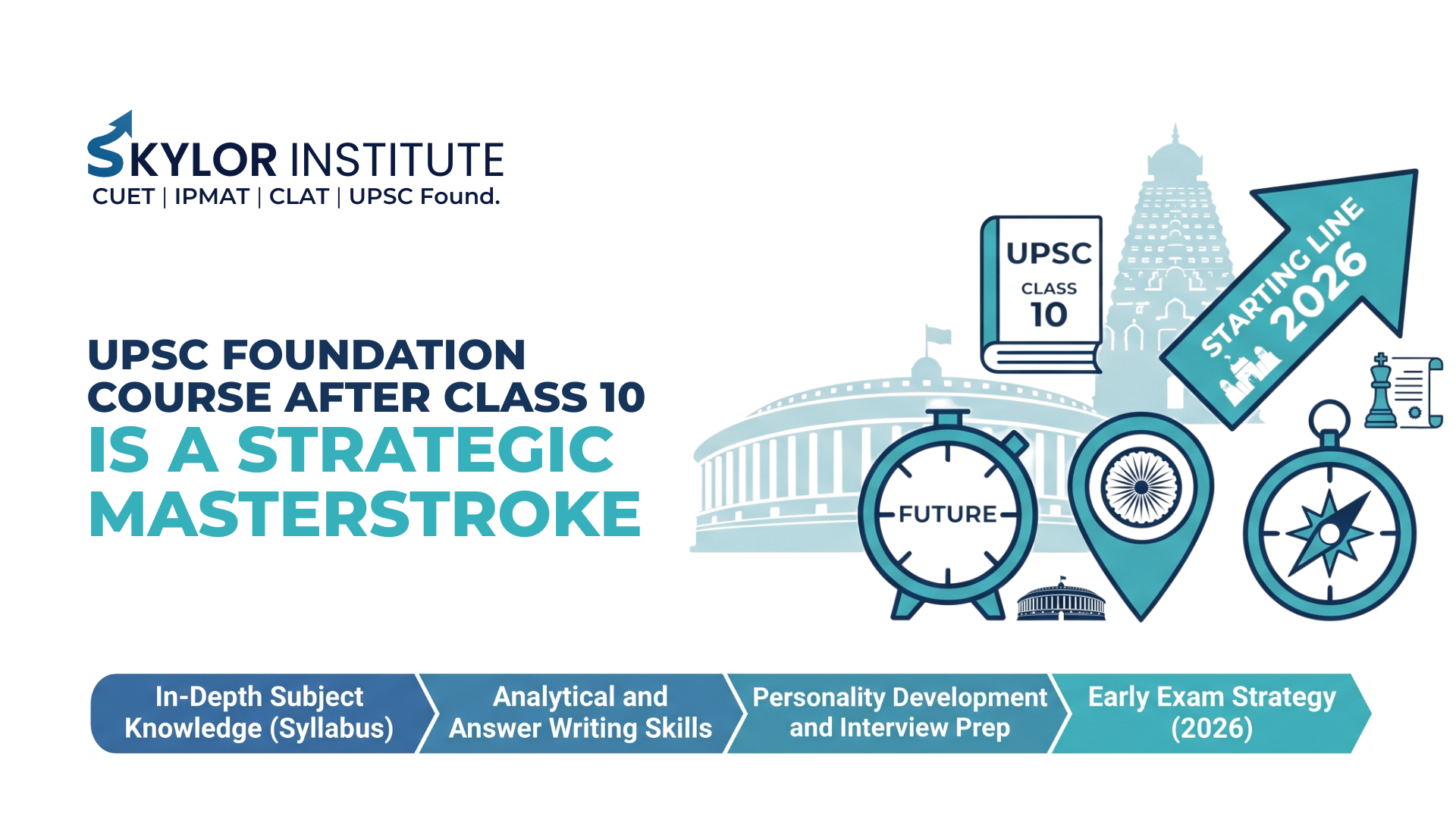
The Civil Services Examination, conducted by the Union Public Service Commission (UPSC), is often regarded as the “Mount Everest” of Indian competitive exams. Every year, hundreds of thousands of aspirants vie for a few hundred seats in the IAS, IPS, and IFS. Traditionally, the narrative has been that preparation begins after graduation. However, a seismic shift is occurring in the coaching landscape. Top rankers and educational experts are increasingly advocating for a “Foundation” approach that begins immediately after Class 10.
Starting early is not about rote-learning facts at age 16; it is about the gradual cultivation of a specific intellectual temperament. Here is an in-depth exploration of why starting UPSC foundation preparation right after Class 10 is the most strategic move an aspirant can make.
1. The Luxury of Time: Moving from “Panic” to “Process”
The greatest enemy of a UPSC aspirant is the vastness of the syllabus. When a candidate begins preparation after graduation, they typically have one year to cover History, Geography, Economics, Polity, Science and Technology, Environment, Ethics, and International Relations – not to mention their Optional subject and daily Current Affairs.
By starting after Class 10, a student expands that one-year window into a five-year horizon.
- Reduced Cognitive Load: Instead of studying for 12 hours a day in a high-pressure environment, a foundation student can dedicate just 1–2 hours a day. This consistency allows for better retention and prevents academic burnout.
- Depth over Breadth: Time allows a student to read a book not just to finish it, but to question it. They can explore supplementary materials, watch documentaries, and engage in debates that a “crash course” student simply cannot afford.
2. Synergizing with the School Curriculum
One of the most significant advantages of starting after Class 10 is the overlap between the UPSC syllabus and the Senior Secondary (Class 11 and 12) curriculum.
For students choosing the Humanities stream, the synergy is nearly 80%. Their school subjects – History, Political Science, Sociology, and Geography – are the very core of the UPSC General Studies papers. Even for Science or Commerce students, the UPSC foundation provides the “social science” perspective that is often missing from their technical studies.
- The NCERT Pillar: UPSC is famously “NCERT-centric.” By starting early, students master these foundational texts while they are still using them in school. They learn to identify which parts of their textbook are relevant for a national-level competitive exam, making them more efficient learners overall.
3. Developing the “UPSC Mindset”: Beyond the Textbook
UPSC does not just test what you know; it tests how you think. The Mains examination and the Interview (Personality Test) require a candidate to be objective, analytical, and empathetic.
- Critical Thinking: A 16-year-old who starts observing the “why” behind government policies or international conflicts develops a level of maturity that is hard to replicate in a few months.
- Interdisciplinary Approach: UPSC questions often bridge multiple subjects. For example, a question on “Water Scarcity” requires knowledge of Geography (climate), Economics (resource management), and Polity (inter-state disputes). An early start allows the brain to build these neural pathways naturally over time.
4. The “Current Affairs” Habit: Building a Mental Archive
Most post-graduate aspirants find “The Hindu” or “The Indian Express” intimidating. They struggle to understand the context of an editorial because they lack the historical background of the issue.
A foundation student, however, grows with the news.
- Contextual Memory: If a student follows the evolution of a policy (like the National Education Policy or a specific Supreme Court judgment) from its inception in 2024 to their first attempt in 2029, they don’t need to “memorize” it. They have lived through the debate.
- Vocabulary and Expression: Daily reading of high-quality journalism naturally improves a student’s vocabulary and their ability to structure complex arguments – skills that are vital for the 250-word answers required in the Mains.
5. Mastering the Optional Subject
The Optional Subject in UPSC carries 500 marks and is often the “make or break” factor in the final merit list. Many candidates choose an Optional after graduation and struggle to master it in a year.
An early start allows a student to “test-drive” different subjects. Through foundation modules, they can explore whether they have a natural affinity for Sociology, Psychology, Public Administration, or History. Once they identify their interest, they can choose that subject as their college major, essentially completing 70% of their UPSC Optional preparation during their degree.
6. The Science of Answer Writing: A Physical Skill
Writing a 150-to-250-word answer that is concise, factual, and persuasive is an art form. It requires a specific structure: Introduction, Body (with bullet points), and a forward-looking Conclusion.
Most aspirants only start “Answer Writing Practice” a few months before the Mains. This leads to poor handwriting, lack of structure, and time management issues. A foundation student can practice writing just one answer a week. Over five years, they will have written hundreds of answers, making the process as instinctive as breathing.
7. Buffering Against the “Year Loss” Anxiety
The average age of a successful UPSC candidate is often between 26 and 28. This is because many start late and take multiple attempts. Starting after Class 10 changes the timeline.
If a student is “exam-ready” by the time they finish their degree, they can give their first serious attempt at age 21. Even if they don’t clear it on the first go, they have the age and the mental stamina to try again without the looming pressure of “unemployment” or social “settling down” milestones that hit candidates in their late 20s.
8. CSAT and Logical Prowess
The Civil Services Aptitude Test (CSAT) in the Prelims has become increasingly difficult, with a greater focus on high-level logical reasoning and quantitative aptitude.
For students who move away from Mathematics after Class 10, the CSAT can become a nightmare. A foundation program ensures that the student remains in touch with basic numeracy and logical puzzles throughout their Class 11, 12, and college years. This consistent “brain gym” keeps their analytical skills sharp.
9. Building “Officer-Like Qualities” (OLQs)
The final stage of UPSC is the Personality Test. The board looks for integrity, leadership, mental alertness, and the ability to handle stress. These are not academic traits; they are personality traits.
An early start gives a student the “mental space” to participate in extracurriculars – debates, NCC, sports, or social work. Because their academic preparation is spread out, they don’t have to sacrifice their personality development. They enter the interview room as well-rounded individuals with diverse interests, which is exactly what the Commission seeks.
10. Financial and Emotional Sustainability
Intense UPSC coaching in hubs like Old Rajinder Nagar can be financially draining for families. A long-term foundation approach, often conducted through hybrid or local modules, is significantly more cost-effective.
Emotionally, the “do-or-die” atmosphere of late-stage coaching can lead to severe anxiety. An early start fosters a healthier relationship with the exam. It becomes a goal to be achieved, not a burden that defines one’s entire self-worth.
The Road Map: A Five-Year Vision
To understand the impact, let us look at the ideal progression of a foundation student:
- Phase 1 (Classes 11 & 12): Focus on NCERTs, basic newspaper reading, and identifying interest areas. The goal is “Curiosity.”
- Phase 2 (Undergraduate Year 1 & 2): Diving into standard reference books (e.g., Laxmikanth for Polity, Spectrum for History). Starting basic answer writing. The goal is “Conceptual Clarity.”
- Phase 3 (Final Year of Graduation): Intensive focus on the Optional subject, Ethics (GS Paper 4), and rigorous Mock Tests. The goal is “Exam Readiness.”
Conclusion: The Strategic Imperative
In the 21st century, the Civil Services require officers who are not just “knowledgeable” but are “visionary.” The transition from a school student to a district administrator is a massive leap.
Starting UPSC foundation preparation after Class 10 provides the bridge for that leap. It turns the preparation from a “stressful hurdle” into a “transformative education.” For those who aim to lead India in the coming decades, the journey doesn’t start after the degree – it starts the moment they decide to look beyond the horizon of their school gates.
By choosing to start now, a student is not just preparing for an exam; they are architecting a life of purpose, discipline, and excellence. The “Steel Frame” of India requires a foundation that is deep, strong, and built with the patience of time.