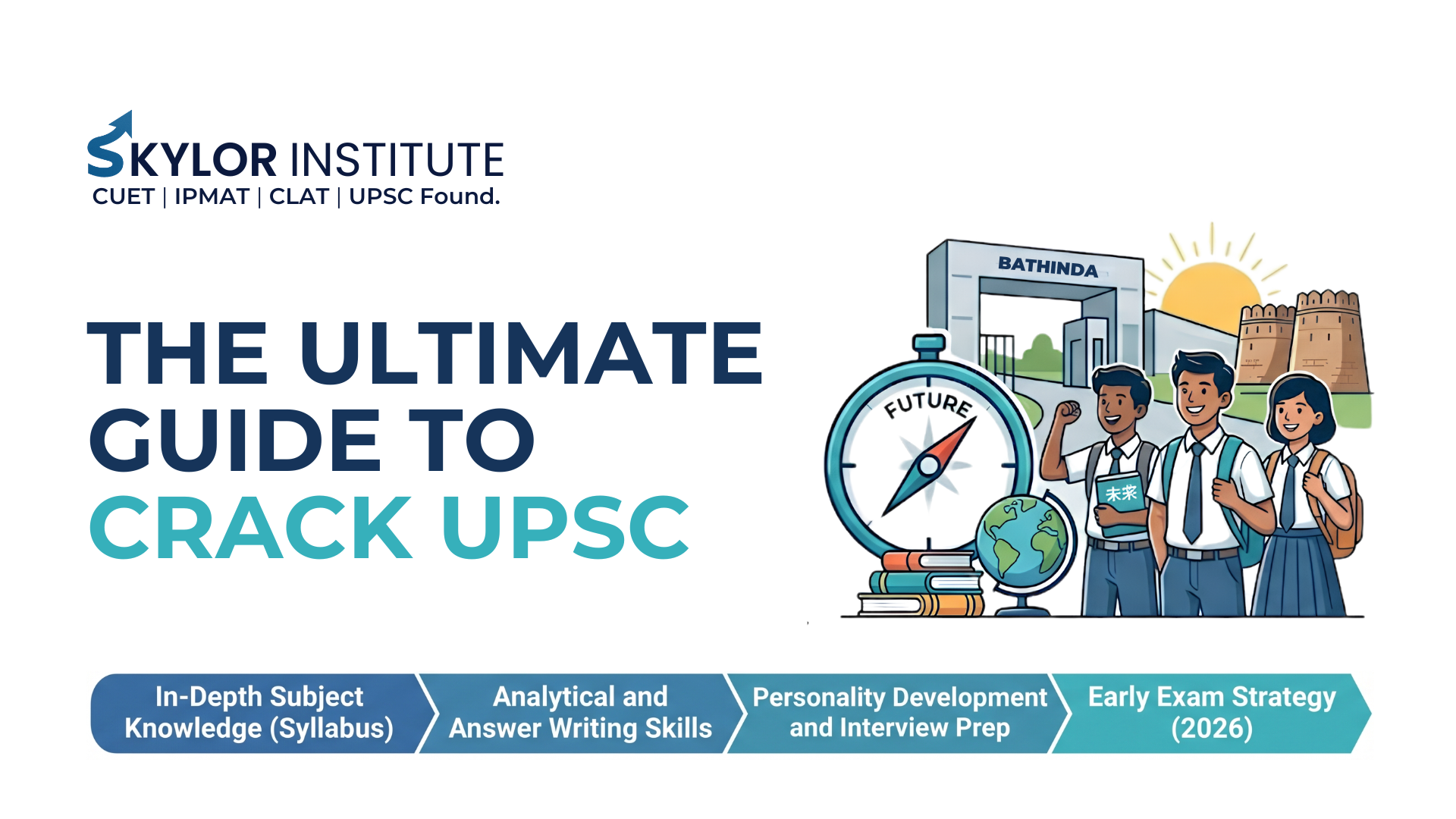
The Civil Services Examination, conducted by the Union Public Service Commission (UPSC), is more than just a test of academic knowledge; it is a grueling marathon that assesses an individual’s endurance, character, and analytical depth. Often called the “exam of exams,” it serves as the gateway to the most prestigious administrative positions in India, including the IAS, IPS, and IFS.
To “crack” the UPSC is to navigate a three-tier system: the Preliminary Examination (objective), the Main Examination (written/descriptive), and the Personality Test (interview). Achieving success requires moving beyond simple hard work and adopting a high-level strategic blueprint. This guide breaks down that blueprint into actionable pillars.
Pillar 1: Understanding the Landscape (The Syllabus & Pattern)
Before buying a single book, the most critical step is to internalize the syllabus. Many aspirants spend years studying without ever truly understanding what the UPSC expects of them.
1.1 The Preliminary Stage (The Eliminator)
The Prelims consists of two papers: General Studies I and the Civil Services Aptitude Test (CSAT). While the CSAT is qualifying (requiring 33%), it has become a significant hurdle due to its increasing difficulty in logical reasoning and quantitative aptitude. GS I, on the other hand, determines the cutoff. It covers History, Geography, Economy, Polity, Environment, and Science & Tech.
1.2 The Main Examination (The Decider)
The Mains consist of nine papers, including an Essay paper, four General Studies papers (GS I–IV), and two papers for one Optional Subject. This stage is descriptive and requires the ability to articulate complex thoughts under tight time constraints.
1.3 The Personality Test
The interview is not a test of knowledge—which has already been tested—but a test of “Officer-Like Qualities” (OLQs). The board assesses your mental alertness, critical powers of assimilation, clear and logical exposition, and your balance of judgment.
Pillar 2: Building the Foundation (The NCERT Strategy)
The foundation of every topper’s journey is the NCERT textbooks from Class 6 to 12. These books provide the conceptual clarity required to understand more complex reference materials later.
- Social Sciences: History, Geography, and Political Science (Class 6–12) are indispensable.
- Economics: Focus on Class 11 and 12 for fundamental concepts like GDP, inflation, and fiscal policy.
- Science: Class 6–10 NCERTs provide the basics, while current developments are tracked through news.
Pillar 3: Mastering the “Big Five” Reference Books
Once the NCERTs are mastered, aspirants must move to standard reference books. The key here is “Minimum Books, Maximum Revision.”
- Indian Polity: M. Laxmikanth is the undisputed “Bible” for this subject.
- Modern History: A Brief History of Modern India (Spectrum) by Rajiv Ahir is essential for its concise, exam-oriented approach.
- Economy: Ramesh Singh or Nitin Singhania provide deep insights into the Indian economic structure.
- Geography: Certificate Physical and Human Geography by GC Leong is vital for understanding physical phenomena.
- Environment: Shankar IAS notes or similar consolidated resources are necessary as this section carries significant weight in Prelims.
Pillar 4: The Current Affairs Ecosystem
Current affairs are the “soul” of the UPSC preparation. The exam has shifted from static questions to dynamic ones where the UPSC asks about the historical or legal background of a current event.
4.1 The Newspaper Habit
Reading The Hindu or The Indian Express is non-negotiable. However, the goal is not to read the whole paper but to focus on:
- Editorials: To build a balanced opinion for Mains.
- National News: Government schemes, Supreme Court judgments, and legislative changes.
- International Relations: Focus on India’s bilateral ties and global summits.
4.2 Monthly Compilations
To ensure nothing is missed, supplement daily reading with monthly current affairs magazines. This helps in consolidating facts and data that can be used as “value addition” in Mains answers.
Pillar 5: The Art of Answer Writing
The difference between a candidate who clears the Prelims and one who makes it to the final list is often the quality of their Mains answers.
- The Structure: Every answer should follow an Introduction – Body – Conclusion format.
- Directives: Understand the difference between “Discuss,” “Critically Analyze,” “Examine,” and “Comment.” Each requires a different tone and depth.
- Value Addition: Use diagrams, maps, flowcharts, and data points. For example, in a Geography answer about cyclones, drawing a quick map of the Indian coastline with affected zones can earn an extra 0.5 to 1 mark.
- Conciseness: You must be able to summarize complex global issues in exactly 150 or 250 words.
Pillar 6: Choosing the Right Optional Subject
The Optional Subject accounts for 500 marks. Choosing the wrong one is the most common reason for failure.
- Interest vs. Scoring: Do not pick a subject just because it is “scoring.” If you find the subject boring, you will struggle to complete the vast syllabus.
- Overlap with GS: Subjects like Sociology, History, Political Science (PSIR), and Geography have significant overlap with General Studies, potentially saving preparation time.
- Availability of Resources: Ensure that good study material and mentorship are available for your chosen subject.
Pillar 7: CSAT – The Silent Killer
In recent years, the CSAT (Paper II) has become significantly tougher, focusing heavily on Quant and Logical Reasoning.
- Do not ignore it: Even if you are from a technical background, practice at least 5-10 years of previous year papers.
- Focus on Comprehension: Improve your reading speed and accuracy, as this is the most reliable way to score in CSAT.
Pillar 8: The “Personality” in the Personality Test
Preparation for the interview should start on day one of your UPSC journey.
- Detailed Application Form (DAF): The interview is largely based on the info you provide in your DAF (Home state, hobbies, educational background). Research every word you write in this form.
- Communication Skills: Practice speaking in a mirror or with friends. You need to be able to express a firm opinion without sounding arrogant or biased.
- Mental Alertness: Stay updated on current controversies and be ready to provide a “middle-path” solution that reflects administrative pragmatism.
Pillar 9: Mental Health and Discipline
The UPSC journey is long, often taking 2–3 years. Managing your mental health is as important as managing your study schedule.
- The Power of Routine: A disciplined 8-hour study schedule is better than a 15-hour “burst” followed by three days of burnout.
- The “Digital Fast”: Limit social media. The “FOMO” (Fear Of Missing Out) generated by seeing others’ lives can be detrimental to your focus.
- Physical Activity: A 30-minute walk or workout can significantly improve cognitive function and reduce cortisol levels.
Pillar 10: The Revision Cycle
The UPSC syllabus is so vast that forgetting is inevitable. The only antidote is a structured revision cycle.
- Daily Revision: Spend the last 45 minutes of your day reviewing what you studied.
- Weekly Revision: Keep Sundays for consolidating the week’s current affairs and static subjects.
- The “3-Step” Rule: Any topic should be revised at least three times—once within 24 hours, once in a week, and once in a month.
Conclusion: The Path to LBSNAA
Cracking the UPSC is not about being a genius; it is about being a persistent strategist. It is about the ability to stay calm when the Prelims paper is unexpected, the stamina to write for six hours a day during Mains, and the humility to learn from every mock test.
The journey to the Lal Bahadur Shastri National Academy of Administration (LBSNAA) is paved with thousands of pages of notes and hundreds of inkless pens. But for those who stay the course, the reward is the chance to shape the future of the world’s largest democracy.
Remember: UPSC is a test of your will. The syllabus is finite; your determination must be infinite. Start with the basics, stay updated with the world, and never stop writing. Success is not an event; it is a habit of daily excellence.