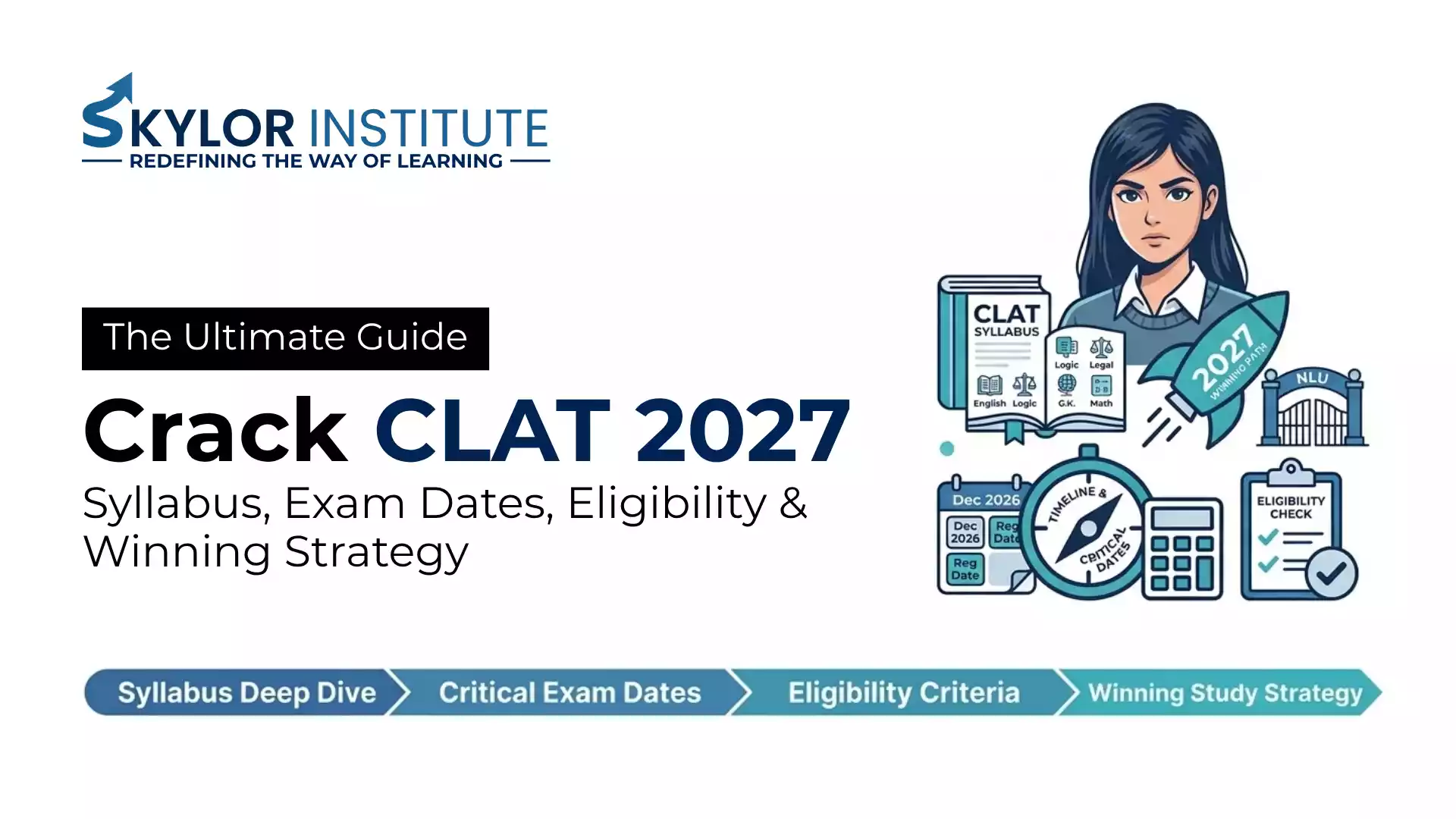
If you are currently in your 10th, 11th or 12th grade and dreaming of walking the corridors of a top National Law University (NLU) like NLSIU Bangalore or NALSAR Hyderabad, you are in the right place. The Common Law Admission Test (CLAT) is your golden ticket to a premium legal education in India.
However, CLAT is not your traditional memory-based school exam. It tests your reading speed, critical thinking, and awareness of the world around you. Because the competition gets tougher every year, starting your preparation early for CLAT 2027 is the smartest move you can make.
This comprehensive, student-friendly guide will walk you through everything you need to know about CLAT 2027—from expected exam dates and eligibility criteria to a detailed syllabus breakdown and an actionable preparation strategy.
What is CLAT 2027?
The Common Law Admission Test (CLAT) is a centralized national-level entrance exam conducted by the Consortium of National Law Universities. It is organized for admissions to the 5-year integrated L.L.B. and L.L.M. programs offered by 24 participating NLUs across India, along with several other top private law schools that accept CLAT scores.
A Crucial Detail You Must Know: Historically, CLAT was held in May. However, the Consortium recently shifted the exam cycle. Now, the exam for a particular academic year is held in December of the previous year.
This means CLAT 2027 will most likely be conducted in December 2026. If you are planning to take this exam, your timeline needs to be aligned with December 2026, not May 2027!
Expected CLAT 2027 Important Dates
While the Consortium will release the official notification in mid-2026, here is the highly expected timeline based on recent trends. Keep these dates in mind to plan your study schedule effectively:
- Release of Official Notification: Early July 2026
- Start of Online Registration: First week of August 2026
- Last Date to Apply: First week of November 2026
- Release of Admit Card: Third week of November 2026
- CLAT 2027 Exam Date: First or Second Sunday of December 2026
- Release of Answer Key: Within 24 hours of the exam
- Declaration of Results: Last week of December 2026
- Commencement of Counselling: January 2027 onwards
Pro Tip: Bookmark this timeline. Missing the registration window because you thought the exam was in May is a surprisingly common mistake.
CLAT 2027 Eligibility Criteria
Before you dive into the books, you need to ensure you are actually eligible to sit for the exam. The Consortium keeps the rules fairly straightforward:
Educational Qualification
- You must have completed your 10+2 (or equivalent) board examination from a recognized state or central board.
- Appearing Students: If you are appearing for your Class 12 board exams in March/April 2027, you are completely eligible to write the exam in December 2026. Your admission will be provisional, subject to passing the board exams.
Minimum Marks Required in Class 12
- General / OBC / PWD / NRI / PIO / OCI Categories: A minimum of 45% aggregate marks.
- SC / ST Categories: A minimum of 40% aggregate marks.
Age Limit
- No Upper Age Limit: The Bar Council of India has removed the upper age restriction for appearing in CLAT. Whether you are 17 or 27, you can take the test.
CLAT 2027 Exam Pattern: How Are You Tested?
The CLAT UG exam is uniquely designed to evaluate your aptitude and reasoning abilities rather than rote learning. It is a strictly offline, pen-and-paper test. The entire paper is comprehension-based, meaning you will be given passages of about 450 words each, followed by a series of multiple-choice questions.
Here is a quick snapshot of the exam structure:
- Mode of Exam: Offline (Pen and Paper mode)
- Duration: 2 Hours (120 Minutes)
- Total Questions: 120 Multiple-Choice Questions (MCQs)
- Maximum Marks: 120 Marks
- Marking Scheme: +1 mark for every correct answer.
- Negative Marking: -0.25 marks for every incorrect answer. (Accuracy matters!)
- Language: English only.
Section-Wise Syllabus Breakdown & Weightage
To conquer CLAT 2027, you need to know exactly what each section demands. Let’s break down the 120 questions across the five sections:
1. English Language (Approx. 22-26 Questions)
This section tests your reading comprehension and vocabulary. You will be given passages derived from contemporary or historically significant fiction and non-fiction sources.
- What you need to do: Read the passage, comprehend the main point, infer the author’s tone, and answer questions based on the text.
- Skills tested: Inference, vocabulary in context, understanding central themes, and basic grammar.
2. Current Affairs & General Knowledge (Approx. 28-32 Questions)
This is often the make-or-break section. Instead of direct one-liner questions, you will get passages taken from news sources, journalistic pieces, or editorial columns.
- What you need to do: Answer questions related to the events mentioned in the passage, as well as historical events directly related to the current news.
- Topics covered: National and international events of significance, arts and culture, international affairs, and historical events of continuing importance.
3. Legal Reasoning (Approx. 28-32 Questions)
You do not need prior knowledge of the law to ace this section! The Consortium explicitly states that the paper will test your general awareness of contemporary legal and moral issues.
- What you need to do: Read a passage outlining a legal principle or a factual scenario (like a contract dispute or a criminal act). You must apply the rules given in the passage to the specific situation asked in the questions.
- Key rule: Stick strictly to the principles given in the passage, even if they seem absurd or factually incorrect in the real world.
4. Logical Reasoning (Approx. 22-26 Questions)
This section is all about critical reasoning. The passages are usually opinion pieces, editorials, or arguments.
- What you need to do: Identify the main premise and conclusion of the argument. You will be asked to weaken or strengthen the argument, identify flaws in the author’s reasoning, or draw logical conclusions.
- Skills tested: Analytical thinking, identifying paradoxes, and understanding logical structures.
5. Quantitative Techniques (Approx. 10-14 Questions)
Don’t let the word “Quantitative” scare you. This section only tests basic 10th-grade mathematics, but it is presented in the form of Data Interpretation (DI).
- What you need to do: Derive numerical information from short passages, graphs, pie charts, or tables, and apply basic math to solve the questions.
- Topics covered: Ratios and proportions, basic algebra, mensuration, percentages, and statistical estimation.
How to Start Preparing for CLAT 2027 Today: A Winning Strategy
If you have a year or more before the exam, you have a massive advantage. Here is how you can utilize your time to build a rock-solid foundation:
1. Make the Newspaper Your Best Friend
CLAT is fundamentally a test of reading. You have 120 minutes to read roughly 10,000 words and answer 120 questions. You need reading stamina.
- Actionable Step: Start reading The Hindu or The Indian Express every single day. Focus heavily on the Editorial and Opinion pages. This will simultaneously cover your English, Logical Reasoning, and Current Affairs preparation.
2. Build Your Vocabulary Contextually
Don’t sit and memorize a dictionary; it doesn’t work. When you read the newspaper, note down unfamiliar words. Understand how they are used in a sentence. CLAT tests your ability to guess the meaning of a word based on its context.
3. Clear Your Math Basics Early
Since the math section is based on 10th-grade concepts, do not ignore it. Many students skip this section out of fear, but scoring a solid 10/12 here can easily push your rank up by hundreds of places. Practice percentages, ratios, and fractions until you can calculate them in your head quickly.
4. Understand Legal Fundamentals
While prior knowledge isn’t strictly required, knowing basic legal terminology (like Tort, Contract, Liability, Mens Rea, and Fundamental Rights) will drastically increase your reading speed during the Legal Reasoning section. It stops you from getting bogged down by heavy legal jargon.
5. Take Mocks and Analyze Them Religiously
Mock tests are the holy grail of CLAT preparation.
- Phase 1: Take one mock every two weeks to get used to sitting and focusing for 2 hours.
- Phase 2: By mid-2026, take one mock a week.
- The Golden Rule: Spending 2 hours taking a mock is useless if you don’t spend 3 hours analyzing it. Figure out why you got a question wrong. Was it a reading error? A lack of knowledge? Did you run out of time? Fix the root cause.
Highly Recommended Books for CLAT 2027
While coaching modules are great, here are a few standard books to build your foundation:
- English Language: Word Power Made Easy by Norman Lewis, Objective General English by S.P. Bakshi.
- Logical Reasoning: Analytical Reasoning by M.K. Pandey, Verbal and Non-Verbal Reasoning by R.S. Aggarwal. (Focus primarily on Critical Reasoning chapters).
- Legal Reasoning: Legal Awareness and Legal Reasoning by A.P. Bhardwaj.
- Quantitative Techniques: Quantitative Aptitude by R.S. Aggarwal, or data interpretation books used for bank PO exams (to practice charts and graphs).
- Current Affairs: Daily newspapers, monthly compilations (like Pratiyogita Darpan or coaching institute magazines).
Final Thoughts: The Road to Top NLUs
Preparing for CLAT 2027 is a marathon, not a sprint. The exam doesn’t care how many formulas you have memorized; it cares about how well you can process information under pressure. Start building your reading habit today. Read diverse materials—economics, philosophy, science, and politics. The more you read, the faster you will process the CLAT question paper.
Stay consistent, track your progress through mock scores, and don’t let temporary low scores demotivate you.